The Mathematics of Luminosity: Why Embellishment Requires Precision
In the haute couture atelier, figure skating workroom, and bridal design studio, few elements capture the imagination quite like hand-applied crystal and beadwork. From the dense, blinding pavé on an Olympic skater’s bodice to the gossamer degrade of Swarovski flatbacks drifting down a cathedral veil, embellishment elevates a garment from tailored form to luminous art. Yet, beneath the glamour lies one of the most mathematically demanding challenges in garment construction: surface area calculation and packing geometry.
Miscalculating stone counts is disastrous for an atelier. Under-ordering halts production mid-run, risking dyelot inconsistencies and missed deadlines, while over-ordering locks significant capital into specialized components that may never be reused. Furthermore, applying stones without understanding planar packing geometry creates heavy, rigid textiles that pull along the warp and weft, distorting the drape and destroying the intended silhouette. To achieve professional results, a couture specialist must approach embellishment with geometric discipline, textile foresight, and rigorous material estimation.

Stone Calibration: Decoding the Stone Size (SS) System
Rhinestones are traditionally measured using the historical Stone Size (SS) scale, a standard originally derived from sieve calibrations in Bohemian glassworks. Because these sizes do not follow a simple linear millimeter progression, an artisan must understand the precise metric conversions to plan spacing accurately:
- SS6 (2.0 to 2.1 mm): Micro-pavé detailing, intricate script lettering, and dense blending near edges.
- SS10 (2.8 to 2.9 mm): Ideal for fine lace outlining, illusion mesh embellishment, and transitional shading.
- SS16 (3.9 to 4.0 mm): The primary workhorse for dancewear, competitive gymnastics leotards, and evening wear.
- SS20 (4.7 to 4.8 mm): Bold stage impact; standard focal stone for ballroom gowns and performance costuming.
- SS30 (6.4 to 6.5 mm): High-visibility focal accents and structural anchor points.
- SS40 (8.5 to 8.7 mm): Large statement jewels, used sparingly to prevent fabric sagging under point-loaded weight.
For seed beads and bugles, workrooms rely on the aught system (15/0, 11/0, 8/0, 6/0), where higher numbers indicate smaller beads. Understanding the metric diameter of each component is the foundational metric upon which all surface area equations rely.
Circle Packing Geometry: Orthogonal Grid vs. Hexagonal Pavé
When applying circular flatback crystals onto planar cloth, the spacing pattern dictates both stone consumption and mechanical behavior. Disregarding this geometry leads to uneven gaps, visible adhesive pooling, and unexpected stone counts.
1. Orthogonal Grid Packing
In an orthogonal grid, stones align strictly in perpendicular rows and columns, parallel to the garment’s warp and weft. While structurally straightforward, this grid produces substantial interstitial voids. The theoretical maximum coverage is calculated using the ratio of a circle’s area to its bounding square:
Density = π / 4 ≈ 78.54% coverage
In practice, orthogonal packing rarely achieves 75% coverage once standard clearances are introduced. Furthermore, grid packing creates rigid lines along the grain, which can cause synthetic meshes to ripple.
2. Hexagonal Pavé (Honeycomb) Packing
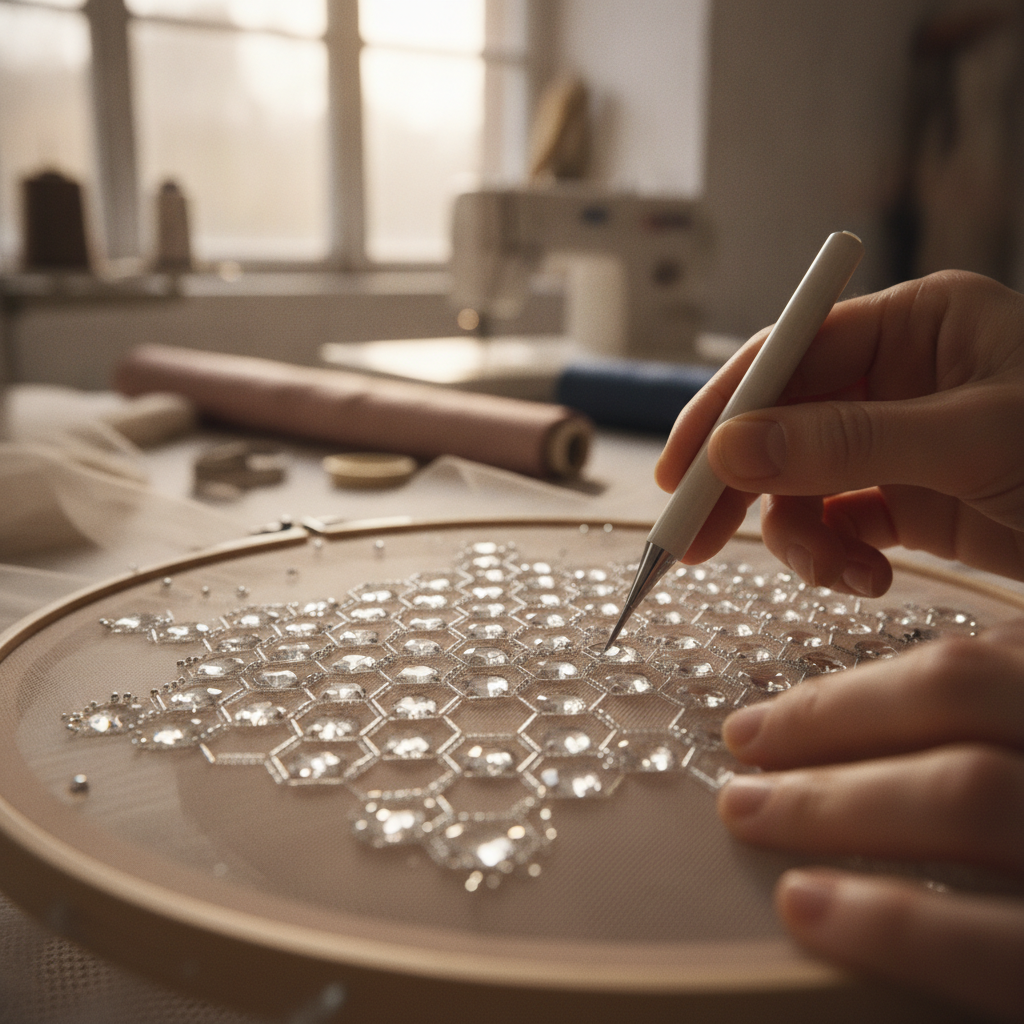
The gold standard of couture embellishment is hexagonal pavé packing. In this formation, alternating rows nest into the valleys created by the previous row, mirroring the natural efficiency of a honeycomb. The theoretical maximum density is:
Density = π / (2√3) ≈ 90.69% coverage
Hexagonal packing distributes weight evenly across both true bias and straight grainlines. This multidirectional tension preserves the fluid drape of silk crepe and maintains the four-way elasticity of performance spandex.
Calculating Embellishment Yields by Surface Area
To determine crystal requirements manually, calculate the effective footprint of each stone, which includes its diameter ($D$) plus the intended inter-stone gap ($g$):
Effective Diameter ($D_{eff}$) = D + g
For a hexagonal pavé layout across a defined surface area ($A_{total}$), the unit cell area occupied by a single component is calculated as:
Area per Stone = √3 / 2 × (D_{eff})² ≈ 0.866 × (D + g)²
Dividing your total design area by this unit cell gives the raw stone count. However, manually adjusting these figures across varying stone sizes, irregular pattern pieces, and wholesale packaging conversions can introduce costly mathematical errors.
🛠️ Interactive Atelier Tool: Embellishment & Rhinestone Calculator
Skip manual math and cutting guesswork. Use our free interactive tool to instantly calculate your exact measurements, fabric yield, and project specifications:
Textile Behavior, Substrates, and Structural Stabilization
Rhinestones add measurable dead weight to a garment. A ballroom bodice featuring 5,000 SS20 stones carries roughly 400 to 500 grams of localized crystal mass. If the textile is not stabilized correctly, the garment will buckle, pull away from the body, and drape unevenly.
Stabilization Rules for Workrooms
- Four-Way Stretch Mesh & Spandex: Stretch substrates must be mounted on a dress form or a foam stretching board at an exact 15% to 20% stretch tension before applying adhesive or hotfix stones. If applied relaxed, the glue bonds will snap when the garment stretches over the body.
- Silk Chiffon & Fine Tulles: Delicate fabrics cannot bear dense pavé without tearing along the warp. Back the reverse side with an iron-on water-soluble stabilizer during application, or mount the area over an invisible illusion tulle underlining to carry the weight.
- Seam Allowance Clearances: Never place stones within seam allowances. Maintain a clear perimeter of at least 12 mm (1/2 inch) from raw cut edges and 15 mm from zipper channels. Crushed crystals will break sewing machine needles, shatter zipper teeth, and ruin blade alignments.
Purchasing Protocols: The Gross System and Safety Allowances
Couture stones are sold according to the classic Gross counting standard:
- 1 Gross (Gr): 144 pieces
- 10 Gross Pack: 1,440 pieces
- 50 Gross Wholesale Pack: 7,200 pieces
A cardinal error in production planning is purchasing only the exact theoretical number of stones. In high-speed couture execution, stones flip upside down, hotfix glue backings occasionally fail, pick-up tools drop stones onto workroom floors, and pattern alterations demand last-minute edge adjustments. Always apply a mandatory 10% atelier safety buffer to your raw piece count before rounding up to the nearest full Gross or 10-Gross wholesale package.
Professional Workflow Integration
Begin every bespoke embellishment project with clear planning. Sketch the distribution and density gradients on our Fashion Sketchpad to map stone flow over anatomical seam lines. When billing clients for intricate custom work, track application hours and stone expenses accurately using the Alteration Price Estimator to ensure your specialized handcraft remains profitable.
By treating embellishment as an exact science of surface geometry, packing density, and balanced weight distribution, you safeguard your studio against costly material shortages and elevate your garments to true couture standards.
Do you enjoy the content on Agenda Creativa?
Your contributions help me create new articles, share creative ideas, and keep this platform alive! If you like what I do and want to support my work, you can buy us a coffee.
Every cup of coffee means more than just a gesture – it's direct support for my passion to create inspiring and useful content. Thank you for being part of this journey!
☕ Buy me a coffee