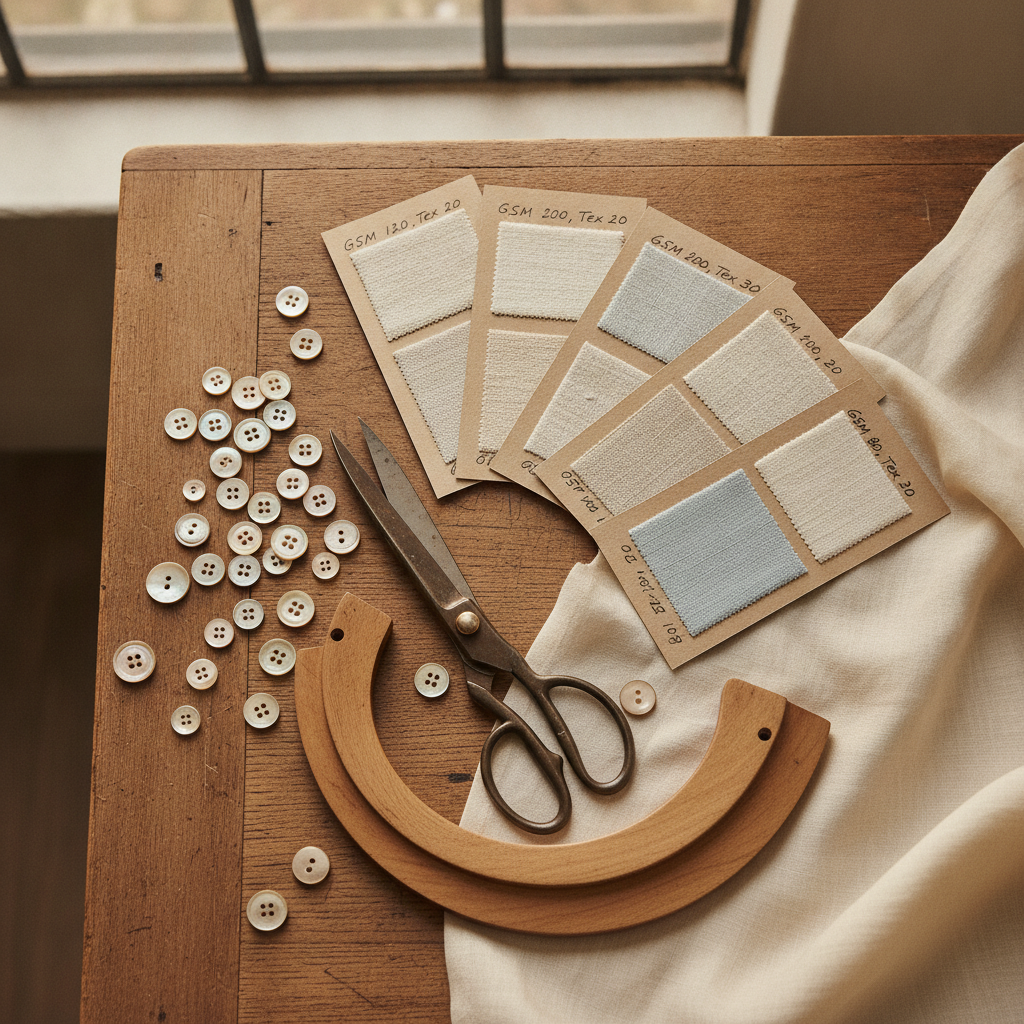
In contemporary couture ateliers, bespoke tailoring houses, and indie patternmaking studios, the cutting table is an international crossroads. A modern master garment technician routinely coordinates disparate technical specifications: drafting an American block with 5/8-inch and 1/2-inch seam allowances, cutting English or Italian worsted wool denominated in grams per square meter (GSM), setting French mother-of-pearl buttons sized in historical Lignes, and tensioning German core-spun polyester thread labeled in industrial Tex.
When these overlapping measurement systems are handled through guesswork or rough mental approximations, the structural integrity of the garment degrades. A 2-millimeter discrepancy on a button diameter distorts the roll of a collar stand. An imprecise conversion of fabric weight leads to sagging lapels or under-structured sleeve heads. An uncalibrated pattern PDF printout distorts grainlines across an entire production run. Mastering atelier mathematics is not merely an academic exercise; it is the cornerstone of haute couture precision and repeatable bespoke fit.
1. Button Sizing Architecture: Lignes, Millimeters, and Placket Geometry
Fastener proportions dictate the architecture of front closures, cuffs, and pocket flaps. Buttons are universally measured in Lignes (abbreviated L), an 18th-century French guild standard that survived metrication. Mathematically, the unit is defined as:
- 1 Ligne (L) = 1/40 of an imperial inch = 0.025 inches = 0.635 millimeters
Understanding this ratio is vital when drafting front extensions and button wraps on jackets and shirts. A fundamental tailoring rule states that the edge extension (the distance from the garment centerline to the outer finished edge) must equal at least the diameter of the button plus a minimum buffer (typically 1/4 inch or 6 mm for shirts, and 1/2 inch to 3/4 inch for tailored jackets):
- 16L (10.16 mm / ~3/8″): Standard shirt cuff and collar button. Requires a delicate 1/2-inch placket clearance.
- 24L (15.24 mm / ~5/8″): Standard waistcoat, shirt placket, or lightweight jacket sleeve vent button.
- 32L (20.32 mm / ~13/16″): Single-breasted tailored suit jacket front closure.
- 40L (25.40 mm / 1.0″): Double-breasted overcoat or heavy winter pea coat closure.
If you mistakenly substitute a 36L button onto an extension drafted strictly for a 30L button, the button edge will crowd the garment fold, causing visual heaviness and tension pull along the front line. Furthermore, the buttonhole cut length must equal the button diameter plus its thickness (plus 1/16 inch for clearance); calculating button diameter down to exact tenths of a millimeter prevents loose, gaping buttonholes or tight, fabric-distorting closures.
2. Fabric Areal Density: GSM versus Ounces per Square Yard
Fabric weight determines how a garment drapes, falls along the straight grain, behaves on the true bias, and responds to internal tailoring canvases. Textile mills express areal density in two predominant units: metric Grams per Square Meter (GSM or g/m²) and imperial Ounces per Square Yard (oz/yd²).
Because a yard is shorter than a meter (0.9144 m) and an ounce is roughly 28.3495 grams, the mathematical conversion factor between these two systems is:
- GSM = oz/yd² × 33.906
- oz/yd² = GSM / 33.906
In the cutting room, recognizing these density categories dictates pattern drafting ease, canvas interlinings, and needle selection:
- Featherweight (30 to 100 GSM / 0.9 to 3.0 oz/yd²): Silk chiffon, georgette, batiste. Demands Microtex needles (size 60/8 to 70/10), narrow French seams (1/8″ to 1/4″), and zero functional ease distortion.
- Shirting & Blouse Weight (110 to 170 GSM / 3.2 to 5.0 oz/yd²): Poplin, chambray, silk crepe de Chine. Requires standard 75/11 needles and balanced single-needle flat-felled or 3/8-inch enclosed seams.
- Midweight Suiting & Trousers (180 to 280 GSM / 5.3 to 8.2 oz/yd²): Worsted wool, linen, tropical suiting. Compatible with floating horsehair canvas interfacings and standard 1/2″ to 5/8″ tailored seam allowances.
- Heavyweight Tailoring & Outerwear (300 to 550+ GSM / 8.8 to 16.2+ oz/yd²): Melton, tweed, double-face wool, raw denim. Requires ball-head sleeve rolls, heavy pad-stitching, universal size 100/16 or 110/18 needles, and increased cap ease on sleeve heads to prevent dimpling.
🛠️ Interactive Atelier Tool: Textile & Fashion Measurement Converter
Skip manual math and cutting guesswork. Use our free interactive tool to instantly calculate your exact measurements, fabric yield, and project specifications:
3. Thread Linear Mass Density: Deciphering Tex, Denier, and Ticket Numbers
Seam pucker, thread breakage, and seam balance are frequently caused by mismatched thread weights. Thread sizing systems fall into two opposing mathematical categories: direct systems (where higher numbers indicate heavier thread) and indirect systems (where higher numbers indicate finer thread).
The Direct Systems: Tex and Denier
- Tex: The weight in grams of 1,000 meters of thread. An absolute metric standard (1 Tex = 1 g / 1,000 m).
- Denier: The weight in grams of 9,000 meters of filament yarn or fiber. Widely used for silks, synthetics, and hosiery (Denier = Tex × 9).
The Indirect Systems: Thread Weight (Wt) and Ticket (No.)
Sewing threads labeled as “40 wt” or “No. 120” derive from historical cotton count standards. In these systems, a higher number signifies a finer thread:
- Tex 24 to 27 (~No. 120 / 40–50 wt): Standard atelier shirting, silk dressmaking, and fine bespoke tailoring for seams and basting.
- Tex 40 to 45 (~No. 75 / 30 wt): Medium-duty topstitching, button sewing, and trouser seat construction.
- Tex 80 to 105 (~No. 36 / 16 wt): Heavy decorative saddle stitching, structural jeans topstitching, and coat hand-sewn buttonhole bar tacks.
Pairing a Tex 45 thread with a delicate 65/9 needle forces the thread through an undersized needle eye, abrading the core fibers and creating irregular bobbin tension. Conversely, running Tex 24 thread through a 110/18 needle creates visible puncture holes that fail to fill with thread, weakening the seam along the warp or weft.
4. Pattern Drafting Conversions: Fractional Inches to Precise Metric Grids
Pattern drafters operating globally often translate vintage or Anglo-American drafting manuals (based on 1/8″, 1/4″, 3/8″, 1/2″, 5/8″, and 3/4″ increments) into European metric slopers (denominated in 0.5 cm, 1 cm, 1.2 cm, and 1.5 cm allowances).
Rounding errors compound rapidly across multi-panel garments. Consider an eight-gored skirt with 16 seam allowances. If a cutter roughly rounds 5/8″ (15.875 mm) to an even 15 mm, the garment loses nearly 14 mm (over 1/2 inch) across the cumulative circumference, turning an impeccably drafted waistline into an unwearable garment.
When working between drafting rulers, use exact 16th-inch tolerances:
- 1/8″ = 0.125″ = 3.175 mm (Fine welt pockets, piping lips)
- 1/4″ = 0.250″ = 6.350 mm (Enclosed collar points, sharp neckline curves)
- 3/8″ = 0.375″ = 9.525 mm (Industrial knit seams, overlocked seams)
- 1/2″ = 0.500″ = 12.700 mm (Standard European commercial seam allowances)
- 5/8″ = 0.625″ = 15.875 mm (Standard American commercial home-sewing seam allowances)
- 3/4″ = 0.750″ = 19.050 mm (Tailored trouser crotch forks, jacket side-body fitting reserves)
5. Digital Pattern Plotting & Calibration: DPI to Real-World Millimeters
As independent ateliers adopt digital vector drafting (CAD) and client-delivered printable PDF patterns, scale calibration has emerged as an essential step before laying shears to fabric. Vector graphics software exports pattern assets at variable print resolutions: standard screen resolution (72 DPI), contemporary system scaling (96 DPI), or high-definition print rasterization (300 DPI).
To confirm that your cutting line preserves its true drafting grainline:
- 1 PostScript typographical point (pt) = 1/72 of an inch = 0.3528 mm
- At 300 DPI, an engineered 100 mm test calibration square measures exactly 1,181 pixels. At 72 DPI, that same square measures 283.5 points.
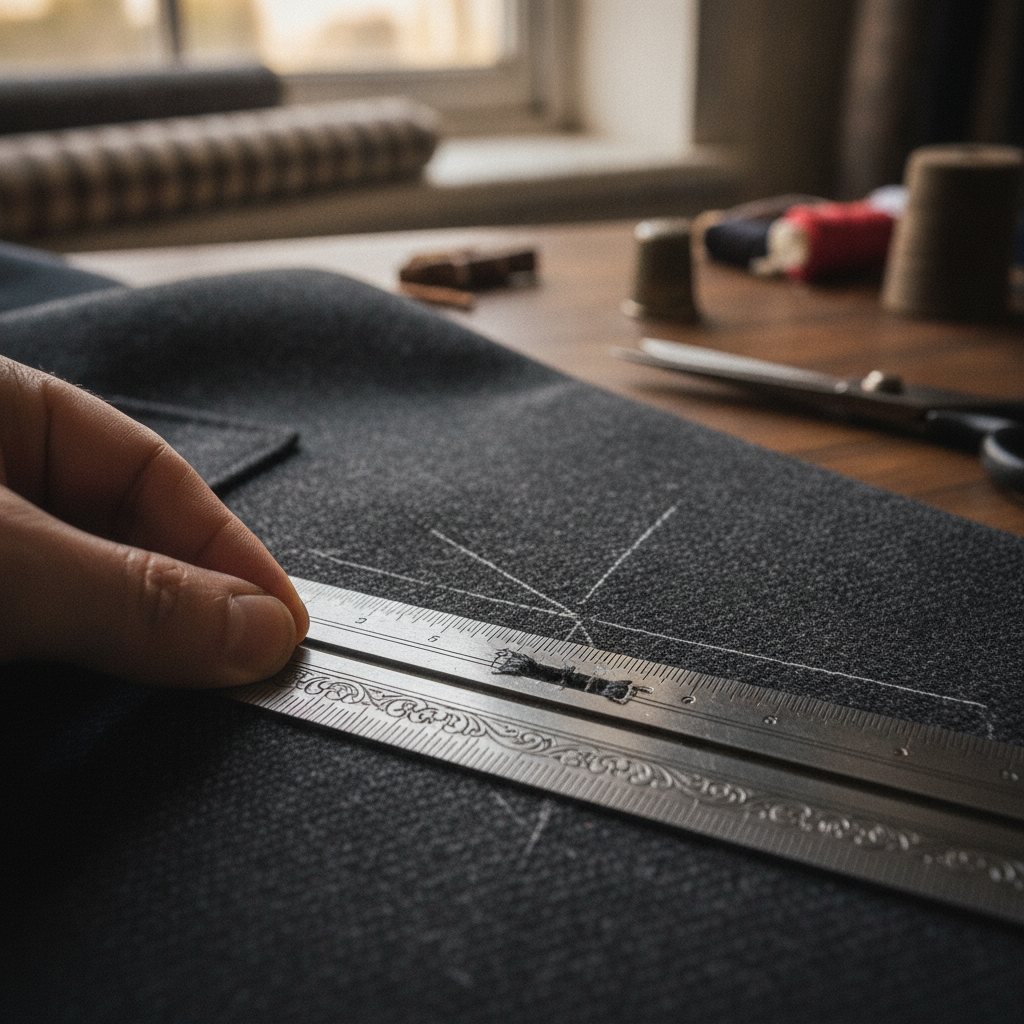
Always inspect the calibration grid on printed tiles with an engineer’s steel rule before tape assembly. A 2% print distortion across a 36-inch jacket back piece alters the armscye curve, shifting the sleeve pitch and causing diagonal tension lines across the wearer’s shoulder blades.
6. Atelier Integration: Preparing the Cut
Accurate conversions set the stage for professional cut and construction. Once your areal densities, button clearances, and metric pattern increments are aligned, factor in material stabilization. Before cutting your final pattern layout, evaluate your yardage with our Fabric Shrinkage Calculator to absorb relaxation shrinkage after pre-steaming wool or washing linen. If your project involves intricate surface couture, beadwork layouts, or spaced button accents, calculate supply margins with our Embellishment Calculator to eliminate shortfalls at the finish.
By grounding your tailoring craft in rigorous mathematical conversions, you bridge the gap between design vision and construction excellence, ensuring every seam, fold, and closure sits precisely as drafted.
Do you enjoy the content on Agenda Creativa?
Your contributions help me create new articles, share creative ideas, and keep this platform alive! If you like what I do and want to support my work, you can buy us a coffee.
Every cup of coffee means more than just a gesture – it's direct support for my passion to create inspiring and useful content. Thank you for being part of this journey!
☕ Buy me a coffee
