The Unspoken Signature of Bespoke Tailoring
In high-end dressmaking and bespoke tailoring, the care label and hang tag are far more than administrative afterthoughts; they represent the tactile threshold between an amateur craft project and an archival, heirloom-quality garment. A carefully engineered label communicates provenance, fiber purity, and structural preservation guidelines. When a collector or client turns a garment inside out, clean seam finishes paired with an impeccably drafted care label affirm that the artisan respected every stage of construction—from warp and weft alignment down to post-purchase textile longevity.
Yet, small ateliers and independent designers frequently stumble at this final hurdle. Common mistakes include utilizing non-compliant laundry glyphs, applying incorrect fiber percentage tolerances, or neglecting to engineer adequate seam allowances on ribbon substrates, leading to frayed, illegible tags after just three wash cycles. Crafting compliant, durable, and visually refined garment tags requires an understanding of both textile regulatory frameworks and micro-scale manufacturing mechanics.

The International Care Symbol Standard: ISO 3758 & GINETEX Syntax
Textile labeling is regulated across international markets to protect garments from catastrophic laundering failures. Under the ISO 3758:2012 standard (and the internationally trademarked GINETEX system), laundry glyphs must follow an immutable, five-step chronological sequence. Misordering these symbols not only violates commercial apparel statutes in regions such as the European Union and the United Kingdom, but it also disorients dry cleaners and discerning clients.
The Mandatory Five-Symbol Sequence
- 1. Washing (The Washtub): Depicts maximum water temperature and mechanical agitation. A plain tub indicates normal mechanical cycle; a single horizontal bar beneath specifies a mild/gentle cycle (reduced agitation, suitable for delicate synthetics or rayons); a double bar indicates a very mild cycle (e.g., machine-washable wools). A hand submerged in the water specifies hand-wash only (maximum 40°C), while a cross through the tub strictly prohibits water washing.
- 2. Bleaching (The Triangle): Denotes chemical oxidative bleaching tolerances. An open equilateral triangle permits any bleaching agent (chlorine or non-chlorine). Two parallel diagonal lines within the triangle permit only non-chlorine (oxygen-based) bleach. A solid or crossed-out triangle forbids all forms of bleaching.
- 3. Drying (The Square): Encompasses both natural air drying and tumble drying. A circle inside the square indicates tumble drying; dots within the circle establish heat thresholds (one dot for low heat/60°C, two dots for medium heat/80°C). Plain squares with interior lines govern flat drying (horizontal line), line drying (curved drooping line), or drying in the shade (diagonal slashes in the upper left canton)—imperative disclosures for weighted silks and open-knit cashmeres prone to distortion.
- 4. Ironing (The Hand Iron): Governs thermal contact finishing. Points denote temperature thresholds calibrated to fiber melt/scorch points: one dot corresponds to 110°C (acrylic, nylon, spandex), two dots to 150°C (wool, silk, polyester blends), and three dots to 200°C (linen, heavy cottons). A cross below the iron forbids steaming.
- 5. Professional Textile Care (The Circle): Reserved for commercial dry and wet cleaning. The letter P dictates perchloroethylene and hydrocarbon solvents; F specifies flammable hydrocarbon solvents only (essential for delicate couture embellishments); W indicates professional wet cleaning. A cross over the circle completely prohibits dry cleaning.
Fiber Composition Accounting and Legal Thresholds
Accurate fiber disclosure protects the wearer against allergens and guarantees truth-in-advertising under FTC (Federal Trade Commission) and EU Textile Regulations. Fiber components must be listed in descending order by net mass percentage (e.g., 70% Wool, 20% Mulberry Silk, 10% Cashmere).
When calculating fiber percentages for custom-woven or composite fabrics, tailors must distinguish between primary shell textiles, interfacings, and structural linings:
- Sectional Composition Disclosures: If a coat features a wool shell and a cupro lining, the label must delineate them explicitly: Outer Shell: 100% Virgin Wool / Lining: 100% Cupro Bemberg. Interfacings and internal shoulder pads are generally exempt unless they constitute functional insulation.
- The 5% Rule & Generic Designations: Minor structural fibers may only be labeled as “Other Fibers” if they do not exceed 5% of the total garment mass, or 15% aggregate across multiple decorative threads. However, if a fiber imparts significant functional properties (such as 2% Elastane for mechanical recovery), it must be explicitly declared by its generic non-proprietary chemical name.
- Animal Origin Disclosures: Any garment utilizing bone buttons, horn toggles, leather patches, or down feathers must carry the explicit phrase: “Contains non-textile parts of animal origin.”
🛠️ Interactive Atelier Tool: Garment Care Label & Hang Tag Designer
Skip manual math and cutting guesswork. Use our free interactive tool to instantly calculate your exact measurements, fabric yield, and project specifications:
Substrate Engineering: Loop Folds, End Folds, and Seam Calculations
Drafting a care label requires understanding how flat ribbon dimensions translate into sewn, multi-dimensional seams. A standard woven or printed ribbon substrate undergoes mechanical tension and fold compression when bound inside a seam allowance.
1. The Center-Fold (Loop) Label Geometry
The center-fold label is the gold standard for side-seam insertion. To draft a balanced loop tag:
- Visible Finished Length ($L_f$): Typically 40 mm to 55 mm to accommodate five symbols, fiber composition, and wash copy.
- Seam Allowance ($SA$): Must match the garment’s seam allowance exactly—standard production uses 10 mm to 12 mm ($3/8″$ to $1/2″$).
- Fold Allowance Margin ($F_m$): An extra 2 mm to 3 mm at the vertex to prevent micro-puckering when the ribbon is folded back on itself.
- Total Cut Length Calculation: $$L_{cut} = (2 times L_f) + (2 times SA) + F_m$$
2. End-Fold and Mitre-Fold Applications
For necklines and internal pocket facings where a loop tag causes cutaneous irritation, use an End-Fold (where the left and right raw edges turn under by 6 mm to 8 mm and are edge-stitched) or a Mitre-Fold (where ribbon ends are folded upward at 45-degree angles to form a hanging loop). When using lightweight printed satin or cotton twill tape, always finish raw cut edges with a hot-knife thermal seal or a micro-overlock stitch to prevent the ribbon from unraveling past the anchor stitch line.
Atelier Integration: Precision Insertion Techniques
Placement of the care label must adhere to historic tailoring etiquette while respecting the ergonomic drape of the garment:
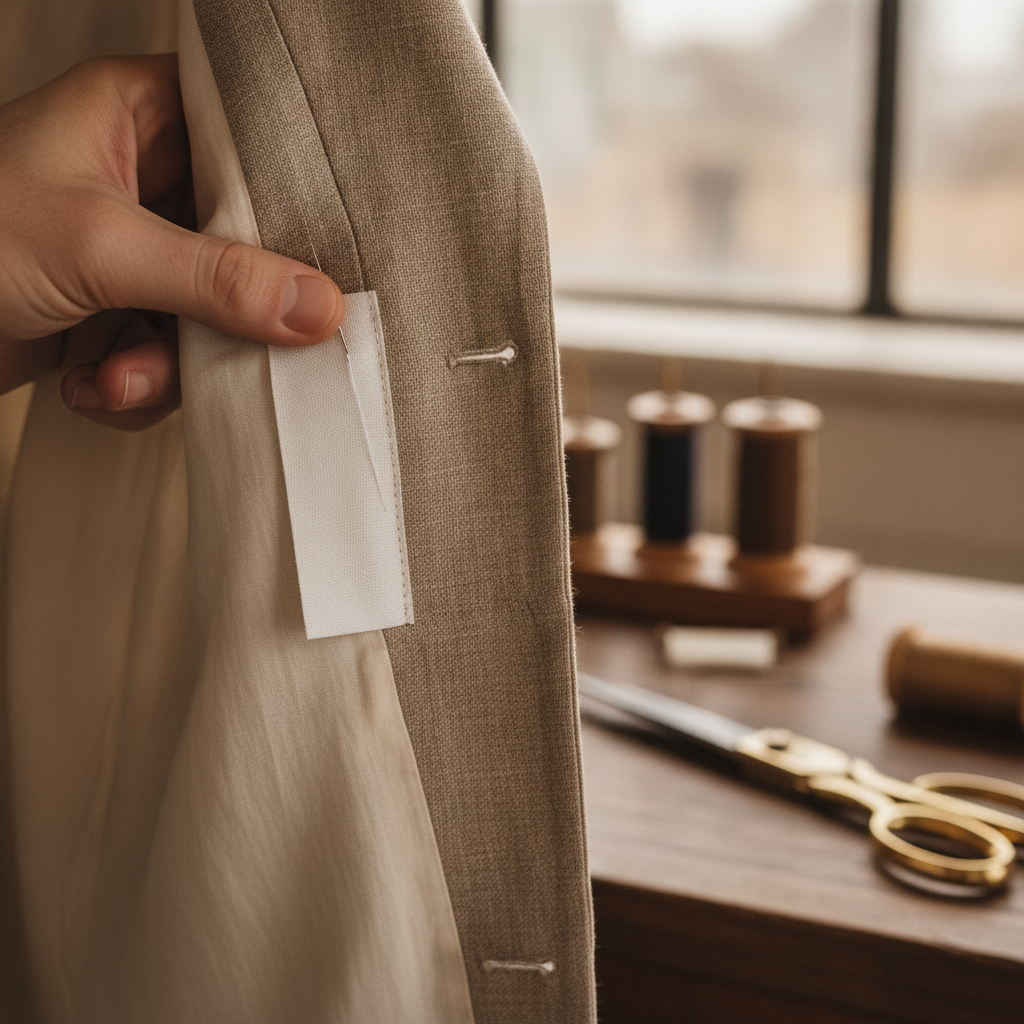
- Tops, Dresses, and Tailored Jackets: Insert care labels into the wearer’s left side seam, positioned approximately 10 cm to 15 cm above the finished hemline. In unlined tailored coats, bind the care label directly into the bias-bound seam or conceal it discretely within an internal breast pocket welt.
- Trousers and Skirts: Insert the label into the left side seam or the rear waistband seam below the yoke. Ensure the loop clears pocket bags to eliminate bulk during pressing.
- Tension and Grain Alignment: Ribbons are predominantly woven with high warp tension. When inserting a label into a seam running along the fabric’s warp or true bias, baste the tag within the seam allowance first using a long basting stitch. Never stretch the ribbon while closing the structural seam on an overlocker or lockstitch machine; doing so will result in an unsightly ripple on the garment’s exterior face.
Curating the Retail Presentation: Hang Tag Systems
While the care label handles long-term preservation, the exterior hang tag sets the tactile tone at point of sale. High-end bespoke ateliers avoid lightweight offset-printed paper in favor of heavy-weight cardstocks (400 to 600 gsm), such as duplexed cotton rag or unbleached kraft board.
Secure the hang tag using natural waxed linen thread, silk gimp, or custom twill ribbon paired with a brass coil-less safety pin inserted through an interior seam binding, facing, or garment loop. Avoid piercing exterior shell textiles—especially dense wools, silks, or coated membranes—as puncturing fibers with aggressive plastic fasteners causes irreversible thread breakage and distortive laddering.
By harmonizing rigorous regulatory compliance with meticulous substrate calculations and couture insertion techniques, your garments maintain their structural integrity, communicate pristine brand authority, and instruct your clients in caring for hand-tailored luxury garments over a lifetime of wear.
Explore Companion Atelier Tools
Refining every facet of your garment construction workflow requires precise drafting and planning. Enhance your pattern cutting and textile drafting with our companion digital tools: analyze silhouette proportions using the Body Shape Adviser, and calculate exact yardage matching across complex plaids and stripes with our Fabric Pattern Repeat Calculator.
Do you enjoy the content on Agenda Creativa?
Your contributions help me create new articles, share creative ideas, and keep this platform alive! If you like what I do and want to support my work, you can buy us a coffee.
Every cup of coffee means more than just a gesture – it's direct support for my passion to create inspiring and useful content. Thank you for being part of this journey!
☕ Buy me a coffee