The Anatomy of the Buffer Illusion
Conventional project management dogma champions the buffer. For decades, the standard wisdom has dictated that whatever your initial time estimate is, you should multiply it by 1.2 or 1.5 to account for the unpredictable. This padding is theoretically designed to absorb the shocks of unexpected friction, sudden interruptions, and inevitable cognitive fatigue. It feels responsible. It feels safe.
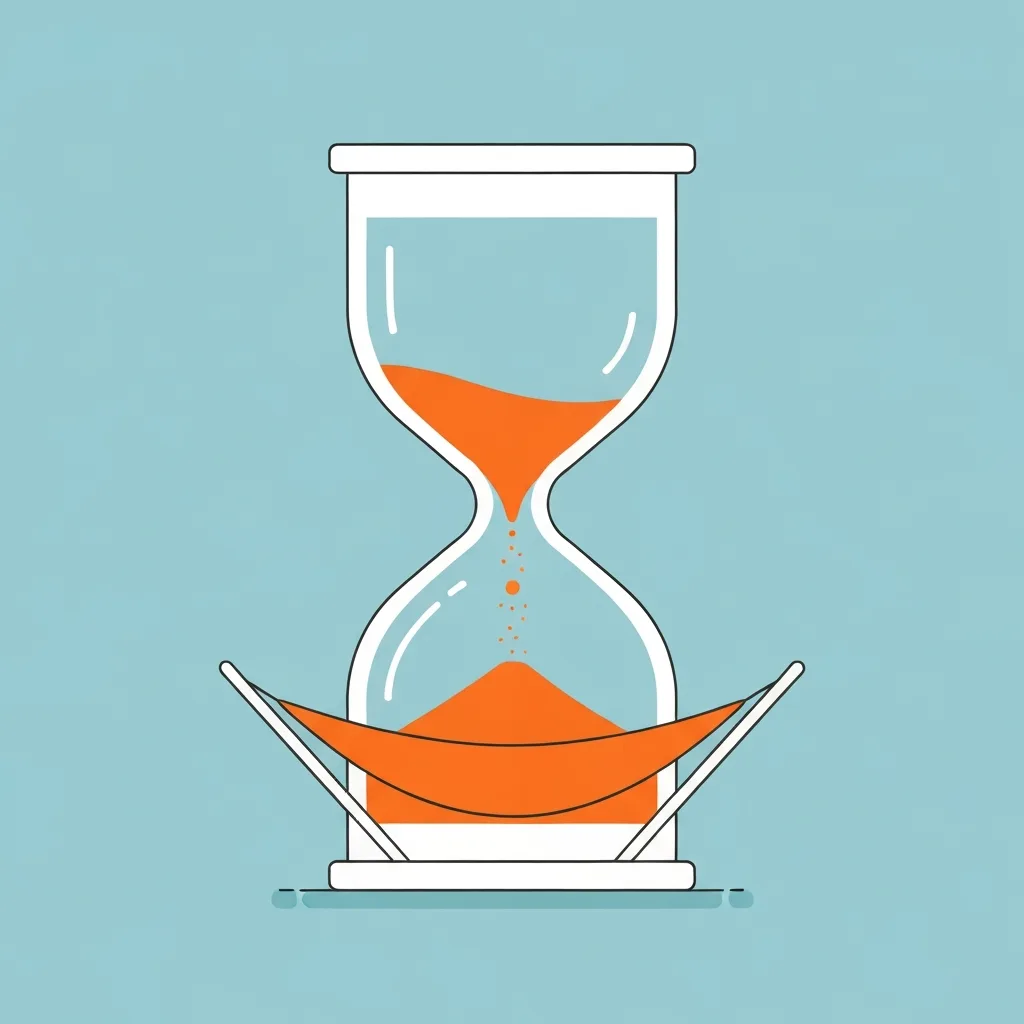
But this well-intentioned advice harbors a hidden psychological trap: the Buffer Illusion. When you intentionally pad a deadline, you assume that your baseline behavior will remain constant and that the extra time will simply act as a safety net. In reality, human psychology does not operate in a vacuum. The moment a buffer is introduced, your perception of the task mutates. The urgency dissolves, the cognitive friction required to start feels less necessary, and the safety net quickly transforms into a hammock.
By artificially expanding the timeline, you are not protecting your workflow; you are diluting your focus. You are giving your brain permission to defer execution, essentially guaranteeing that the work will take exactly as long as the padded timeline allows.

The Parkinson’s Law Multiplier
The Buffer Illusion is the mechanism that activates Parkinson’s Law—the adage that work expands to fill the time allotted for its completion. But the reality of this expansion is far more insidious than simply working at a slower pace.
When you have a comfortable buffer, you do not just stretch the execution phase; you invite scope creep. A presentation that could be completed in three hours of deep, constrained focus suddenly requires a deep dive into secondary research, a complete redesign of the slide deck, and hours spent agonizing over minor phrasing choices. The buffer does not create room for higher quality; it creates room for perfectionism.
This is the perfectionism tax. Because you have the time, your brain invents new, low-leverage requirements to justify the extended timeline. You convince yourself that you are doing thorough, high-quality work, when in fact, you are simply filling the void of the buffer with meta-work and diminishing returns.
Why Safety Nets sabotage momentum
Momentum in knowledge work is generated by a specific ratio of challenge to capacity. When a deadline is tight but achievable, it acts as a forcing function. It strips away the luxury of overthinking and forces you to identify the critical path—the absolute minimum sequence of actions required to deliver the desired outcome.
Buffers destroy this ratio. They remove the constraint that forces prioritization. Without a tight constraint, the brain defaults to the path of least resistance, which usually involves tackling the easiest, least impactful parts of a project first, while leaving the heavy cognitive lifting for the final hours before the extended deadline. The irony of the Buffer Illusion is that despite the extra time, you still end up experiencing a frantic, stress-fueled rush at the very end. The buffer didn’t prevent the last-minute panic; it merely delayed it while wasting the preceding days.
How to Engineer Hard Stops
If padding deadlines is counterproductive, the solution is not to simply guess faster timelines and hope for the best. The antidote to the Buffer Illusion is the implementation of engineered Hard Stops. A Hard Stop is not an aspirational goal; it is a structural, non-negotiable barrier that forcefully terminates the work phase, regardless of how “finished” you feel.
Here is how to build them into your workflow.
1. The Pre-Commitment Protocol
The most effective Hard Stop relies on external stakes rather than internal willpower. The Pre-Commitment Protocol involves scheduling the delivery or review of a project before the execution phase has even begun. If you need to draft a proposal, do not give yourself until Friday to finish it. Instead, schedule a brief review meeting with a colleague or client for Thursday afternoon.
By locking in an external commitment, you eliminate the possibility of extending the deadline. The social pressure of showing up empty-handed overrides the perfectionist urge to endlessly polish the work. The timeline is no longer a suggestion; it is an immovable wall.
2. The Artificial Squeeze
To force your brain to identify the critical path, you must intentionally introduce constraints. The Artificial Squeeze requires taking your most realistic estimate for a task and ruthlessly cutting it by 20%. If you believe a report will take five hours to write, give yourself four.
This is not about rushing or producing sloppy work. It is about constraint-driven innovation. When the brain realizes it does not have the time to indulge in secondary details, it automatically prioritizes the core architecture of the task. You will find yourself making faster decisions, ignoring minor formatting issues, and focusing entirely on the substance of the output. The squeeze forces clarity.
3. Environmental Termination
A Hard Stop is only effective if you actually stop. Relying on yourself to close your laptop when the clock strikes five is a losing battle against momentum and the “just one more thing” fallacy. Environmental Termination involves tying your deadlines to physical or logistical constraints.
This could mean working from a coffee shop that closes at an exact time, scheduling a hard commitment immediately after your work block (like a fitness class or picking up your children), or using software that forcibly blocks your access to work applications at a specific hour. The goal is to make continuing to work physically impossible or socially unacceptable, thereby enforcing the boundary.
Relocating the Buffer: From Within to Between
Abandoning the Buffer Illusion does not mean you should operate at 100% capacity with zero margin for error. A system without margin is brittle and prone to catastrophic failure when the unexpected inevitably occurs.
The strategic shift lies in where you place the buffer. Instead of embedding buffers inside the timelines of individual tasks—where they breed procrastination and scope creep—you must extract them and place them between tasks.
Compress the execution of the project itself using Hard Stops and the Artificial Squeeze. Force yourself to execute swiftly and decisively. Then, take the time you saved and use it as a structural buffer between major projects. This creates white space in your week to absorb systemic shocks, process administrative debris, or simply recover cognitive bandwidth, without sabotaging the urgency of your deep work.
Time is not a neutral container; it is an active variable that shapes your behavior. By stripping away the illusion of the buffer and enforcing rigorous constraints, you stop managing time and start engineering execution.

Do you enjoy the content on Agenda Creativa?
Your contributions help me create new articles, share creative ideas, and keep this platform alive! If you like what I do and want to support my work, you can buy us a coffee.
Every cup of coffee means more than just a gesture – it's direct support for my passion to create inspiring and useful content. Thank you for being part of this journey!
☕ Buy me a coffee