
The Problem with the 12-Month Mindset
Every December, a collective amnesia washes over the professional world. We buy fresh planners, open blank documents, and map out ambitious twelve-month trajectories. We assume that the motivation we feel in the dead of winter will somehow sustain us through the dog days of August. This ritual feels highly productive, yet for the vast majority of knowledge workers and creators, it is the exact moment their execution begins to fracture.
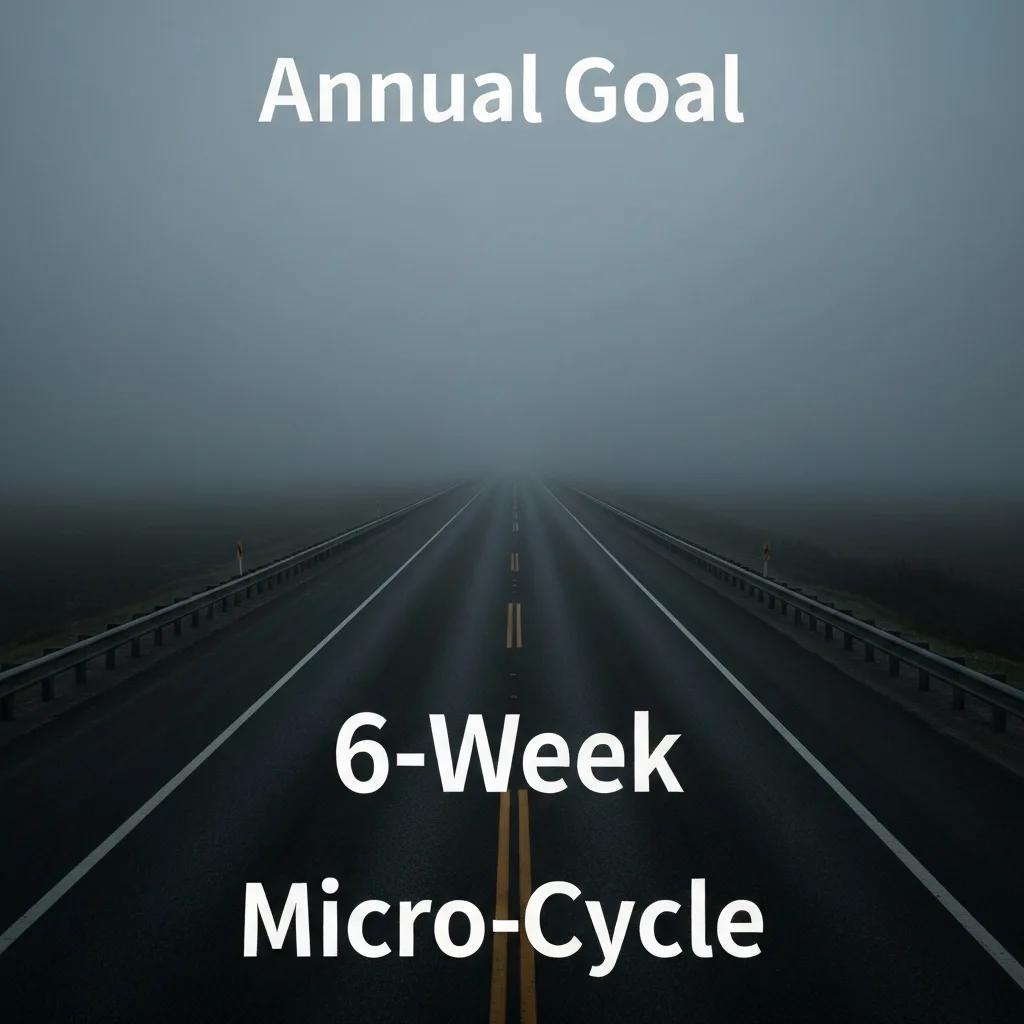
The core issue is not a lack of discipline or poorly defined objectives. The issue is the timeline itself. When you operate on an annual horizon, you are falling into a psychological snare known as the Horizon Trap. A year is simply too large a unit of time for the human brain to process with any sense of immediate urgency. It feels infinite. And when time feels infinite, your daily actions lose their weight.
If you have a massive project due in November, what you do on a random Tuesday in March feels inconsequential. You can always ‘make it up tomorrow.’ This creates a dangerous permission structure for procrastination, disguised as pacing. The distance between the present moment and the deadline is so vast that the feedback loop breaks entirely. You are operating in a vacuum, relying entirely on raw willpower to push forward without the natural forcing function of an impending deadline.
The Anatomy of the Horizon Trap
To dismantle the annual planning default, we first have to understand the specific mechanical failures that occur when we stretch our goals across 365 days. The Horizon Trap typically manifests in three distinct ways.
The U-Shaped Motivation Curve
Behavioral psychology shows us that motivation over the lifespan of a project follows a distinct U-shape. We experience a massive spike of energy at the beginning, fueled by novelty and optimism. We experience another spike at the very end, fueled by panic and the proximity of the finish line. In the middle lies the ‘Valley of Despair’—a period where the initial excitement has faded, but the deadline is too far away to trigger urgency.
When you set an annual goal, you are engineering a ten-month Valley of Despair. You are guaranteeing that for the vast majority of the year, you will be fighting an uphill battle against your own neurochemistry, trying to manufacture urgency where none naturally exists.
Macro-Parkinson’s Law
Parkinson’s Law states that work expands to fill the time allotted for its completion. We typically apply this to daily tasks—if you give yourself four hours to write a report, it takes four hours; if you give yourself one hour, it takes one hour. But this law scales perfectly to the macro level. If you give yourself a year to write a book, launch a product, or overhaul a system, the project will magically bloat in complexity until it requires a full twelve months. The artificial timeline forces artificial complexity.
The Pivot Penalty
The modern landscape shifts rapidly. The assumptions you make in January are often obsolete by June. However, when you have publicly or privately committed to an annual goal, changing course feels like a failure. The 12-month framework creates rigid thinking. You become more committed to the plan than to the outcome, grinding away at objectives that no longer serve your primary interests simply because they are written on your yearly roadmap.
The Antidote: The 6-Week Micro-Cycle
If the annual horizon is too long and the daily horizon is too tactical, where is the sweet spot for strategic execution? The answer lies in the 6-week micro-cycle.
Six weeks is long enough to accomplish something highly meaningful—you can build a substantial feature, write a massive cornerstone essay, or completely overhaul a physical environment. Yet, it is short enough that the deadline is always visible. In a 6-week cycle, there is no room for a Valley of Despair. Week three is the halfway point. By week four, you are already feeling the heat of the finish line. Every single day matters, because a single lost day represents a significant percentage of your total available time.
Operating in micro-cycles forces ruthless prioritization. You can no longer hide behind the comfort of ‘I will get to it later.’ It forces you to strip away the non-essential and focus entirely on what actually moves the needle.
How to Engineer a Micro-Cycle Workflow
Transitioning from an annual mindset to a micro-cycle framework requires more than just chopping your year into smaller pieces. It requires a fundamental restructuring of how you approach scoping, execution, and rest. Here is the architecture of a successful micro-cycle system.
Step 1: The Ruthless Scope-Down
The biggest mistake people make when adopting shorter cycles is trying to cram a year’s worth of expectations into six weeks. This leads to immediate burnout. Instead, you must practice the art of the ‘scope-down.’ Look at your broader ambition and ask: What is the minimum viable progress I can make in the next 42 days?
If your macro-goal is to write a book, your 6-week cycle is not ‘write the book.’ Your 6-week cycle is ‘outline the manuscript and draft the first three chapters.’ You must define an outcome that is entirely within your control and physically possible within the time constraint. The goal must be binary: at the end of the six weeks, it is either definitively done, or definitively not done.
Step 2: The Execution Sprint
During the six weeks, you operate with singular focus. Because the scope is tightly defined, you do not need to spend mental energy wondering what you should be working on. You simply execute the plan. This is where you leverage daily deep work blocks. You are no longer managing a sprawling, ambiguous project; you are simply moving bricks from one side of the room to the other, day by day, until the wall is built.
If new ideas, side projects, or ’emergencies’ arise during the cycle, they are not allowed to derail the current sprint. You capture them in a holding tank—a simple list of things to consider for the next cycle. This protects your current focus while ensuring good ideas are not lost.
Step 3: The Two-Week Cooldown
This is the most critical and most frequently ignored component of the system. You cannot run back-to-back 6-week sprints indefinitely; your cognitive engine will overheat. After a 6-week cycle concludes, you must enforce a 2-week cooldown period.
During the cooldown, there are no heavy strategic goals. This time is reserved for the necessary administrative maintenance of professional life. You clear out your inbox, organize your files, fix broken systems, catch up on minor tasks, and—most importantly—breathe. The cooldown acts as a buffer, allowing you to recover from the intensity of the sprint. Toward the end of the two weeks, you use your clear, rested mind to scope out the next 6-week cycle.
Recalibrating Your Relationship with Time
When you adopt the 6-week cycle with a 2-week cooldown, your year cleanly divides into roughly six distinct phases. You are effectively getting six ‘fresh starts’ every single year. If one cycle goes poorly, you do not have to wait until next January to reset; your next clean slate is, at most, a few weeks away.
This framework drastically accelerates your output because it aligns perfectly with human psychology. It leverages our need for urgency, respects our biological need for recovery, and forces us to break ambiguous ambitions into concrete, executable realities. You stop measuring progress by how much time has passed, and start measuring it by how many tangible outcomes you have shipped.
Shrink Your Horizon, Expand Your Output
The desire to plan a year in advance is rooted in a desire for control. We want to believe that we can predict the future and map our exact steps through it. But true productivity is not about rigid prediction; it is about rapid, focused adaptation.
By abandoning the 12-month horizon and embracing the 6-week micro-cycle, you are trading the illusion of a long-term plan for the reality of short-term execution. You are building a system that forces action today, rather than promising action tomorrow. Stop letting the distance of the horizon dilute your daily effort. Shrink the timeline, define the immediate outcome, and get to work.
Do you enjoy the content on Agenda Creativa?
Your contributions help me create new articles, share creative ideas, and keep this platform alive! If you like what I do and want to support my work, you can buy us a coffee.
Every cup of coffee means more than just a gesture – it's direct support for my passion to create inspiring and useful content. Thank you for being part of this journey!
☕ Buy me a coffee