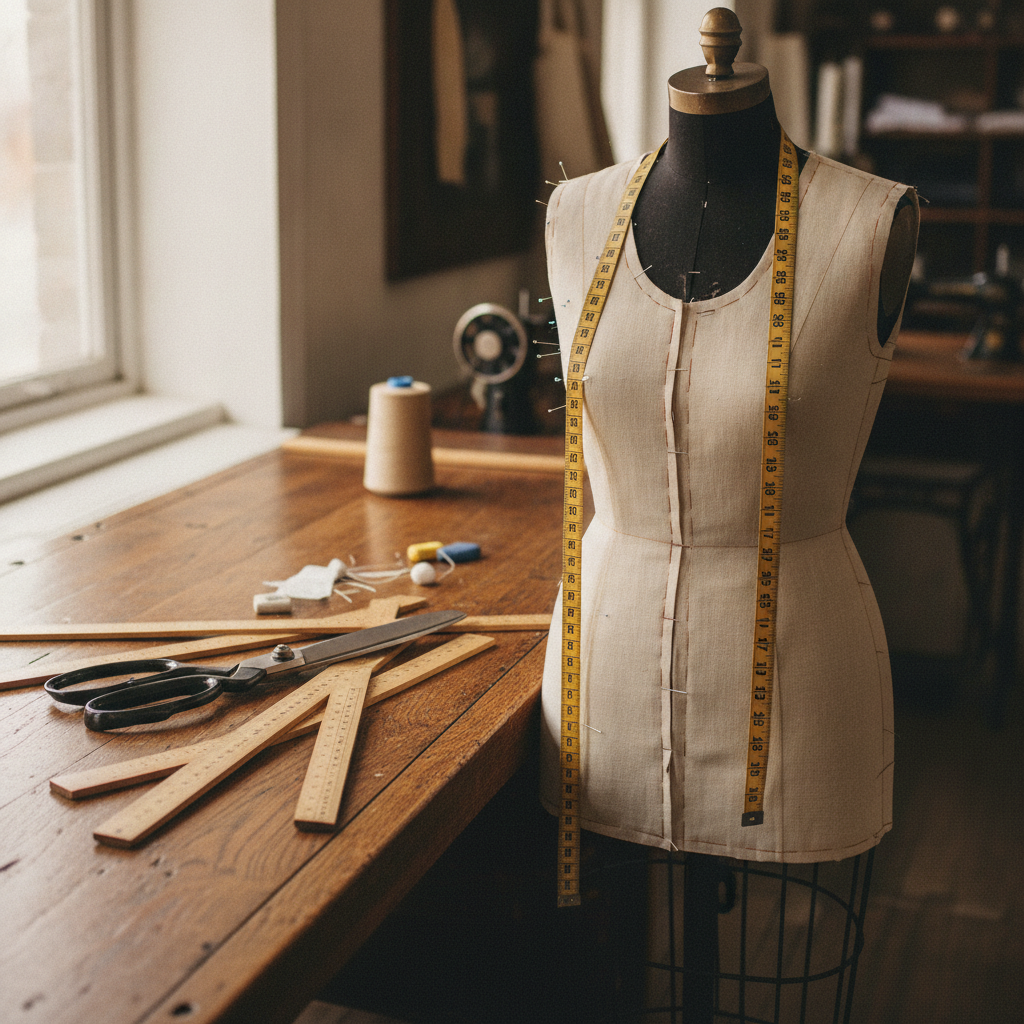
In commercial garment manufacturing, patterns are graded across a static, uniform scale based on an idealized hourglass figure that represents fewer than eight percent of modern clients. When bespoke dressmakers and couturiers attempt to execute tailored pieces straight from standard commercial pattern blocks, the consequences are immediate: gaping armscyes, unsightly draglines pulling across hip apexes, horizontal back-waist pooling, and poor balance along the vertical plumb line.
Achieving true bespoke fit demands an intimate understanding of anatomical geometry. Before shears meet cloth, a tailor must decode the proportional relationships between the shoulder line, bust projection, natural waist indentation, and low hip arc. By systematically classifying silhouette archetypes through rigorous anthropometric ratios, you can predict exactly how grainlines will drape, where ease must be allocated, and how pattern drafts must be manipulated to balance the wearer’s natural architecture.
The Couturier Anthropometric Protocol: Precision Measurement
Accurate pattern drafting begins with repeatable, non-distorting measurement methodology. A flexible woven tailor’s tape must be held flush against the body, maintaining exact parallelism to the floor without compressing soft tissue. Have the client wear their chosen foundational undergarments, standing naturally with feet shoulder-width apart.
- Fullest Bust Circumference: Measure across the fullest projection of the bust mounds, carrying the tape horizontally under the axilla (armpits) and straight across the scapulae (shoulder blades). Ensure the tape does not sag across the back.
- Natural Waist: Locate the anatomical waist by having the client bend laterally. The point of muscular indentation, typically 2.5 to 5 centimeters (1 to 2 inches) above the umbilicus, defines the natural waistline. Secure an elastic waist stay around this point to serve as an immutable horizontal balance datum for all vertical pattern measurements.
- High Hip (Abdominal Projection): Measure approximately 8 to 10 centimeters (3 to 4 inches) below the natural waist, crossing the top of the iliac crest and the lower abdominal curve. This measurement is critical for drafting smooth contour darts.
- Fullest Low Hip: Measure around the widest circumference of the buttocks and trochanters, typically located 18 to 23 centimeters (7 to 9 inches) below the waist stay. Ensure the tape remains level across the seat apex.
The Five Silhouette Archetypes and Proportional Mathematics
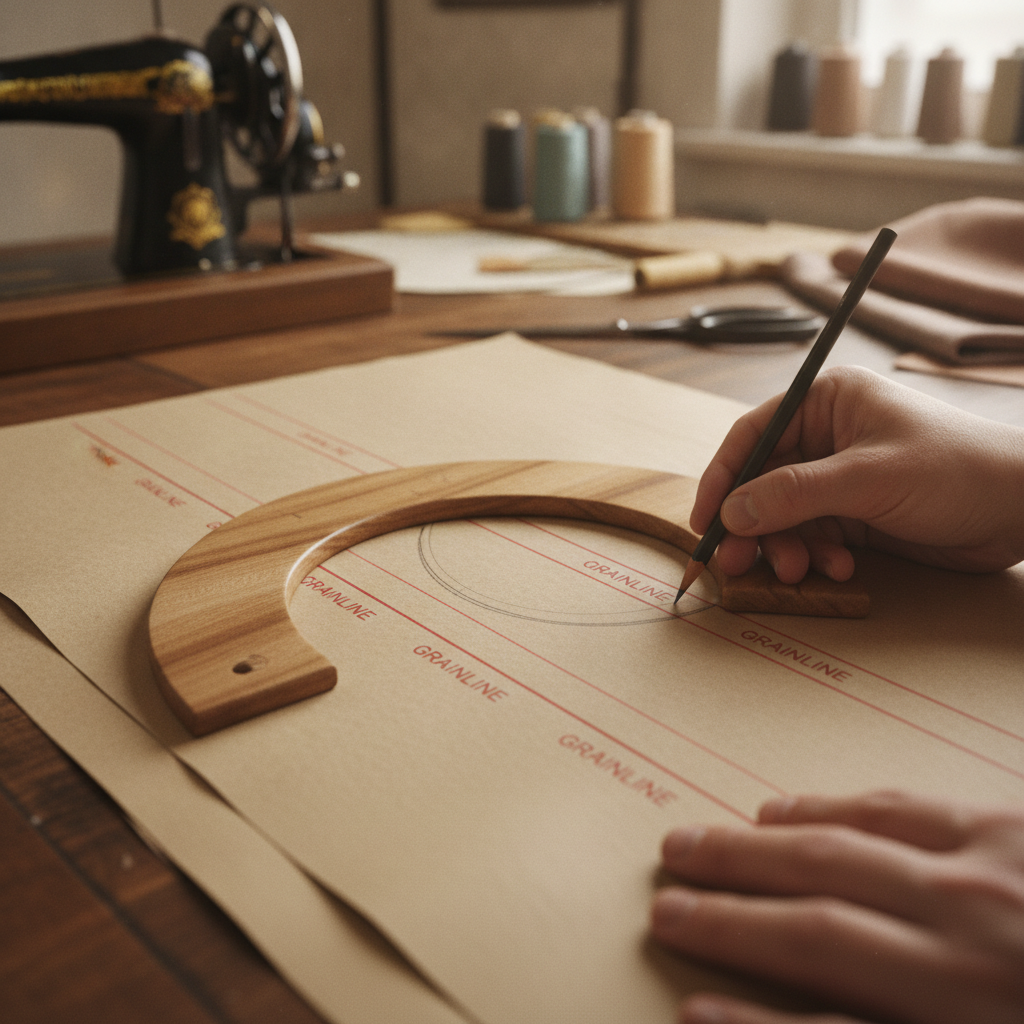
Patternmakers classify the human form into five distinct geometric archetypes. These categories are not aesthetic value judgments; they are practical mathematical frameworks that dictate dart suppression values, seam curvature, and grainline orientation.
1. The Hourglass (Balanced Curvilinear)
Defined by balanced bust and hip circumferences accompanied by a dramatic waist suppression. Mathematically, the bust and hip measurements are within 5% of one another (Bust / Hip ratio between 0.95 and 1.05), while the waist circumference is at least 25% smaller than both the bust and hip (Waist / Hip ratio ≤ 0.75). The tailoring challenge here lies in dart distribution: accommodating extreme curves without introducing puckering or diagonal stress lines along the high hip.
2. The Pear (Triangle / Lower Dominant)
Characterized by a hip circumference significantly greater than the shoulder and bust line. The hip measurement exceeds the bust by more than 5% (Bust / Hip ratio < 0.90), typically accompanied by a well-defined waist. The primary draft intervention involves stabilizing the shoulder slope, widening the neckline to visually broaden the upper torso, and adding ample flare or release over the lateral hip curve.
3. The Inverted Triangle (Upper Dominant)
The inverse of the Pear: the bust and shoulder cross-measurements significantly exceed the low hip circumference (Bust / Hip ratio > 1.05). Clients frequently exhibit broad back widths, deep armscyes, and narrower pelvic frames. Pattern drafts require reducing shoulder seam lengths, deepening armhole drops, and generating structural volume below the waistline via pleating, godets, or structural peplums.
4. The Rectangle (Columnar / Athletic)
A silhouette where bust, waist, and hip circumferences exist in close proximity. The bust and hip are balanced, but the waist is less than 25% smaller than the hip (Waist / Hip ratio > 0.75). The patternmaker’s task is architectural illusion: utilizing curved princess seams, strategic color-blocking along true grainlines, and contoured waistbands to construct an artificial waist suppression.
5. The Apple (Oval / Central Dominant)
Characterized by a full central torso where the waist measurement approaches or exceeds the bust and low hip circumferences (Waist / Hip ratio ≥ 0.85). The bust is often prominent, while the limbs and lower hips remain relatively slender. The draft must relocate the visual waist datum upward toward the empire position, releasing ease across the midsection while utilizing vertical seam placements to guide the eye along the longitudinal axis.
🛠️ Interactive Atelier Tool: Body Shape & Style Adviser
Skip manual math and cutting guesswork. Use our free interactive tool to instantly calculate your exact measurements, fabric yield, and project specifications:
Pattern Engineering & Dart Manipulation by Silhouette
Once you identify the mathematical archetype, pattern manipulation moves from guesswork to strategic drafting. Every alteration directly impacts fabric grainline behavior.
Controlling Extreme Curvature in Hourglass Blocks
When drafting for an Hourglass, a single waist dart per quadrant will inevitably cause fabric tenting around the apex. Instead, distribute waist suppression across double contour darts. Divide the total front waist reduction: allocate 60% to a primary dart aligned with the bust apex line, and 40% to a secondary dart positioned midway between the primary dart and the side seam. Curve the dart legs slightly outward (convex) to mimic the natural rise of the hip shelf.
Correcting Grainline Drift on Pear Figures
On pear-shaped figures, tight side seams will pull the fabric crossgrain (weft) upward at the hips, producing horizontal stress wrinkles that collapse the garment hemline inward. To correct this, slash the skirt block from hem to waist along the princess line and spread the lower panels to introduce an A-line silhouette. This ensures the lengthwise warp threads hang plumb to the floor, allowing the fabric to drape smoothly over the hip curves without horizontal tension.
Shoulder and Armscye Adjustments for Inverted Triangles
An inverted triangle requires structural softening across the shoulder girdle. Narrow the shoulder seam by 1 to 1.5 centimeters, shifting the armscye seam inward. Compensate for the reduced armhole circumference by dropping the base of the armscye by 1 centimeter. This allows the sleeve cap to set cleanly without binding across the bicep. Pair this alteration with raglan or soft drop-shoulder blocks to break up the broad cross-front plane.
Fabric Behavior, Grainlines, and Wearing Ease
Pattern alterations cannot be divorced from textile physics. A pattern drafted for a fluid 4-ply silk crepe will behave radically differently than the same block cut in a structured 14-ounce wool flannel.
- Warp and Weft Tension: Garment balance depends on the warp (lengthwise grain) running strictly parallel to the body’s plumb line. When altering side seams for full-hipped or oval figures, never swing the side seam out so far that it cuts across the true bias without adding reinforcement; doing so will cause the side seams to stretch and ripple over time.
- True Bias Draping: Cutting garments on the 45-degree true bias allows woven fabric to emulate the mechanical stretch of knitwear. This makes bias cuts ideal for rectangular silhouettes seeking fluid cling, or hourglass figures wanting liquid drape over hip curves. Always hang bias-cut panels for at least 24 hours prior to hemming to allow the yarn matrix to settle.
- Allocating Wearing Ease: Ensure you differentiate between design ease and essential wearing ease. Minimum structural wearing ease values are: bust +5 to 7.5 cm (2 to 3 in), waist +2.5 to 3.8 cm (1 to 1.5 in), and low hip +5 to 7.5 cm (2 to 3 in). Figures with high waist-to-hip differentials require at least 5 cm of hip ease to prevent the garment from riding up when sitting.
Professional Atelier Finishing
Executing high-level custom garments requires rigorous documentation and impeccable construction standards. When designing full, sweeping lower halves to balance upper-body dominant silhouettes, use our Circle Skirt Calculator to accurately compute waist radii and yardage without waste. Once your bespoke piece is constructed, fitted, and pressed, finish it with custom garment tags generated through our Label Designer to preserve care guidelines, sizing metrics, and your couture studio branding.
Do you enjoy the content on Agenda Creativa?
Your contributions help me create new articles, share creative ideas, and keep this platform alive! If you like what I do and want to support my work, you can buy us a coffee.
Every cup of coffee means more than just a gesture – it's direct support for my passion to create inspiring and useful content. Thank you for being part of this journey!
☕ Buy me a coffee
