The Hidden Physics of Atelier Time: Why Bespoke Projects Drift
In bespoke tailoring, theatrical costume fabrication, and independent bridal couture, a staggering number of projects run dangerously past their target completion dates. Makers frequently attribute these delays to personal procrastination or unexpected client demands. However, the root cause lies in cognitive miscalculation: the Planning Fallacy. When estimating the delivery timeline for an intricate garment, artisans subconsciously project an ideal sequence of events—a frictionless universe where every seam falls straight, silk shears glide without snagging, the fabric grain relaxes uniformly, and fittings demand zero structural adjustments.
In reality, haute couture and high-end bespoke garments do not behave like mass-market ready-to-wear production lines. Handcraft demands an ongoing dialogue between needle, iron, fiber tension, and live anatomy. When you attempt to calculate delivery based solely on aggregate sewing speed, you guarantee delivery panic, late nights, compromised finishing, and eroded profit margins.
The Reality of Hofstadter’s Law in Garment Construction
Hofstadter’s Law succinctly states: It always takes longer than you expect, even when you take into account Hofstadter’s Law. In an artisan studio, this reality manifests through non-negotiable physical and structural steps that cannot be rushed without jeopardizing the garment’s integrity:
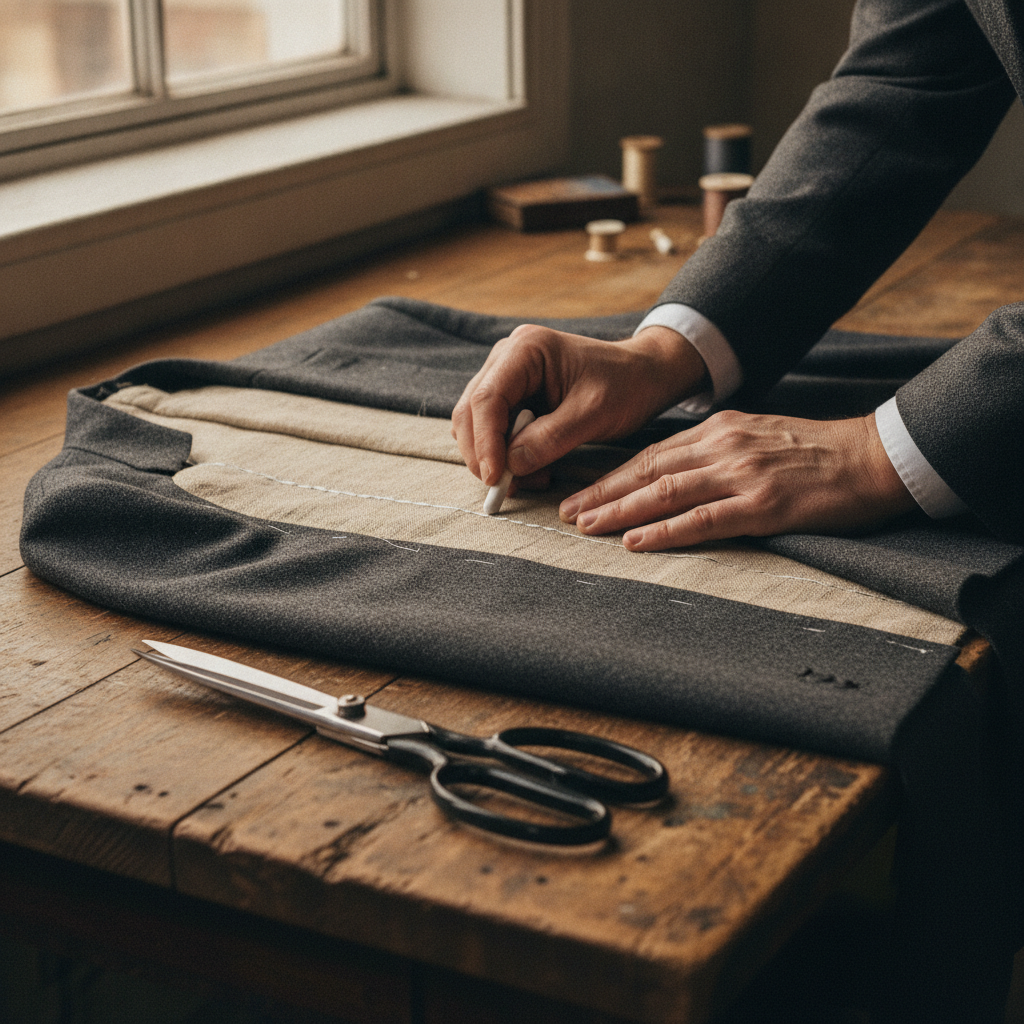
- Thermal Recovery & Fiber Stabilization: When shaping pure wool canvas with steam, or pressing a curved seam on a tailored jacket, the fibers undergo plastic deformation under heat and moisture. They must sit undisturbed under a heavy hardwood tailor’s clapper until stone cold. Handling warm, moist wool distorts the three-dimensional silhouette, introducing ripple effects that waste hours of correcting later.
- Anatomical Fluidity: Live clients change. Between an initial consultation and the second fitting, weight fluctuates, posture changes depending on footwear choices, and undergarment structures alter seam apexes. Adjusting a canvas chest piece or re-keying the pitch of a two-piece tailored sleeve requires methodical deconstruction, not hasty fixes.
- Substrate Temperament: A roll of bias-cut 4-ply silk crepe does not behave predictably on the cutting table. It requires suspension time—hanging for 24 to 48 hours to stretch under its own weight before the hemline can even be marked. Skipping this pause yields a wavy, distorted hem that requires completely unpicking and restitching.
The Five Critical Phases of Bespoke Production
To establish a bulletproof completion schedule, every commission must be broken into distinct operational phases. By treating each phase as a separate milestone with dedicated time allotments, you eliminate the cognitive blind spot of viewing a garment as a single unbroken task.
Phase 1: Pattern Drafting, Ingestion & The First Toile (Muslin)
Never measure cutting time based on final cloth alone. This phase encompasses draft geometry, flat pattern adjustments, cutting the cotton calico or rayon lining test, basting the toile with long running stitches, and the initial client fitting. For complex silhouettes—such as corsetry, structural coats, or gowns with asymmetrical drape—you must account for pattern re-digitization or manual re-truing after the fitting.
Phase 2: Cloth Preparation & Grain Rectification
Before shears touch high-value textiles, cloth must be prepared. Wool requires London shrinking or thorough steam sponging; linens must be washed or shrunk to prevent post-delivery contraction; silks must be checked under raking light for warp defects. Straightening the grainline—snapping a weft thread across the width to establish true perpendicularity—often reveals severe skewing that requires steam blocking back into square.
Phase 3: Internal Architecture & Foundation Prep
The unseen internal infrastructure constitutes at least 40% of authentic couture labor. In tailoring, this includes pad-stitching linen horsehair canvas to wool chest pieces, installing domette flannels, shaping collars over the hand, tape-reinforcing roll lines, and bonding interfacing layers under precision heat and pressure. In eveningwear, this step demands channel stitching spiral steel boning, waist stay construction, and underlining delicate laces to silk organza.
Phase 4: Shell Assembly & Tailoring Press
This is the traditional mechanical sewing phase: joining seamlines, balancing side seams, inserting set-in sleeves, under-pressing each seam open over tailor’s hams, and baste-fitting collars. Professional practice dictates that no intersecting seam is ever crossed by another stitch line until it has been completely pressed and cooled.
Phase 5: Fine Finishes, Hand Work & Packaging
The final phase carries the highest risk of schedule compression. Hand-bound silk buttonholes require 15 to 30 minutes of undisturbed concentration each; blind catch-stitched hem sweeps on wide ballgowns can consume hours; pick-stitching lapels demands precise hand pacing. Finally, lint extraction, final pressing over a velvet board, hanger attachment, and packaging must be accounted for in the schedule.
🛠️ Interactive Atelier Tool: Project Deadline Calculator
Skip manual math and cutting guesswork. Use our free interactive tool to instantly calculate your exact measurements, fabric yield, and project specifications:
Calibrating Contingency Buffers: The Studio Multipliers
A professional atelier schedule does not merely sum task hours and divide by an eight-hour workday. Net productive studio capacity differs drastically from gross calendar hours. Admin duties, thread changes, machine oiling, and needle replacements silently consume 20% of your day. Furthermore, project risks vary across different fabric categories and client requirements.
The Standard Tailoring Buffer (+10%)
Apply this multiplier to structured, stable commissions executing familiar block patterns in stable woven textiles (e.g., 350gsm worsted wool, twill outerwear, structured shirting). The 10% safety cushion accommodates minor thread adjustments, needle replacements, and minimal pattern alterations without jeopardizing the calendar.
The Complex Construction Buffer (+25%)
Mandatory for designs involving delicate surface treatments, unstable grainlines, or complex multi-layer interlinings. Examples include tailored jackets featuring hand-padded horsehair floating canvases, velvet cutting requiring directional nap brushing, multi-panel princess seams requiring careful ease-distribution, or garments requiring an intermediate basted fitting with the client.
The High-Risk Couture & Bridal Buffer (+50%)
Apply this substantial margin when tackling true high-risk variables:
- Bias-cut textiles (silk georgette, silk satin charmouse) requiring extended fabric rest cycles.
- Illusion tulle or heavily beaded lace demanding precise hand appliqué and motifs cut out with micro-shears.
- Strict destination bridal milestones where a delayed fitting causes catastrophic client logistics.
- Commissions demanding unconventional boned silhouettes or theatrical armor integration.
Implementing Production Travelers on the Studio Floor
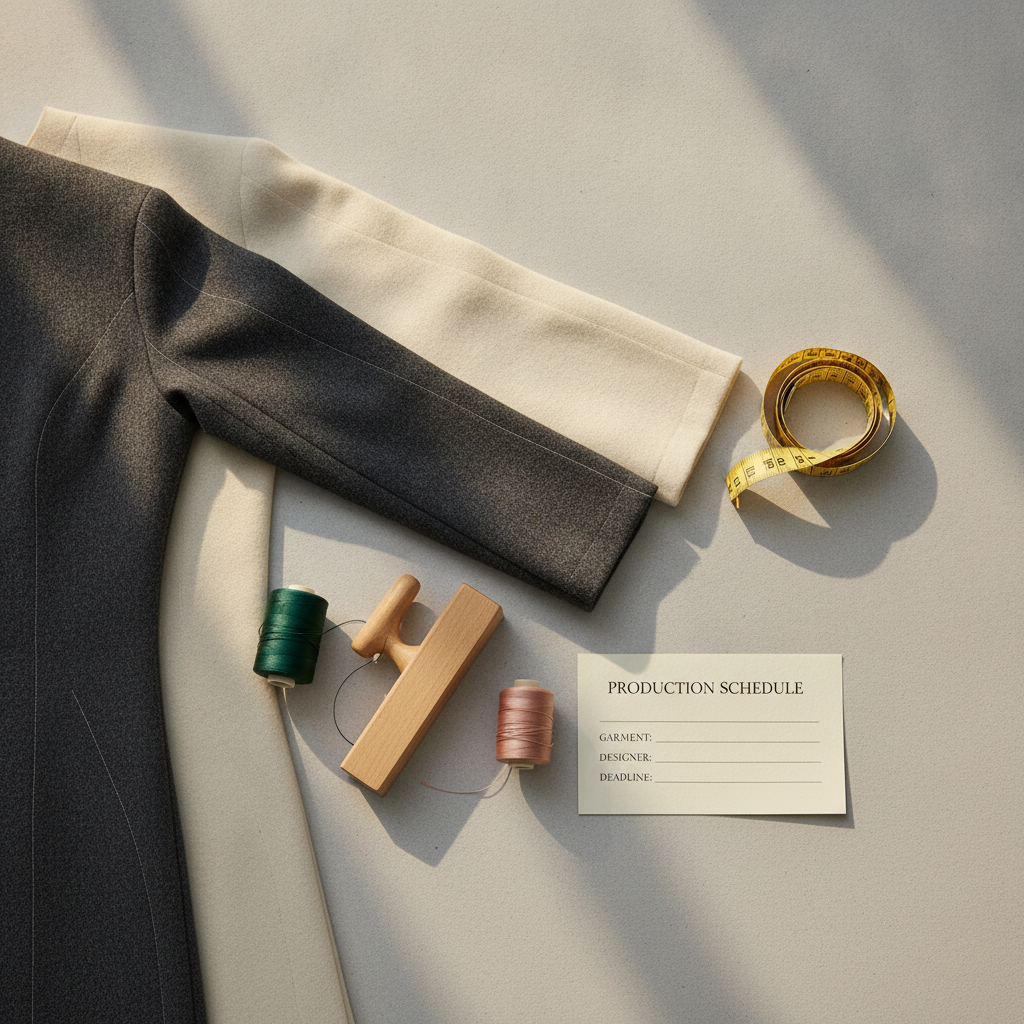
Once you calculate your phase milestones and target completion dates, commit that schedule to physical paper. In heritage manufacturing and high-end workrooms, this takes the form of a Production Traveler (or atelier job card).
A production traveler is a physical document clipped to the garment rack alongside the cut pieces, patterns, and notions. It outlines:
- Target completion dates for every phase (Toile Fitting, Canvas Assembly, Second Fitting, Hemming).
- The allocated labor hours versus logged hours for each stage.
- Special handling notes (e.g., “Press only with organza cloth; maximum iron temperature 130°C; hung bias skirt 36 hours prior to hem leveling”).
Operating with a visible, physical production traveler converts abstract temporal goals into tactile milestones. It keeps you accountable, exposes bottlenecks early, and gives clients confidence during intermediate fittings.
Elevate Your Atelier Workflow
Predictable timelines form the foundation of a successful creative business. When you respect the physics of your cloth, understand your genuine daily output capacity, and schedule non-negotiable fitting contingencies, rush orders become a relic of the past.
To streamline the upfront design phase before calculating your deadlines, explore our Fashion Sketchpad for developing clean technical proportions and flat sketches. If your commission incorporates volumetric skirts, ruffles, or tiered tulles, pair your workflow with our dedicated Gathering Calculator to ensure precise yardage and gathering ratios before cutting into your fashion fabric.
Do you enjoy the content on Agenda Creativa?
Your contributions help me create new articles, share creative ideas, and keep this platform alive! If you like what I do and want to support my work, you can buy us a coffee.
Every cup of coffee means more than just a gesture – it's direct support for my passion to create inspiring and useful content. Thank you for being part of this journey!
☕ Buy me a coffee