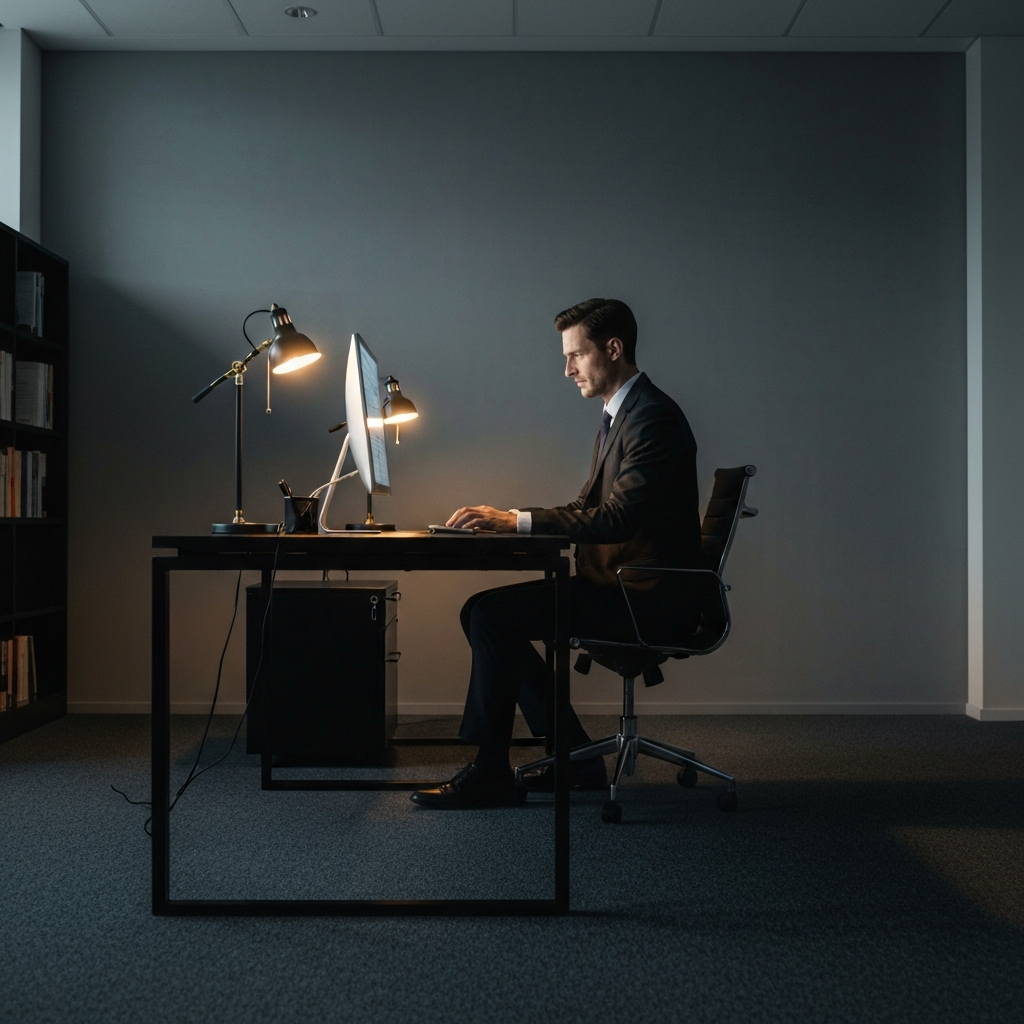
The Brain-in-a-Vat Fallacy
Modern knowledge work operates on a fundamentally flawed premise: that the human brain can be isolated from the biological chassis that carries it. We obsess over digital architectures. We meticulously curate our task managers, build elaborate note-taking systems, and rigidly time-block our calendars. Yet, when our focus inevitably fractures at 2:00 PM, we blame our software, our willpower, or our schedule. We rarely blame our posture, our breathing, or our blood flow.
This is the Somatic Disconnect. It is the dangerous assumption that cognitive output is entirely divorced from physiological input. By treating the body as a mere life-support system for the brain—or worse, an inconvenience that occasionally requires food and bathroom breaks—we inadvertently sabotage the exact executive functions we are trying to optimize. You cannot out-plan a brain that is starving for oxygen, and you cannot out-schedule a nervous system that is trapped in a state of chronic, low-grade physical stress.
True productivity is not just psychological; it is deeply physiological. To sustain high-leverage output without succumbing to cognitive decay, we must stop engineering workflows exclusively for the mind and start designing them for the body.

The Science of Stagnation: Why Sitting Kills Strategy
When you sit completely still at a desk for three hours, your body does not know you are architecting a brilliant marketing campaign or writing complex code. From a biological standpoint, physical stagnation signals one of two things to your nervous system: either you are hiding from a predator, or you are preparing for sleep.
As you remain motionless, your heart rate drops. Circulation slows, causing blood to pool in your lower extremities. This results in a measurable decrease in cerebral blood flow. The prefrontal cortex—the area of your brain responsible for problem-solving, emotional regulation, and deep focus—requires a massive amount of metabolic energy to function. When circulation drops, oxygen and glucose delivery to the brain slows down. You begin to experience brain fog, not because the task is too difficult, but because your hardware is literally powering down to conserve energy.
Most professionals attempt to solve this biological energy crisis with chemical intervention. They flood their system with caffeine. While this artificially blocks adenosine receptors to mask fatigue, it does nothing to restore cerebral blood flow or oxygenation. The result is a ‘wired but tired’ state: your heart rate spikes, but your cognitive clarity remains muddy. You have successfully engineered an anxiety state without the benefit of actual alertness.
Screen Apnea and the Oxygen Deficit
The physical toll of digital work extends beyond simple stagnation. In 2007, former Apple executive Linda Stone observed a phenomenon she coined ‘Screen Apnea’—the unconscious suspension of breath or shallow breathing that occurs when we stare at screens. When you open an overflowing inbox or begin reading a dense document, your posture naturally hunches forward. Your shoulders round, compressing your diaphragm. Consequently, your breathing becomes shallow and erratic.
This is not just an ergonomic issue; it is a biochemical disaster. Shallow chest breathing triggers the sympathetic nervous system, signaling to your brain that you are in an active threat environment. Your body releases cortisol and adrenaline. However, because you are physically immobile, these stress hormones have nowhere to go. This creates a destructive loop: your brain perceives stress, your body remains frozen, and your cognitive bandwidth narrows to focus solely on immediate, short-term survival (which, in a modern context, usually translates to frantically clearing low-value emails rather than executing deep, strategic work).
Engineering a Body-First Workflow (Kinesthetic Architecture)
To break free from the Somatic Disconnect, you must build a Kinesthetic Architecture—a workflow that intentionally manipulates your physical state to support your desired cognitive state. This requires moving away from the monolithic ‘desk’ as the only place where work happens and embracing task-posture matching.
1. Task-Posture Matching
Different types of cognitive work require different physiological states. By matching your physical posture to the specific demands of a task, you can artificially induce the ideal mental state for that work.
Divergent Thinking (Brainstorming, Strategy, Ideation): This requires a relaxed, expansive mental state. Research consistently shows that walking increases creative output by up to 60 percent. When you need to generate new ideas, leave your desk. Walk without a destination, or pace in a dedicated space. The bilateral stimulation of walking forces the brain out of rigid, linear patterns.
Active Execution (Email Triage, Drafting, Managing): This requires high energy and momentum. Standing is the ideal posture here. A standing desk slightly elevates the heart rate and engages the core, preventing the lethargy that often accompanies administrative tasks. Standing creates a sense of physical urgency that translates into faster, more decisive action.
Convergent Thinking (Deep Editing, Coding, Complex Analysis): This requires intense, narrowed focus and minimal physical distraction. Sitting is optimal for this phase. When you sit, your body requires less energy to maintain balance, allowing you to route maximum metabolic resources to the prefrontal cortex. However, sitting should be reserved exclusively for this type of deep work, turning the chair into a psychological trigger for intense concentration rather than a default resting place.
2. Strategic Micro-Mobilization
You do not need an hour-long gym session to reset your cognitive baseline; you need strategic micro-mobilization. These are 90-second physical interventions designed to spike your heart rate, flush out metabolic waste, and flood the brain with oxygenated blood.
Implement a ‘Friction-Triggered Reset.’ Whenever you hit a cognitive wall—a bug in your code, a paragraph you cannot seem to write, a strategic problem you cannot solve—do not stare harder at the screen. Use that friction as a trigger to move. Stand up, do twenty air squats, or hold a plank for one minute. This brief physical stressor forces a massive influx of blood back into circulation. By the time you sit back down, the neurochemical environment of your brain has been fundamentally altered, often breaking the mental deadlock instantly.
3. Visual Anchoring and Horizon Shifting
Your eyes are a direct extension of your brain, and how you use them dictates your level of fatigue. Staring at a fixed, two-dimensional plane (your monitor) exactly twenty-four inches from your face for eight hours forces your ciliary muscles into a state of chronic contraction. This ocular lock physically narrows your cognitive focus, making you prone to tunnel vision and mental exhaustion.
To combat this, you must engineer horizon shifts. Every time you complete a task, before moving to the next one, walk to a window and focus on an object at least two hundred feet away for sixty seconds. This physical release of the eye muscles triggers the parasympathetic nervous system, signaling to your brain that the immediate threat has passed. It acts as a cognitive palate cleanser, allowing you to enter the next task with a reset attention span rather than dragging the mental residue of the previous task with you.
The Environmental Levers: Temperature and Light
Finally, a body-first workflow acknowledges that we are biological organisms highly sensitive to our environment. You can leverage external stimuli to manipulate internal alertness.
Temperature: Warm environments promote relaxation and sleepiness. If you are struggling with afternoon lethargy, do not reach for another coffee. Instead, drop the temperature in your workspace by a few degrees, or splash cold water on your face. Mild cold exposure triggers the release of norepinephrine, a neurotransmitter that acts as a powerful, natural attention enhancer.
Light: Your circadian rhythm dictates your energy levels, and it is governed almost entirely by light. Working in a dimly lit room signals to your suprachiasmatic nucleus that the day is ending, prompting the release of melatonin. To sustain deep focus, flood your workspace with bright, cool-toned light during the first half of the day. As you transition into the late afternoon and evening, shift to warmer, dimmer lighting to naturally ease your nervous system out of high-alert mode, preparing your body for genuine recovery.
The Biological Mandate
The mind cannot outperform the body it resides in. For too long, the productivity industry has sold us the illusion that if we just find the right app, the right framework, or the right morning routine, we can transcend our biological limits. But human beings are not software. We are complex, flesh-and-blood machines that require movement, oxygen, and dynamic environments to function at peak capacity.
By acknowledging the Somatic Disconnect and engineering a kinesthetic workflow, you stop fighting your physiology and start weaponizing it. You will find that the deep focus you have been desperately trying to force through sheer willpower becomes the natural, effortless byproduct of a body that is finally being treated as a partner in the work, rather than an obstacle to it.
Do you enjoy the content on Agenda Creativa?
Your contributions help me create new articles, share creative ideas, and keep this platform alive! If you like what I do and want to support my work, you can buy us a coffee.
Every cup of coffee means more than just a gesture – it's direct support for my passion to create inspiring and useful content. Thank you for being part of this journey!
☕ Buy me a coffee
