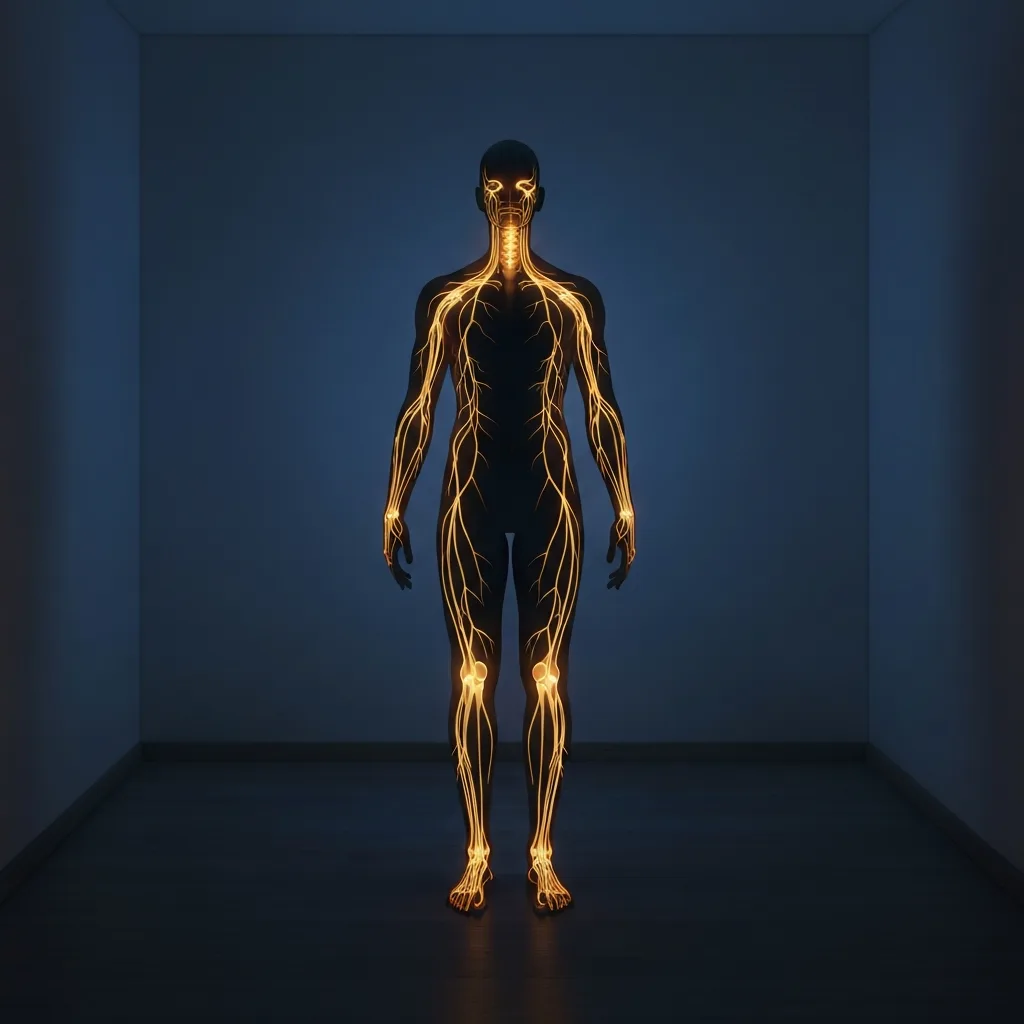
The Rupture of Somatic Trust
For those who have spent months or years navigating chronic anxiety, panic, or prolonged periods of high stress, the body ceases to be a home. Instead, it becomes a crime scene—a highly unpredictable environment where danger seems to lurk in every biological corner. This phenomenon represents a profound psychological rupture known as the loss of somatic trust. When you lose somatic trust, you no longer believe that your body is capable of keeping you safe. Every minor physiological fluctuation—a skipped heartbeat, a sudden wave of heat, a slight tightening of the chest—is immediately interpreted by the brain as an impending catastrophe. You begin to treat your own nervous system as a hostile entity that must be managed, monitored, and subdued.
Somatic trust is the foundational belief that your physiological sensations are data, not directives. It is the quiet, subconscious understanding that your heart rate will rise and fall, your breathing will shift, and your muscles will tense and relax, all without requiring your conscious intervention to prevent disaster. When prolonged anxiety erodes this baseline, you are thrust into a state of interoceptive hyper-vigilance. You become acutely aware of internal bodily processes that are meant to operate in the background of your consciousness. Rebuilding somatic trust is not about eliminating anxiety; it is about changing your relationship with your physical sensations so that distress no longer equates to danger.

The Mechanics of the Betrayal: Why Your Brain Turns Against Your Body
To understand how to rebuild somatic trust, you must first understand how it is broken. The brain is, at its core, a prediction machine. It relies on a process called interoception—the nervous system's ability to perceive, interpret, and integrate signals originating from within the body. In a healthy, regulated nervous system, the brain receives a signal (such as a flutter in the stomach) and correctly predicts its cause (too much coffee, or anticipation of an upcoming meeting). It registers the sensation as benign and moves on.
However, when you endure a prolonged state of survival mode, the brain’s prediction algorithms become distorted. The amygdala—the brain’s threat-detection center—becomes hyper-sensitized. It begins to issue “prediction errors.” Because the nervous system has been primed for danger, it starts interpreting entirely neutral physiological signals as evidence of a life-threatening crisis. A normal shift in digestion becomes the onset of a panic attack; a slight change in breathing cadence signals suffocation. Your brain effectively turns against your body, acting like a faulty smoke detector that triggers a five-alarm response every time you toast a piece of bread. This neurobiological misfiring is exhausting, entirely stripping you of your emotional bandwidth and trapping you in a self-perpetuating loop of fear.
The Trap of Somatic Micromanagement
The natural human response to this loss of trust is to attempt to seize control. If the body cannot be trusted to regulate itself, the conscious mind steps in to micromanage the process. This manifests as somatic checking: compulsively taking your pulse, manually controlling your breathing, scanning your muscles for tension, or constantly assessing your internal state to ensure you are “okay.”
This micromanagement is a psychological trap. In quantum physics, there is a concept known as the observer effect, which states that the mere act of observing a phenomenon inevitably changes it. The same principle applies to the human nervous system. When you hyper-focus your attention on an autonomous bodily function, such as your heart rate or your breathing, you introduce psychological friction. Your anxiety about your breathing actually causes your breathing to become shallow and erratic. Your hyper-fixation on your heart rate causes your heart to beat faster. The attempt to control the nervous system is precisely what dysregulates it. To rebuild somatic trust, you must gradually surrender this illusion of control and allow the body to do what it has evolved to do: self-regulate.
Rebuilding the Bridge: Strategies for Cultivating Somatic Trust
Restoring confidence in your nervous system is a slow, iterative process. It requires you to gently expose yourself to the sensations you fear while withholding the narrative of danger. Here is the architecture of rebuilding somatic trust.
1. Shift from Somatic Monitoring to Somatic Neutrality
When people try to heal from anxiety, they often try to force themselves to feel “good” or “calm.” This is an overcorrection that your nervous system will instantly reject. If you are in the middle of a high-anxiety state, demanding that your body feel relaxed will only create more internal pressure. Instead, aim for somatic neutrality. You do not have to love the sensation of a racing heart, but you must practice not pathologizing it. Neutrality sounds like: “My chest is tight right now. It is uncomfortable, but it is a normal physiological response. I do not need to fix it immediately.” By removing the moral judgment from the sensation, you strip the fear of its momentum.
2. Practice the Art of Pendulation
Developed by trauma expert Dr. Peter Levine, pendulation is a foundational somatic practice for rebuilding trust. When you feel a distressing sensation in your body, your instinct is either to dissociate from it entirely or to become entirely consumed by it. Pendulation offers a middle path. It involves consciously moving your attention back and forth between a localized area of distress and a localized area of safety or neutrality. For example, if you feel a heavy, anxious knot in your stomach, you allow yourself to feel it for a few seconds. Then, you intentionally shift your focus to a part of your body that feels completely fine—perhaps your right foot, or the tip of your nose. You rest your attention on the neutral zone, then gently swing your awareness back to the stomach. This teaches your nervous system that distress is not all-encompassing. It proves that safety and discomfort can coexist in the same body at the same time.
3. Decouple Sensation from the Narrative
Anxiety requires a storyline to survive. A physical sensation alone is rarely enough to sustain a panic attack; it is the catastrophic narrative attached to the sensation that fuels the fire. To rebuild somatic trust, you must rigorously separate the raw physical data from the psychological story. When a trigger occurs, practice speaking to yourself in strictly objective, biological terms. Instead of saying, “I am losing control and I am going to have a panic attack,” reframe it to, “I am experiencing an influx of adrenaline. My heart rate is elevated, and my palms are sweating.” By keeping your language clinical and descriptive, you prevent the cognitive fusion that turns a temporary wave of emotion into a psychological crisis. You become the observer of the weather, rather than the storm itself.
4. Reframe and Celebrate the Recovery Phase
One of the most overlooked aspects of building somatic trust is how you handle the comedown. Most people are so relieved when an anxiety spike ends that they immediately try to distract themselves and forget it happened. However, the moments immediately following the cessation of panic are the most critical for neuroplasticity. This is the parasympathetic return—the moment your body naturally decelerates. To build trust, you must consciously anchor your attention in this recovery phase. Notice the feeling of your heart rate slowing down. Notice the deepening of your breath. Acknowledge to yourself, “My body became highly activated, and then it brought itself back to baseline. It knows how to recover.” Trust is not built by never experiencing distress; it is built by surviving distress and witnessing your body’s inherent capacity to return to equilibrium.
The Long Game of Nervous System Reconciliation
Rebuilding somatic trust is not a linear journey. There will be days when the interoceptive alarms ring loudly, and the old habits of somatic micromanagement attempt to take over. When this happens, view it not as a regression, but as an opportunity to practice decoupling your identity from your physiology. Your nervous system is an ancient, highly evolved mechanism designed entirely for your survival. It has simply become confused by the abstract pressures of the modern world. By practicing somatic neutrality, pendulation, and objective observation, you slowly teach your brain that the body is not a battlefield. You begin to understand that you do not need to fight your physical sensations to find peace. Ultimately, true emotional balance is found the moment you realize that your body was never your enemy—it was simply waiting for you to feel safe enough to trust it again.
Do you enjoy the content on Agenda Creativa?
Your contributions help me create new articles, share creative ideas, and keep this platform alive! If you like what I do and want to support my work, you can buy us a coffee.
Every cup of coffee means more than just a gesture – it's direct support for my passion to create inspiring and useful content. Thank you for being part of this journey!
☕ Buy me a coffee