The Sneakiest Form of Self-Sabotage
You sit down at your desk with a clear objective: draft the quarterly strategic roadmap. It is the most critical project on your plate, the one that will dictate your team’s direction for the next three months. You open a blank document. The cursor blinks. And then, a thought intrudes: I should probably clear out my inbox first so I can focus without distractions.
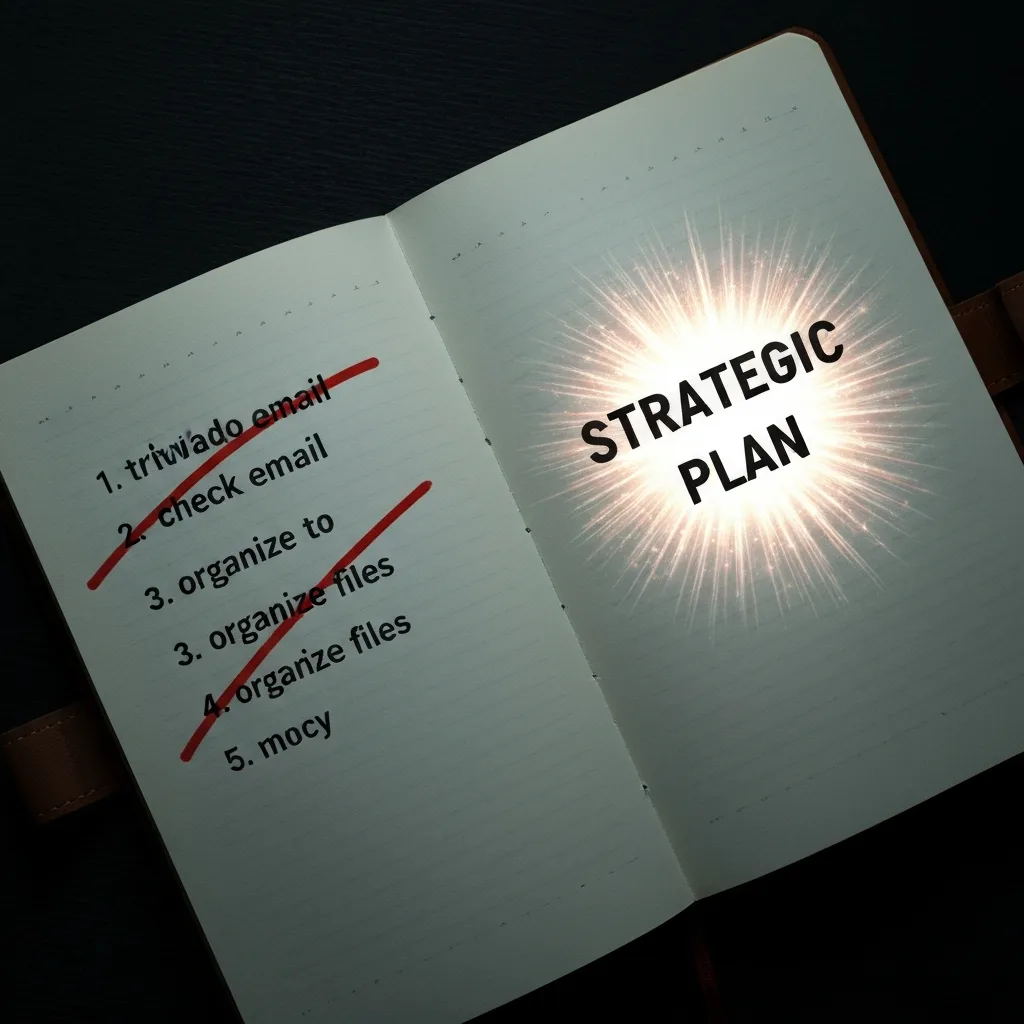
Two hours later, your inbox is pristine. You have responded to a dozen minor requests, organized your digital filing system, and even updated a tracking spreadsheet that nobody has looked at since last November. You feel a distinct sense of accomplishment. You were busy. You were working. But you have fallen victim to the most insidious trap in modern knowledge work: The Displacement Fallacy.
The Displacement Fallacy occurs when we substitute a high-leverage, cognitively demanding task with a low-leverage, easily executable task—and convince ourselves we are being productive. Unlike traditional procrastination, which involves obvious distractions like scrolling social media or watching television, displacement masquerades as legitimate work. It provides all the emotional rewards of productivity with none of the strategic progress.
The Architecture of Productive Procrastination
To understand why we displace important work, we have to examine the brain’s relationship with cognitive strain and ambiguity. Human beings are biologically wired to conserve energy. When faced with a heuristic task—a project with unclear boundaries, no obvious starting point, and a high risk of failure or frustration—the brain perceives a threat to its energy reserves.
In contrast, algorithmic tasks—like sorting emails, paying invoices, or rearranging a digital workspace—have clear rules, obvious endpoints, and a guaranteed dopamine hit upon completion. When you are staring down the barrel of a complex strategic initiative, the brain desperately looks for an off-ramp. Routine maintenance work provides the perfect escape route because it offers plausible deniability. If your manager asks what you did all morning, or if you ask yourself, you can point to a tangible list of completed chores.
This is why the Displacement Fallacy is far more dangerous than outright laziness. When you spend two hours watching videos instead of working, guilt eventually forces you back to the task at hand. The friction of your own conscience acts as a corrective mechanism. But when you spend two hours doing low-value administrative work, the guilt is neutralized by a false sense of efficiency. You end the day exhausted, having checked twenty boxes, yet your most critical project remains entirely untouched.
The Ambiguity Aversion and the Illusion of Velocity
The root cause of displacement is rarely a lack of discipline; it is almost always an aversion to ambiguity. High-leverage work is inherently messy. Writing a book, coding a new software architecture, or designing a marketing campaign requires you to navigate a period of intense uncertainty. You have to make decisions without complete information, and you have to tolerate the discomfort of producing a terrible first draft.
Rather than sitting with that discomfort, we pivot to tasks where the outcome is guaranteed. This creates the illusion of velocity. You feel like you are moving fast, but you are moving horizontally, not vertically. You are optimizing the sails while the hull of the ship is leaking.
Over time, chronic displacement leads to a specific type of career stagnation. You become known as a highly reliable operator who handles the day-to-day minutiae flawlessly, but you fail to produce the deep, transformative work that drives real growth. You are constantly busy, yet perpetually behind on the things that actually matter.
How to Engineer Priority Anchoring
Breaking free from the Displacement Fallacy requires a structural shift in how you approach your daily workflow. You cannot rely on willpower to force yourself into deep work; the brain’s craving for easy wins is too strong. Instead, you must engineer an environment that anchors your attention to high-leverage tasks and structurally prevents productive procrastination. Here is how to build that system.
1. The Ambiguity Audit
Because ambiguity is the primary trigger for displacement, your first line of defense is to eliminate it. When a task feels too large or undefined, your brain will reject it. Before you attempt to execute a high-leverage project, perform an Ambiguity Audit.
Break the project down until the next physical action is ridiculously small and entirely algorithmic. Do not put “Draft Strategy Report” on your to-do list. That is a heuristic trap. Instead, write down: “Open a new document and outline the three main headers.” By reducing the cognitive threshold required to start, you strip the brain of its excuse to flee toward easier administrative tasks.
2. The First-Hour Firewall
The most effective way to defeat displacement is to quarantine your low-value tasks. Implement a strict First-Hour Firewall: for the first sixty minutes of your workday, you are categorically forbidden from doing maintenance work. No email, no Slack, no organizing files, no checking metrics.
By removing the option to do easy work, you force yourself to confront the hard work. Even if you spend the first twenty minutes staring at a blank screen, you are building the cognitive endurance required to tackle high-leverage projects. Once the first hour is complete, you can open the gates and allow the routine tasks in, but only after you have secured your strategic beachhead for the day.
3. The “Ugly Draft” Exemption
Perfectionism is the engine that drives displacement. If you believe that your initial output must be flawless, the pressure will push you toward tasks where perfection is easily attainable—like organizing your desktop folders. To counter this, grant yourself an explicit “Ugly Draft” Exemption.
Commit to producing something terrible. Tell yourself that the only goal for the next forty-five minutes is to generate raw, unpolished, embarrassing material. By intentionally lowering the stakes, you bypass the amygdala’s threat response. You remove the fear of failure, which in turn removes the need to procrastinate by doing easier work. You can always edit bad work; you cannot edit a blank page.
4. Segregating Maintenance from Creation
Displacement thrives in environments where creation and maintenance are allowed to co-exist on the same to-do list. If “Write Chapter 4” and “Pay Internet Bill” are sitting next to each other, your brain will choose the bill every time. To prevent this, you must physically and temporally segregate these two modes of work.
Create two separate lists and assign them to different phases of your day. Dedicate your peak energy hours—usually the morning for most people—strictly to creation and high-leverage problem-solving. Relegate all maintenance, administrative, and organizational tasks to a specific time block in the late afternoon, when your cognitive reserves are naturally depleted. When you strip the easy tasks from your morning environment, displacement becomes impossible.
Reclaiming Your Cognitive Leverage
The modern workplace is a factory for displacement. We are surrounded by endless streams of shallow demands that beg for our immediate attention, offering the seductive promise of feeling productive without the heavy lifting of actually being productive. Recognizing the Displacement Fallacy is the first step toward reclaiming your cognitive leverage.
True productivity is not about the volume of tasks you complete; it is about the trajectory of the tasks you choose to engage with. It requires the courage to let minor fires burn while you focus on building something that lasts. By auditing ambiguity, protecting your first hour, lowering your barrier to entry, and segregating your work modes, you can stop using motion as a shield against action. You can finally anchor your focus on the work that moves the needle, leaving the illusion of velocity behind for the reality of progress.
Do you enjoy the content on Agenda Creativa?
Your contributions help me create new articles, share creative ideas, and keep this platform alive! If you like what I do and want to support my work, you can buy us a coffee.
Every cup of coffee means more than just a gesture – it's direct support for my passion to create inspiring and useful content. Thank you for being part of this journey!
☕ Buy me a coffee