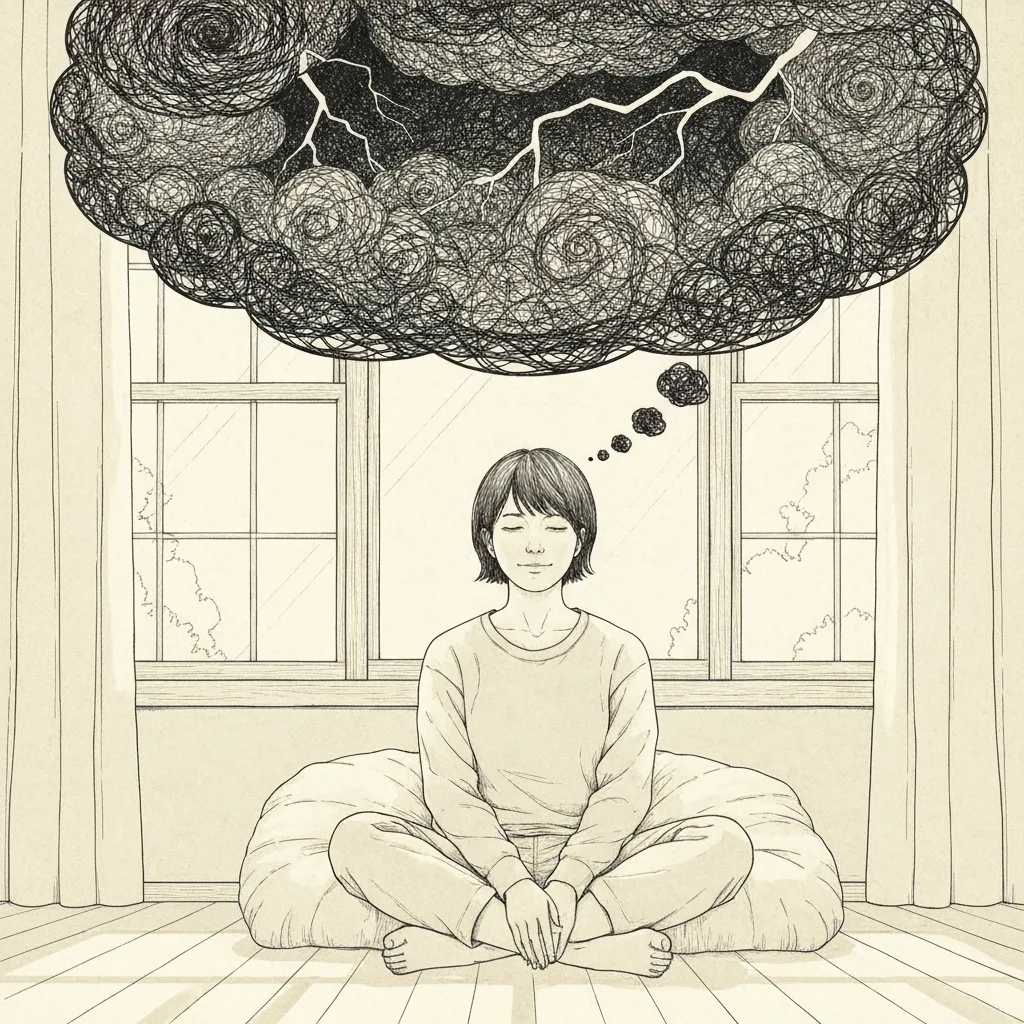
The Trap of Preemptive Coping
You are lying in bed, staring at the ceiling, mentally scripting a conversation that has not yet happened. You anticipate the other person’s objections, formulate your counterarguments, and imagine the sting of their hypothetical rejection. You tell yourself you are simply preparing. If you can map out every possible disaster, you will not be caught off guard. You will be safe.
This is the trap of preemptive coping. It is a psychological mechanism where we attempt to manage future anxiety by mentally rehearsing worst-case scenarios. On the surface, it masquerades as productive problem-solving. We live in a culture that rewards foresight and risk mitigation, so we naturally apply these corporate strategies to our emotional lives. However, when applied to psychological distress, preemptive coping does not insulate you from pain. Instead, it guarantees that you experience the distress multiple times, bankrupting your present-moment emotional reserves for a future that rarely unfolds as you imagined.

The Neuroscience of Mental Rehearsal
To understand why preemptive coping is so destructive, we have to look at how the brain processes imagination versus reality. The human brain is essentially a sophisticated prediction engine. It constantly simulates future environments to ensure survival. But there is a fundamental flaw in this evolutionary hardware: your nervous system struggles to differentiate between a vividly imagined threat and a physical, present-moment danger.
When you mentally rehearse a catastrophic outcome—whether it is a breakup, a financial crisis, or a public failure—your amygdala, the brain’s threat detection center, sounds the alarm. It signals your adrenal glands to release cortisol and adrenaline. Your heart rate variability drops, your breathing becomes shallow, and your digestive system slows down.
You are sitting safely in your living room, but your biology is reacting as if you are actively under attack. By engaging in preemptive coping, you are not deferring the stress until the event happens. You are importing the stress of a hypothetical future directly into your present reality. You are paying a heavy physiological tax on a scenario that does not actually exist.
The Illusion of Control and Uncertainty Intolerance
Why do we subject ourselves to this mental torture? The root cause is rarely a desire to suffer; rather, it is a profound intolerance for uncertainty. The human brain despises ambiguity. An unpredictable environment is historically a dangerous environment. To our primitive wiring, knowing that something bad will happen feels safer than not knowing what will happen at all.
Preemptive coping offers a mirage of control. We subconsciously believe that if we worry enough about an outcome, we are somehow managing it. It functions almost like a superstitious behavior. If we expect the worst, we feel protected against the shock of disappointment. We trade the peace of the present moment for a false sense of preparedness.
The irony is that this chronic anticipation actually degrades your ability to handle real crises. When you keep your nervous system in a state of hyper-arousal, you deplete the very cognitive resources—like executive functioning, emotional regulation, and cognitive flexibility—that you need to navigate difficult situations. When an actual challenge arises, you are already exhausted from fighting phantom battles.
Differentiating Preparation from Preemptive Coping
A common defense of preemptive coping is the necessity of planning. How do we distinguish between healthy foresight and toxic mental rehearsal? The difference lies in utility, finality, and physiological response.
Healthy preparation is concrete, actionable, and finite. It focuses on variables within your control. For example, packing an emergency kit in your car, researching a company before an interview, or outlining talking points for a difficult conversation. Once the action is completed, the mental loop closes. You have done what you can, and your nervous system returns to baseline.
Preemptive coping, conversely, is abstract, uncontrollable, and infinite. It fixates on variables you cannot influence, such as other people’s reactions, systemic failures, or sheer bad luck. Because you cannot control these factors, the mental loop never closes. The rumination feeds on itself, generating increasingly improbable and catastrophic simulated scenarios. If your mental rehearsal does not lead to a concrete action that you can execute immediately, you are no longer planning. You are simply suffering in advance.
The Cost of Chronic Hyper-Arousal
The long-term consequence of this chronic hyper-arousal is a high allostatic load. Allostatic load refers to the cumulative wear and tear on the body and brain caused by repeated exposure to stress hormones. When you constantly engage in preemptive coping, your baseline for anxiety shifts upward. Your nervous system becomes sensitized, meaning it takes progressively smaller triggers to send you into a full fight-or-flight response. This chronic emotional exhaustion leaves you depleted. You lose access to the subtle joys of daily life because your cognitive bandwidth is entirely consumed by managing a future that remains stubbornly out of reach.
Consider the difference between preparing for a medical test and preemptively coping with the results. Preparation involves scheduling the appointment, arranging transportation, and fasting if required. Preemptive coping involves spending the three days prior searching symptoms online, imagining the diagnosis, and mourning a future that has not yet been written. The former protects your health; the latter destroys your peace.
Strategies to Dismantle the Preemptive Coping Trap
Breaking the habit of preemptive coping requires a conscious rewiring of how you relate to your thoughts and your future. It demands a shift from trying to control the uncontrollable to building resilience for the unknown. Here are actionable psychological strategies to decouple from this trap.
1. The Practice of Cognitive Defusion
When you are caught in a preemptive coping cycle, you are fused with your thoughts. You treat the imagined disaster as an absolute fact. Cognitive defusion is a technique used in Acceptance and Commitment Therapy to create psychological distance between you and your mental narratives.
Instead of getting swept away by the thought, I am going to lose my job and go bankrupt, you reframe it by adding a descriptive prefix: I am having the thought that I am going to lose my job. This subtle linguistic shift moves you from the role of a participant in the disaster to the role of an observer of your own mind. It reminds your brain that thoughts are not prophecies; they are merely temporary neurological events.
2. Shifting from the Default Mode to the Task-Positive Network
Preemptive coping typically occurs when the brain is idling, activating the Default Mode Network. This network is responsible for mind-wandering, past-future time travel, and self-referential thought. To break the rumination cycle, you must force a neurological gear shift into the Task-Positive Network, which governs present-moment focus and action.
You can trigger this shift by engaging in activities that require immediate sensory attention or cognitive load. This is why grounding exercises work. Naming five things you can see, four you can touch, and three you can hear forces the brain to process real-time sensory data, pulling energy away from catastrophic simulations. Physical movement, complex puzzles, or even intense temperature changes can effectively interrupt the preemptive coping loop.
3. Establishing Scheduled Worry Windows
Telling yourself to simply stop worrying rarely works; it usually causes the anxiety to rebound with greater intensity. Instead of suppressing the preemptive coping, contain it. Establish a strict, scheduled worry window of fifteen minutes each day, preferably not close to bedtime.
When the urge to mentally rehearse a disaster arises outside of this window, acknowledge it and defer it. Tell yourself that you see this is a potential problem, but you are not going to process it until your scheduled time. When your worry window arrives, write down every worst-case scenario. When the fifteen minutes are up, close the notebook and physically walk away. This trains your brain to understand that anxiety does not get unrestricted access to your psychological real estate.
4. Cultivating Radical Future-Self Trust
The ultimate antidote to preemptive coping is trusting your future self. When you rehearse a disaster, you are making two false assumptions: first, that the worst-case scenario will definitively happen, and second, that you will be entirely incapable of handling it.
Look at your historical data. You have survived every single one of your bad days. You have navigated rejections, failures, and unexpected crises that you never could have anticipated or prepared for. You handled them because, in the moment, you had access to resources, adrenaline, and clarity that you do not have right now while lying in bed.
Reclaiming Your Psychological Autonomy
You do not need to pre-solve every potential problem because your future self is highly capable of managing reality as it unfolds. True emotional balance is not found in eliminating uncertainty. It is found in the quiet confidence that whatever the future brings, you will have the psychological agility to meet it when it arrives, not a moment sooner.
Reclaiming your psychological autonomy requires recognizing preemptive coping for what it is: a defense mechanism that has outlived its usefulness. You cannot control the future by worrying about it, but you can destroy the present by refusing to live in it. By practicing cognitive defusion, containing your worry, and shifting into your task-positive network, you can slowly teach your nervous system that it is safe to put down the shield. You can learn to stand in the ambiguity of the unknown, trusting that you are strong enough to face reality, but only when it actually asks to be faced.
Do you enjoy the content on Agenda Creativa?
Your contributions help me create new articles, share creative ideas, and keep this platform alive! If you like what I do and want to support my work, you can buy us a coffee.
Every cup of coffee means more than just a gesture – it's direct support for my passion to create inspiring and useful content. Thank you for being part of this journey!
☕ Buy me a coffee