
Have you ever hit send on a carefully crafted project update, only to experience a sudden wave of deja vu? You realize, with a sinking feeling, that you wrote almost the exact same message three weeks ago. You spent twenty minutes formatting bullet points, hunting down links, and adjusting the tone, completely forgetting that the exact asset you needed was already buried in your sent folder. This is not just a minor lapse in memory; it is a symptom of a systemic flaw in how modern professionals operate. We are hemorrhaging time and cognitive bandwidth by treating repetitive tasks as unique, bespoke events.
In the manufacturing world, reinventing the wheel for every single product would be considered operational malpractice. Yet, in knowledge work, we do exactly this on a daily basis. We draft emails from scratch. We build weekly reporting spreadsheets from a blank grid. We design presentation decks by staring at a white slide. We operate under the illusion that because our work requires intellect, it must also require continuous, original creation. This mindset is a trap. It drains your executive function on low-leverage formatting and phrasing, leaving you depleted when it is time to do actual deep, strategic work.
The solution is a radical shift in how you view your output. You must transition from a craftsman mindset—where every task is a custom build—to an engineering mindset. This is the foundation of the Modularity Principle: the intentional practice of extracting, refining, and storing the components of your work so they can be reused, assembled, and deployed at scale.
The Bespoke Work Fallacy
Why do we default to starting from scratch? The answer lies in a psychological quirk known as the Bespoke Work Fallacy. When we face a new task, even a familiar one, our brains perceive the slight variations in context as a demand for a completely new approach. If an angry client needs a response, we focus on the specific nuances of their anger rather than the structural reality that 80 percent of client de-escalation emails follow the exact same psychological framework.
Furthermore, starting from a blank page feels deceptively productive. The act of typing out pleasantries, formatting headers, and organizing initial thoughts provides an immediate dopamine hit of ‘doing work.’ However, this is largely performative motion. It is the equivalent of a chef chopping new vegetables for a soup when they already have a perfectly prepped mirepoix sitting in the refrigerator. By succumbing to the Bespoke Work Fallacy, you are not just wasting time; you are introducing unnecessary variability and potential for error into your baseline operations.
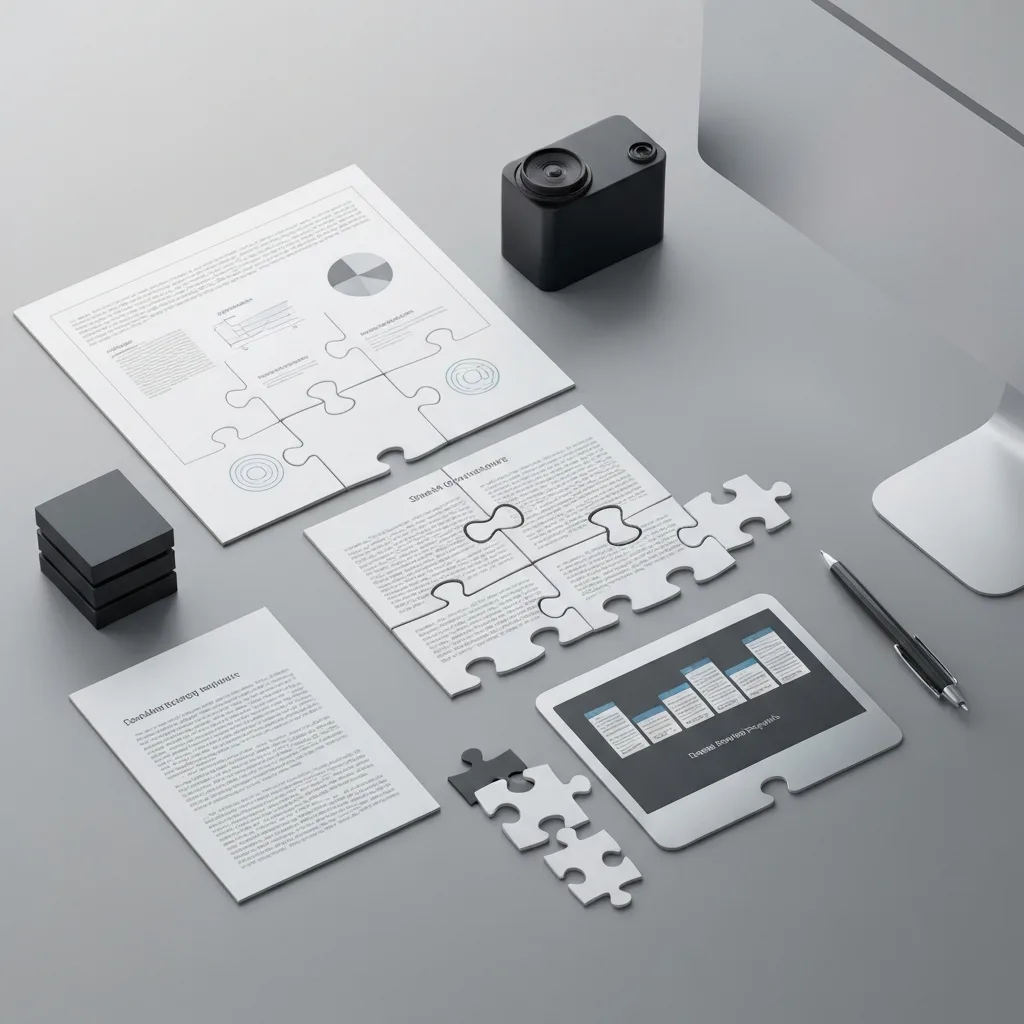
Borrowing from Software Engineering: The DRY Principle
To master workflow modularity, we must look to the discipline of software engineering. Programmers operate by a core tenet known as DRY: Don't Repeat Yourself. If a developer finds themselves writing the same block of code multiple times, they immediately stop, extract that code, turn it into a reusable function, and call upon that function whenever needed. They build libraries of these functions, creating an infrastructure that allows them to build complex software rapidly.
Knowledge workers must adopt an identical approach. Your emails, project plans, meeting agendas, and client briefs are your code. Every time you type out a routine response or build a standard document, you are violating the DRY principle. By applying this concept to your daily operations, you stop being a manual laborer of information and become an architect of systems. You build a personal library of ‘functions’—reusable work assets—that can be deployed in seconds.
The Three Tiers of Reusable Work Assets
Transitioning to a modular workflow requires categorizing your tasks and identifying where leverage can be applied. A robust personal asset library is built across three distinct tiers of complexity, ranging from micro-interactions to macro-operations.
Tier 1: Micro-Assets (Snippets and Syntax)
Micro-assets are the smallest units of your workflow. These are the phrases, links, and short paragraphs you use constantly but rarely notice. Think of the directions to your office, your standard bio for speaking engagements, the polite decline to a vendor pitch, or the two-sentence explanation of your company’s pricing model.
Relying on your memory or your ‘Sent’ folder to retrieve these micro-assets is a massive friction point. Instead, these should be codified into a text expansion tool or a dedicated quick-reference document. By assigning a short keyboard trigger to a long block of text, you eliminate the typing and the cognitive load required to remember the exact phrasing. Over a year, saving three minutes, five times a day on micro-assets reclaims over a full workweek of pure time.
Tier 2: Meso-Assets (Templates and Frameworks)
Meso-assets govern the structure of your recurring deliverables. If you lead a weekly team meeting, write a monthly performance report, or draft project kickoff briefs, you are dealing with meso-level tasks. The trap here is copying last month’s document, deleting the old data, and typing in the new data. This method is highly prone to human error—we have all accidentally left an old client’s name in a new proposal.
A true meso-asset is a sanitized, master template. It contains the exact formatting, headers, and structural flow required, with clear placeholders for the variable data. By separating the structure (the template) from the content (the specific data for this week), you create a frictionless starting line. You never have to wonder how to organize the information; you simply fill in the blanks. This dramatically reduces the activation energy required to start a demanding task.
Tier 3: Macro-Assets (Standard Operating Procedures)
The highest tier of modularity involves process itself. Macro-assets are the step-by-step checklists and Standard Operating Procedures (SOPs) for complex, multi-stage workflows. Examples include onboarding a new employee, launching a marketing campaign, or conducting a quarterly financial audit. These are high-stakes operations where missed steps lead to catastrophic bottlenecks.
When you build a macro-asset, you are essentially offloading your operational memory into a system. You document the exact sequence of events, the tools required, and the specific people who need to be notified at each stage. This not only ensures flawless execution when you perform the task, but it also creates the ultimate leverage: delegability. You cannot effectively hand off a project if the instructions live exclusively in your head. Macro-assets transform your personal expertise into a transferable company asset.
The ‘Extract as You Go’ Implementation Strategy
The most common failure point when adopting the Modularity Principle is attempting to build the entire library at once. Blocking out a Friday afternoon to ‘create all my templates’ is a guaranteed recipe for burnout and abandoned systems. You cannot predict exactly what you will need, and you will end up building assets for scenarios that never occur.
Instead, employ the ‘Extract as You Go’ strategy, governed by the Rule of Two. The first time you perform a task, do it manually. The second time you perform that exact same task, pause. This is your trigger. Before you complete the task, extract the skeleton. Strip away the specific details, save the structure in your asset library, and then finish the task.
This passive accumulation requires almost zero extra time. You are simply capturing the exhaust of your daily workflow and recycling it into infrastructure. Within a month, you will naturally build a highly relevant, battle-tested library of templates that perfectly map to your actual responsibilities, not your theoretical ones.
Overcoming the ‘Creative Exception’ Illusion
A frequent objection to modularity is the belief that structure kills creativity. Professionals in design, writing, or strategic planning often argue that their work is too fluid to be templated. This is a fundamental misunderstanding of how cognitive bandwidth operates.
Templates do not replace creativity; they protect it. By automating and standardizing the administrative, structural, and repetitive aspects of your work, you drastically reduce your cognitive overhead. If you do not have to spend mental energy worrying about the font size of a presentation or the phrasing of a transition slide, you have exponentially more energy to dedicate to the actual narrative, strategy, and creative problem-solving. Modularity handles the mundane so your mind can handle the complex.
The Compounding Returns of Systematized Output
Implementing the Modularity Principle is an investment in your future capacity. In the short term, extracting a template might cost you an extra sixty seconds. In the long term, that asset will pay dividends every single time you encounter a similar task.
As your library of micro, meso, and macro-assets grows, you will experience a profound shift in your daily rhythm. Tasks that used to take an hour will take twelve minutes. Projects that felt overwhelming will be reduced to a series of simple, pre-defined steps. You will stop duplicating your own effort, eliminate the friction of starting, and finally reclaim your time for the high-impact, deep work that actually moves the needle. Stop reinventing the wheel, and start building the factory.
Do you enjoy the content on Agenda Creativa?
Your contributions help me create new articles, share creative ideas, and keep this platform alive! If you like what I do and want to support my work, you can buy us a coffee.
Every cup of coffee means more than just a gesture – it's direct support for my passion to create inspiring and useful content. Thank you for being part of this journey!
☕ Buy me a coffee