
The Allure of the Perfect Calendar
There is a distinct, almost intoxicating satisfaction that comes from mapping out your workday in perfect, color-coded precision. During a Sunday evening planning session, you might drag and drop neat little blocks into your digital calendar, assigning exactly fifteen minutes to email, forty-five minutes to drafting a report, thirty minutes to a team sync, and ten minutes to reviewing notes. On screen, it looks like the ultimate blueprint for a highly productive, perfectly optimized day.
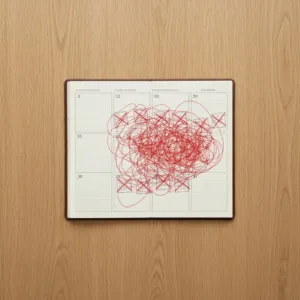
Then Monday morning arrives. Your first task takes twenty-five minutes instead of fifteen. A client calls with an urgent question. By 10:15 AM, your pristine schedule is entirely derailed, and you spend the rest of the day feeling chronically behind, rushing through tasks to catch up to a timeline that no longer reflects reality.
This is the Granularity Trap. It is the false assumption that a higher level of detail in your planning equates to a higher level of output in your execution. In reality, hyper-scheduling creates an incredibly fragile workflow. When you slice your day into highly granular increments, you are not managing your time—you are building a glass structure that will shatter at the first sign of friction. To sustain long-term output and maintain your sanity, you must abandon the rigid micro-schedule and learn to build an elastic day.

The Anatomy of the Granularity Trap
The Granularity Trap is rooted in an attempt to manage anxiety rather than manage time. When faced with a massive, ambiguous workload, the human brain seeks control. By breaking the day down to the minute, we create a psychological safety net. It feels productive to plan because it provides a temporary sense of order.
However, this approach fundamentally misunderstands the nature of knowledge work. Unlike an assembly line, where mechanical processes take a highly predictable amount of time, cognitive tasks are inherently variable. A coding problem might take ten minutes or three hours. A piece of copywriting might flow effortlessly or require intense, prolonged revision. When you force variable cognitive tasks into fixed, granular time slots, you introduce severe structural flaws into your day.
The Domino Effect of Micro-Delays
The most immediate consequence of the Granularity Trap is the domino effect. In a tightly packed schedule, events are interdependent. If task A runs over by just twelve minutes, task B is pushed back. If task B requires its full allotted time, task C is delayed. Because there is no slack in the system, a single, minor miscalculation cascades through your entire afternoon.
This cascade does more than just ruin your timeline; it exacts a heavy cognitive toll. When your schedule breaks, your executive function is forced to work overtime. Instead of focusing on the task at hand, your brain is simultaneously trying to recalculate the rest of the day. You end up spending mental energy continuously renegotiating your commitments rather than actually executing the work.
The Planning Fallacy Multiplier
Psychologists have long documented the Planning Fallacy—our inherent cognitive bias that causes us to underestimate the time it will take to complete a future task. We consistently plan for the best-case scenario, ignoring historical data that suggests delays are inevitable.
The Granularity Trap takes the Planning Fallacy and multiplies it. If you have three broad tasks scheduled for the day, you have three opportunities to underestimate your time. If you have twenty micro-tasks scheduled in strict increments, you have twenty opportunities to be wrong. The more granular your schedule, the higher your margin of error, and the more likely your day is to fail.
The Alternative: Building an Elastic Day
If micro-scheduling is the equivalent of building a rigid glass tower, elastic scheduling is the equivalent of building a suspension bridge. It is designed to sway, flex, and absorb the shocks of reality without breaking.
An elastic day abandons the obsession with timestamps and focuses instead on sequencing, energy management, and broad thematic windows. The goal is to create a structure that provides clear direction but retains enough fluidity to handle the unpredictable nature of actual work.
Step 1: Define Your Hard Anchors
The first step in building an elastic schedule is separating your hard commitments from your soft work. Hard anchors are events that involve other people and require a fixed time—meetings, client calls, medical appointments, or picking up your children. These are the only items that belong on your calendar with specific start and end times.
Everything else—writing, coding, designing, researching, answering emails—is soft work. Soft work should never be bound by rigid timestamps. Once your hard anchors are set, the empty space between them becomes your elastic work windows.
Step 2: Establish Thematic Blocks
Instead of assigning a specific task to a specific hour (e.g., ‘Draft project proposal from 9:00 to 10:15’), categorize the open spaces in your day into broad thematic blocks. A common and highly effective structure divides the day into three primary modes:
Deep Work Blocks: Large, uninterrupted windows dedicated to high-concentration tasks. These blocks require heavy cognitive lifting and should ideally be scheduled during your peak energy hours. You do not dictate exactly which task will take exactly how long; you simply commit to pulling from your high-priority task pool during this window.
Shallow Work Blocks: Windows dedicated to administrative tasks, email processing, Slack replies, and routine maintenance. These tasks are necessary but do not require deep focus. Grouping them into a specific block prevents them from bleeding into your deep work time.
Buffer Blocks: Intentional white space built into the day. This is the crucial element that micro-schedulers miss.
Step 3: Engineer Expansion Joints
In structural engineering, expansion joints are gaps built into bridges and railways that allow materials to expand and contract with temperature changes. Without these joints, the structure would buckle under pressure.
Your schedule requires cognitive expansion joints. You must intentionally design empty space into your day to absorb the inevitable overruns of your tasks. If you expect a deep work session to take two hours, block off two and a half. If an anchor meeting is scheduled to end at 1:00 PM, do not schedule your next focused block to begin until 1:30 PM.
This empty space is not wasted time; it is the shock absorber that protects your workflow. If a task runs long, the expansion joint absorbs the delay, preventing the domino effect. If a task finishes on time, you suddenly have a brief window to decompress, step away from your screen, or process a quick administrative item without feeling rushed.
Implementing the Task Pool Method
With your day structured into elastic blocks rather than rigid increments, how do you actually decide what to work on? This is where the Task Pool method replaces the micro-schedule.
Instead of pinning tasks to the clock, create a small, curated pool of tasks for the day. Select three to five critical items that must be completed. When you enter a Deep Work block, you pull the most important item from the pool and begin working. You work until the task is complete, or until the block ends—whichever comes first.
If you finish the task earlier than expected, you do not need to wait for the next rigid time slot to begin. You simply pull the next item from the pool. If the task takes longer than expected, you do not experience the anxiety of a broken schedule. You simply continue working within your elastic window, knowing that your expansion joints will absorb the overflow.
This method aligns perfectly with human psychology. It provides the clear direction and prioritization necessary to execute, but it removes the artificial constraints that cause frustration and burnout. You are guided by the priority of the work, not the arbitrary ticking of the clock.
Redefining Productivity
The shift away from hyper-scheduling requires a fundamental change in how you define productivity. If you measure your success by how perfectly you adhered to a predetermined timeline, an elastic schedule will initially feel chaotic. You must recalibrate your metrics.
True productivity is not about packing the maximum number of tasks into the minimum amount of time. It is about consistently executing your highest-leverage work at a high level of quality. A brittle, micro-scheduled day might make you feel busy, but it rarely results in sustained, meaningful output. It leaves you exhausted, reactive, and constantly playing catch-up.
By abandoning the Granularity Trap, you accept the reality of cognitive work. You acknowledge that your energy will fluctuate, that tasks will take longer than anticipated, and that friction is inevitable. An elastic schedule does not attempt to fight this reality; it is designed to absorb it. When you stop trying to control every minute, you finally gain control over your actual output.



Do you enjoy the content on Agenda Creativa?
Your contributions help me create new articles, share creative ideas, and keep this platform alive! If you like what I do and want to support my work, you can buy us a coffee.
Every cup of coffee means more than just a gesture – it's direct support for my passion to create inspiring and useful content. Thank you for being part of this journey!
☕ Buy me a coffee