
The Passive Contract of Traditional Reading
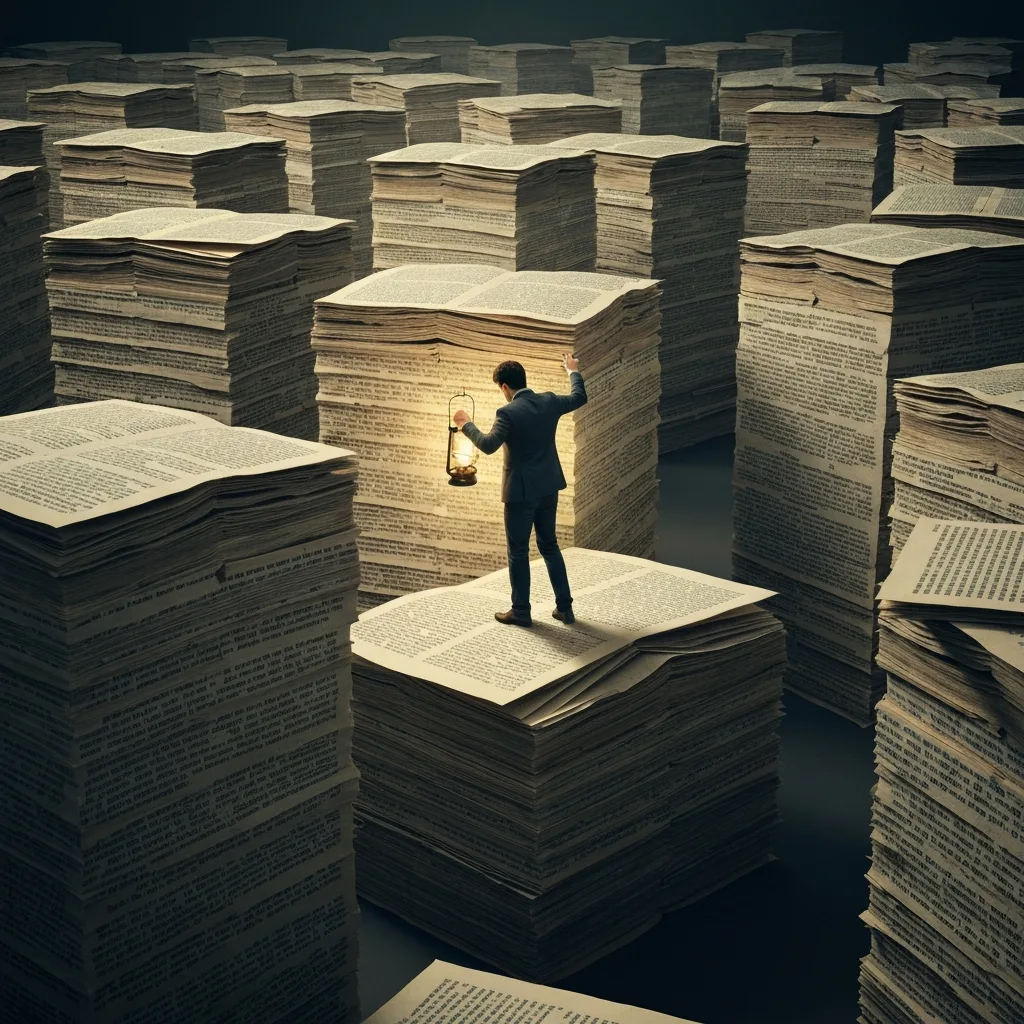
Most books ask only one thing of you: turn the page. You start at the top left, read to the bottom right, and repeat the process until the narrative concludes. It is a comfortable, well-established contract between author and audience. The author provides the narrative, and the reader absorbs it in a linear, passive sequence. But there is a rogue category of fiction that outright rejects this dynamic. It demands labor. It forces you to flip the physical book upside down, follow footnotes that lead to dead ends, decipher handwritten marginalia, and navigate the text as if wandering through a hostile maze. This is the realm of ergodic literature.
Coined in 1997 by cybertext theorist Espen J. Aarseth, the term “ergodic” derives from the Greek words ergon (work) and hodos (path). Aarseth defined it as literature where “nontrivial effort is required to allow the reader to traverse the text.” In traditional fiction, the effort is purely cognitive—you imagine the characters and parse the themes. In ergodic literature, the effort is physical, spatial, and structural. The book ceases to be a mere vessel for a story and becomes an active participant in the narrative, challenging the reader to solve the architecture of the page itself.
The Ancestors of the Labyrinthine Text
While the term was coined in the late 1990s, the concept of forcing readers to struggle with the physical format of a book is centuries old. Long before modern typographical software made experimental layouts easy to produce, authors were finding ways to disrupt the reading experience.
Laurence Sterne’s The Life and Opinions of Tristram Shandy, Gentleman, published in the mid-18th century, is widely considered one of the earliest examples of ergodic fiction. Sterne gleefully broke the rules of narrative structure, inserting completely black pages to mourn a character’s death, marbled pages to represent the chaotic nature of the text, and missing chapters that force the reader to accept massive gaps in the timeline. Sterne understood that the physical form of the book could communicate emotion and tone just as effectively as the words printed within it.
In the 20th century, Vladimir Nabokov pushed the boundary further with Pale Fire. Presented as a 999-line poem written by a fictional murdered poet, the bulk of the novel actually resides in the sprawling, unhinged footnotes provided by the poet’s neighbor and academic editor, Charles Kinbote. To read Pale Fire is to constantly flip back and forth between the poem and the index, piecing together a psychological thriller hidden entirely within academic formatting. The reader is forced into the role of a detective, sifting through the unreliable narrator's commentary to find the truth.
The Dictionary as a Narrative Device
Another monumental precursor to modern ergodic texts is Milorad Pavić’s Dictionary of the Khazars. Formatted literally as an encyclopedic dictionary, the book offers three distinct, often contradictory accounts of a historical event (the conversion of the Khazar people) from Christian, Islamic, and Jewish perspectives. There is no beginning, middle, or end. The reader is invited to start at any entry and follow cross-references, building their own unique path through the narrative. By structuring the novel as a reference book, Pavić dismantled the authority of the author, handing the pacing and sequence entirely over to the reader.
Mark Z. Danielewski and the Modern Masterpiece
If Sterne and Nabokov laid the foundation, Mark Z. Danielewski built the cathedral. Published in 2000, House of Leaves is the undisputed heavyweight champion of modern ergodic literature. The novel is ostensibly about a family who discovers that the internal dimensions of their house are larger than the external dimensions. As a dark, freezing labyrinth opens up in their living room, the formatting of the book mimics the psychological breakdown of the characters and the physical impossible geometry of the house.
Danielewski uses typography as a tool for inducing claustrophobia and panic. When characters are crawling through tight, suffocating spaces, the text on the page shrinks to a single word per page, forcing the reader to frantically flip through the book to keep up with the action. When characters are lost in sprawling, chaotic rooms, the text scatters in multiple directions, requiring the reader to rotate the book 360 degrees just to parse a single sentence. There are footnotes nested within footnotes, some of which require a mirror to read, and others that reference fake academic journals or musical compositions.
The Psychological Impact of Typographical Disruption
What makes House of Leaves so enduring is that its ergodic elements are never just gimmicks; they are deeply tied to the emotional core of the story. The physical exhaustion the reader feels while navigating the dense, heavily footnoted chapters mirrors the exhaustion of the protagonist trying to map an unmappable house. By making the act of reading difficult, Danielewski bridges the emotional gap between character and reader. You are not just reading about someone losing their mind in a maze; you are losing your own spatial awareness in a maze of paper and ink.
Pushing Boundaries: Ship of Theseus and the Tangible Book
As the digital age accelerated, and e-readers threatened to render the physical book obsolete, a counter-movement emerged. Authors and designers began creating books that simply could not be translated to a screen. The most ambitious of these projects is S., conceived by filmmaker J.J. Abrams and written by Doug Dorst.
When you purchase S., you receive a slipcase containing what appears to be a heavily weathered library book titled Ship of Theseus by a mysterious author named V.M. Straka. But the printed story is only half the narrative. The margins of the book are filled with handwritten conversations between two college students who are passing the book back and forth, trying to solve the mystery of the author’s identity.
To complicate matters further, the physical book is stuffed with real-world ephemera. Tucked between the pages are actual postcards, photocopied maps, telegrams, photographs, and even a personalized napkin from a coffee shop. Reading S. requires you to manage these physical objects, carefully pulling them out to examine them and placing them back in their correct locations. It is a tactile, multi-layered experience that turns reading into an act of physical curation.
The Rebellion Against Digital Homogeneity
The rise of books like S. represents a fascinating rebellion against digital homogeneity. An e-reader offers convenience—thousands of books in a lightweight device, all presented in the exact same uniform font and layout. But this convenience strips the book of its identity as an artifact. Ergodic literature reclaims the physical object. It argues that the medium is part of the message, and that the weight, texture, and layout of paper can convey meaning that a sterile digital screen cannot.
Why We Crave Difficult Reading
In an era defined by frictionless user experiences, infinite scrolling, and instant gratification, the appeal of ergodic literature might seem counterintuitive. Why would we willingly subject ourselves to a book that frustrates us? Why do we want a narrative that hides its secrets behind ciphers, dead ends, and physical manipulation?
The answer lies in the psychological satisfaction of the puzzle. When a story is handed to us on a silver platter, we consume it quickly and often forget it just as fast. But when we are forced to work for the narrative—when we have to physically assemble the pieces, cross-reference footnotes, and decode marginalia—we become deeply invested in the outcome. The friction creates value.
Ergodic literature transforms the reader from a passive spectator into an active co-creator. You are no longer just listening to a story being told; you are exploring an environment. You are an archaeologist sifting through textual ruins, a detective piecing together scattered evidence. By demanding our physical and mental labor, these labyrinthine books offer something increasingly rare in the modern world: an experience that demands our absolute, undivided attention.
Do you enjoy the content on Agenda Creativa?
Your contributions help me create new articles, share creative ideas, and keep this platform alive! If you like what I do and want to support my work, you can buy us a coffee.
Every cup of coffee means more than just a gesture – it's direct support for my passion to create inspiring and useful content. Thank you for being part of this journey!
☕ Buy me a coffee