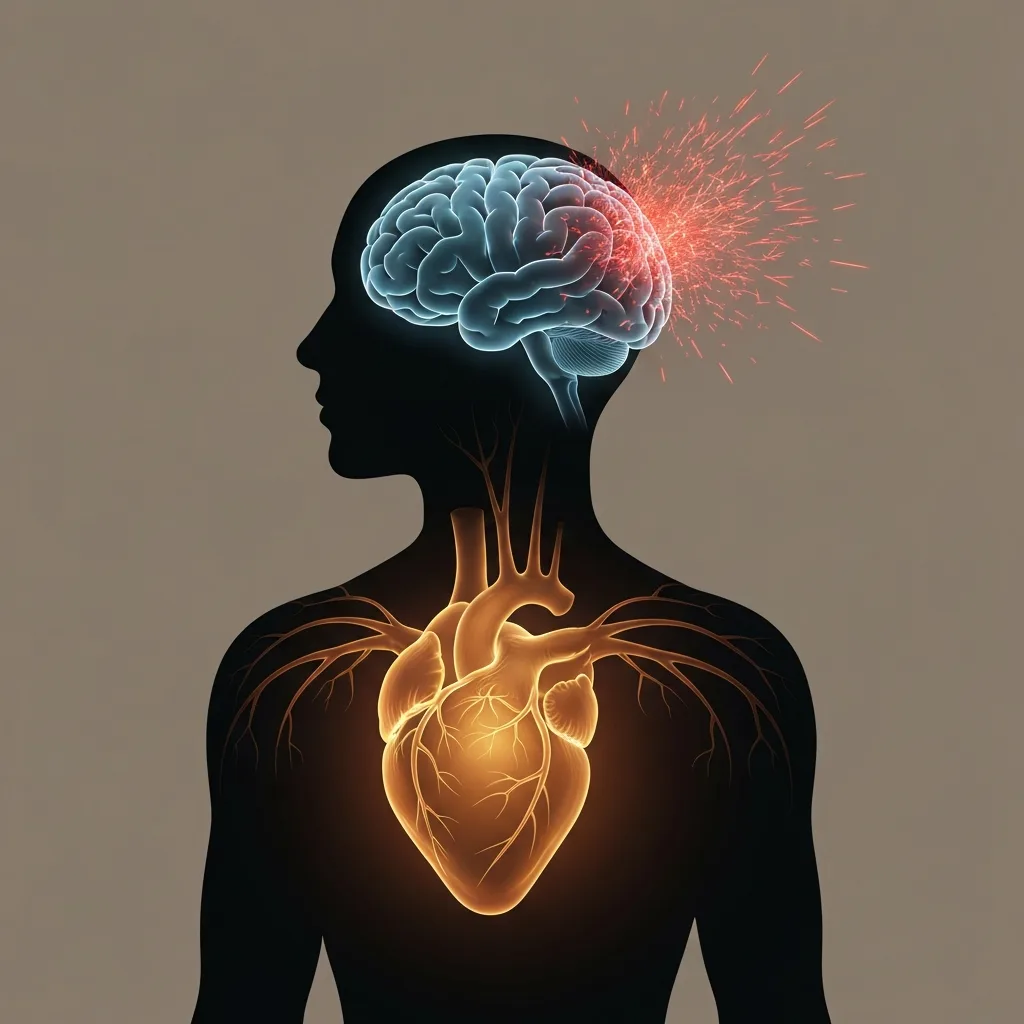
The Silent Translator Inside Your Nervous System
Imagine sitting at your desk, reading an email. You just finished your second cup of strong coffee. Suddenly, your heart rate elevates, your chest feels slightly tight, and a subtle wave of heat washes over your skin. In reality, this is a standard physiological response to caffeine and mild dehydration. But within milliseconds, your brain interprets this biological data and sounds an alarm. You feel an overwhelming sense of impending doom. You assume you are anxious about the email, your job, or your life trajectory.
You are not actually experiencing an emotional crisis. You are experiencing an interoceptive mismatch.
Interoception is your brain’s ability to perceive, interpret, and integrate signals originating from inside your body. It is the sensory system that tells you when you are hungry, cold, or tired. More importantly, it is the foundational architecture of your emotional life. Every emotion you experience begins as a physical sensation—a shift in heart rate, muscle tension, or respiratory depth—which the brain then categorizes and labels. But what happens when the brain becomes a faulty translator? When it begins to read perfectly harmless physical fluctuations as evidence of psychological threat, you enter a state of chronic, manufactured anxiety. Understanding and correcting this misinterpretation is one of the most critical, yet overlooked, components of emotional regulation.

The Brain as a Predictive Machine
To understand why interoceptive mismatches occur, we must abandon the idea that the brain is a passive receiver of information. Your brain is sealed inside a dark, silent skull. It does not actually “know” what is happening in the outside world, nor does it inherently know what is happening in the body. It relies entirely on sensory fragments transmitted through the nervous system. To make sense of these fragments, the brain operates as a prediction machine.
Through a mechanism known as predictive processing, your brain constantly guesses what your bodily sensations mean based on past experiences. If you have a history of chronic stress, trauma, or panic, your brain’s predictive algorithms become heavily skewed toward false positives. It adopts a “better safe than sorry” evolutionary strategy. A slight flutter in your stomach is no longer interpreted as digestion; it is predicted to be dread. A minor shift in your breathing is not interpreted as a need to stretch; it is predicted to be the onset of panic.
This is known as an interoceptive prediction error. The brain takes neutral somatic data and overlays a catastrophic emotional narrative. The tragedy of this mechanism is that once the brain predicts anxiety, it signals the adrenal glands to release cortisol and adrenaline, which creates more intense physical sensations, thereby validating the brain’s initial, faulty prediction. You become trapped in a self-sustaining loop of physiological arousal and psychological distress.
The Somatic Amplifier Effect
When you experience an interoceptive prediction error, your natural instinct is to turn your attention inward to monitor the discomfort. This introduces a secondary complication: the somatic amplifier effect. In human psychology, directed attention acts as a magnifying glass. When you hyper-fixate on a specific bodily sensation, you increase the neural firing associated with that sensation, making it feel objectively larger, faster, and more intense than it actually is.
If you suspect your heart is beating too fast and you focus all your mental bandwidth on your chest, your heart rate will feel deafening. This hyper-vigilance blurs the line between interoceptive accuracy (the ability to correctly identify what is happening in the body) and interoceptive hypersensitivity (the tendency to be overwhelmed by normal bodily noise). Many people who struggle with emotional balance do not actually have more intense emotions than others; they simply have a hypersensitivity to their own biological baseline.
Why Standard Mindfulness Can Backfire
This is precisely why generic mindfulness advice can sometimes exacerbate psychological distress. A common directive in meditation is to “do a body scan” or “focus on your heartbeat.” For someone with a well-regulated nervous system, this promotes relaxation. But for someone suffering from interoceptive hypersensitivity, directing unstructured attention into the body is akin to handing a microphone to their anxiety.
When your brain is already interpreting internal sensations as dangerous, forcing yourself to sit still and observe those sensations without a stabilizing framework can trigger a flood of panic. The goal is not simply to feel your body more intensely. The goal is to change the way your brain interprets the data your body is sending. You must teach your nervous system interoceptive differentiation—the ability to separate raw physical sensation from emotional narrative.
Architecting Interoceptive Clarity: Protocols for Recalibration
Recalibrating your interoceptive system requires moving away from passive observation and engaging in active, targeted nervous system retraining. By deliberately challenging your brain’s predictive models, you can dismantle manufactured anxiety and restore emotional equilibrium.
1. Narrative Decoupling
The first step in resolving an interoceptive mismatch is to strip the sensation of its storyline. When you feel a sudden wave of discomfort, your brain will immediately try to attach it to a psychological cause: “I’m anxious because of my relationship,” or “I’m stressed about money.” Interrupt this process by practicing narrative decoupling. Force your internal dialogue to describe the raw data using strictly biological terms. Instead of saying, “I am feeling panicked,” say, “My chest wall muscles are tight, my palms are warm, and my breathing is shallow.” By refusing to supply an emotional narrative, you deprive the physical sensation of the psychological fuel it needs to escalate into a mood state.
2. Interoceptive Exposure
To teach your brain that physical arousal does not equal emotional danger, you must purposefully induce harmless physical sensations in a safe environment. This is a clinical technique known as interoceptive exposure. If a racing heart triggers your anxiety, run in place for sixty seconds until your heart rate spikes, then sit down and observe the sensation while reminding yourself that you are safe. If shortness of breath triggers panic, breathe through a narrow straw for thirty seconds to safely simulate air hunger. By repeatedly experiencing these physical symptoms without a catastrophic outcome, you update your brain’s predictive algorithms. You teach your nervous system that a racing heart can just be a racing heart—it does not have to be a threat.
3. Dual-Awareness Anchoring
When internal sensations become overwhelming, the most effective way to stabilize the nervous system is to dilute the internal data with external data. This is achieved through dual-awareness anchoring. Instead of trying to ignore the internal discomfort (which rarely works) or diving fully into it (which can amplify it), you split your attention. Notice the tightness in your chest, but simultaneously press your hands firmly against a cold desk and focus on the texture of the wood. Listen to the sound of your own breathing, but also identify three distinct sounds outside your window. By balancing interoception (internal signals) with exteroception (external signals), you signal to your brain that the immediate environment is secure, which naturally down-regulates the internal alarm system.
Restoring the Biological Baseline
True emotional balance is not the absence of physical arousal. It is not about maintaining a perfectly slow heart rate or perpetually relaxed muscles. The human body is designed to fluctuate; it is meant to respond to caffeine, temperature changes, fatigue, and excitement. Psychological stability is achieved when you stop treating these normal biological fluctuations as emergencies.
By understanding the mechanics of interoceptive mismatch, you can step out of the trap of manufactured anxiety. You can learn to listen to your body without letting it dictate your psychological reality. Ultimately, mastering your emotional bandwidth requires recognizing that while your body is constantly providing data, you are the one who gets to decide what that data means.
Do you enjoy the content on Agenda Creativa?
Your contributions help me create new articles, share creative ideas, and keep this platform alive! If you like what I do and want to support my work, you can buy us a coffee.
Every cup of coffee means more than just a gesture – it's direct support for my passion to create inspiring and useful content. Thank you for being part of this journey!
☕ Buy me a coffee