The Inevitability of Pain and the Option of Suffering
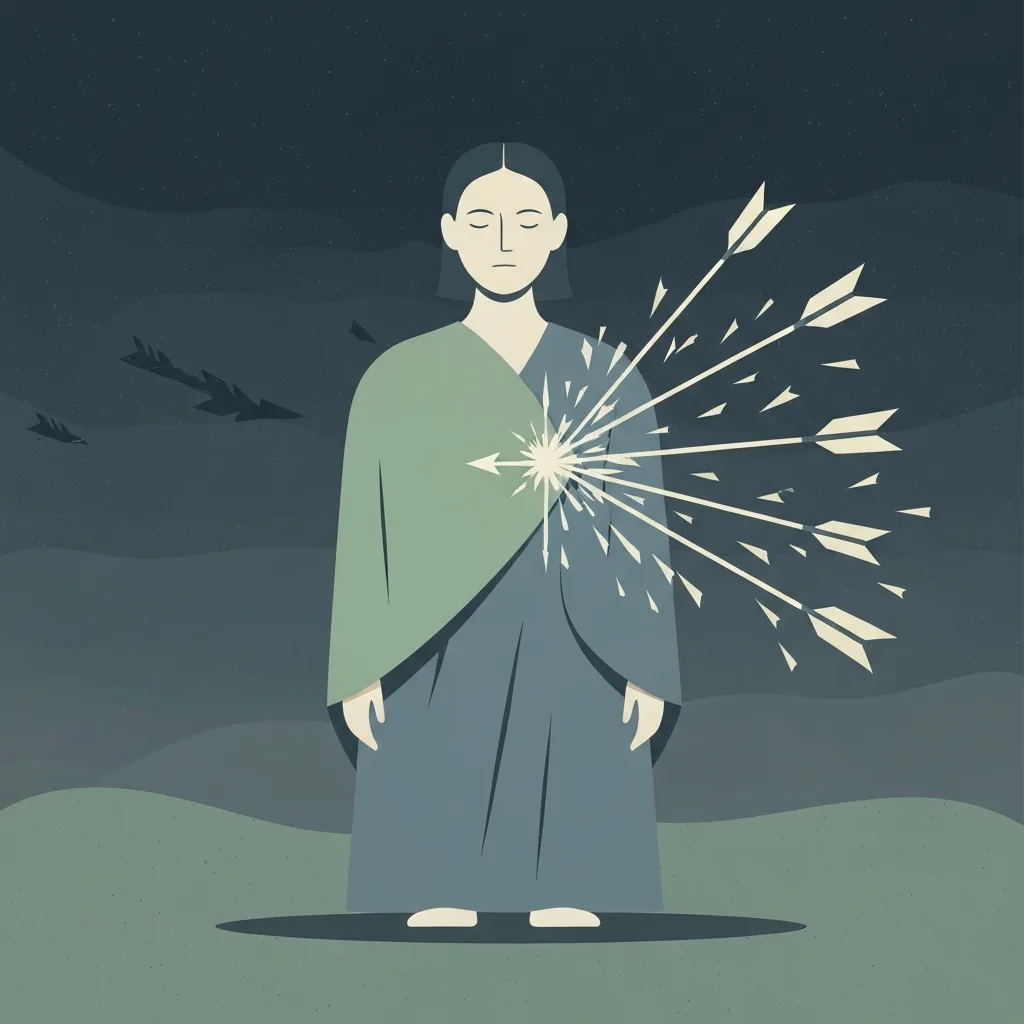
There is a foundational concept in ancient Buddhist psychology that perfectly encapsulates the modern human emotional experience. It is the parable of the second arrow. The premise is simple: If you are walking through a forest and get struck by an arrow, it causes immediate, sharp physical pain. But if you then take a second arrow and stab it into your own wound, you have taken an unfortunate accident and actively multiplied your suffering. The first arrow represents the unavoidable pain of human existence: a painful breakup, a sudden job loss, a harsh criticism from a colleague, or a sudden bout of physical illness. These events hurt. They are the initial sting of reality making contact with our nervous system.
The second arrow, however, represents our reaction to that initial pain. It is the narrative we spin, the judgment we cast upon ourselves, and the resistance we put up against the reality of the moment. When the colleague criticizes your work (the first arrow), the second arrow is the internal monologue that says, ‘I am an imposter, everyone knows I am incompetent, and I am going to be fired.’ The initial sting of critique might last a few minutes or hours; the suffering caused by the second arrow can keep you awake at night for weeks. In the context of emotional balance, recognizing and dodging this second arrow is perhaps the most transformative skill you can develop. It shifts your focus from trying to control an unpredictable world to mastering your internal environment.

The Psychology and Neuroscience of Secondary Suffering
To understand why we instinctively reach for the second arrow, we have to look at the brain’s evolutionary wiring. The human brain is a relentless problem-solving machine. When it encounters physical pain, it immediately assesses the threat and formulates a plan to avoid it in the future. Unfortunately, the brain uses the exact same neural circuitry to process emotional pain. When you feel sadness, rejection, or anxiety, your brain’s Default Mode Network (DMN) activates. It searches for a ‘reason’ for the pain and a ‘solution’ to fix it.
Because emotional pain rarely has a simple, actionable solution like pulling your hand away from a hot stove, the DMN gets caught in a loop. It ruminates. It analyzes the past and projects catastrophic scenarios into the future. This cognitive spinning is the brain’s misguided attempt to protect you, but the physiological result is disastrous. By constantly thinking about the painful event, you repeatedly trigger your amygdala, flooding your system with cortisol and adrenaline long after the initial threat has passed. You are effectively re-wounding yourself. You are firing the second arrow over and over again.
Meta-Emotions: The Hidden Arrows
One of the most common forms the second arrow takes is the phenomenon of meta-emotions, which simply means having an emotion about an emotion. Modern culture places a heavy emphasis on toxic positivity and constant happiness, leading many people to believe that experiencing negative emotions is a sign of failure. Therefore, when a natural emotion arises, we immediately judge it. We feel anxious about a presentation (first arrow), and then we feel angry at ourselves for being anxious (second arrow). We feel grief over a loss (first arrow), and then we feel ashamed that we aren’t ‘over it yet’ (second arrow).
This layering of emotions creates a complex psychological knot. The original emotion was a temporary physiological state that, if left alone, would have moved through the nervous system and dissipated. The meta-emotion, however, traps the original feeling in place. It creates a state of internal resistance. As the old psychological adage goes: what you resist, persists. By fighting the first arrow, you guarantee that its poison spreads.
Mindfulness Strategies for Dodging the Second Arrow
Mindfulness is not about cultivating a state of perpetual bliss or becoming immune to the first arrows of life. That is a dangerous misconception. True mindfulness is the practice of experiencing the first arrow fully, without immediately reaching into your quiver for the second. It is the cultivation of a space between stimulus and response. Here are the practical mechanisms for developing this space.
The Practice of Affect Labeling
When an intense emotion strikes, the brain’s emotional centers are highly activated, while the prefrontal cortex—the area responsible for logic and regulation—often goes offline. The fastest way to bring the prefrontal cortex back online and stop the firing of the second arrow is through a technique called affect labeling. This involves simply stating the emotion you are experiencing in a detached, objective manner.
Instead of saying, ‘I am terrified and everything is falling apart,’ you mentally note, ‘Anxiety is present right now.’ Or, ‘I am noticing a feeling of deep sadness.’ This subtle shift in language creates psychological distance. It separates your core identity from the passing emotional weather. You are acknowledging the first arrow without attaching a dramatic storyline to it. Functional MRI scans have shown that the simple act of labeling an emotion visibly reduces activity in the amygdala.
Decoupling Sensation from Narrative
The second arrow is almost always made of words—it is the story we tell ourselves about our pain. To disarm it, we must shift our attention away from the cognitive narrative and drop into the physical sensation of the emotion. When you feel triggered, ask yourself: Where does this emotion live in my body right now? Is it a tightness in the chest? A hollow feeling in the stomach? A heat in the face?
Focus your entire attention on the raw physical data of the sensation. Imagine you are a scientist observing a phenomenon for the first time. Breathe into that specific area of the body. When your mind inevitably tries to pull you back into the story (‘He shouldn’t have said that to me…’), gently redirect your focus back to the physical sensation (‘I am noticing tightness in my jaw’). Emotions are fundamentally physiological events. By processing them as physical sensations rather than intellectual problems, you allow the first arrow to heal naturally without interference.
Applying Radical Self-Compassion
If the second arrow is driven by self-judgment and resistance, the ultimate shield against it is self-compassion. When we experience emotional pain, our default reaction is often to isolate ourselves, believing that we are uniquely broken or that we somehow deserve the suffering. This isolation fuels the rumination cycle.
Self-compassion interrupts this by acknowledging the pain with kindness. When the first arrow hits, a self-compassionate response looks like pausing and saying, ‘This is a moment of suffering. Suffering is a normal part of life. May I be kind to myself in this moment.’ It is treating yourself with the same gentle objectivity you would offer a close friend who is hurting. You wouldn’t tell a grieving friend that they are weak for crying; you shouldn’t tell yourself that either. Self-compassion neutralizes the shame that usually coats the second arrow.
The Long-Term Impact on Emotional Baseline
Learning to stop firing the second arrow does not happen overnight. It requires consistently catching yourself in the act of rumination and gently guiding your mind back to the present reality of the first arrow. However, as you practice this, you begin to leverage neuroplasticity. You literally rewire your brain’s default response to stress and pain.
Over time, the pathway that leads from ‘pain’ to ‘catastrophic narrative’ begins to atrophy from lack of use. Meanwhile, the pathway that leads from ‘pain’ to ‘mindful observation and self-compassion’ becomes stronger and more automatic. The result is a profound shift in your emotional baseline. You will still experience grief, anger, fear, and disappointment—these are the admission prices to a meaningful human life. But you will experience them cleanly. They will wash over you and eventually recede, leaving your core sense of peace intact.
Ultimately, mastering the space between the first and second arrow is where true emotional freedom lies. It is the realization that while you cannot control the arrows the world shoots at you, you have absolute authority over the ones you hold in your own hands. By putting down the second arrow, you stop being your own tormentor and finally allow yourself the space to heal.




Do you enjoy the content on Agenda Creativa?
Your contributions help me create new articles, share creative ideas, and keep this platform alive! If you like what I do and want to support my work, you can buy us a coffee.
Every cup of coffee means more than just a gesture – it's direct support for my passion to create inspiring and useful content. Thank you for being part of this journey!
☕ Buy me a coffee