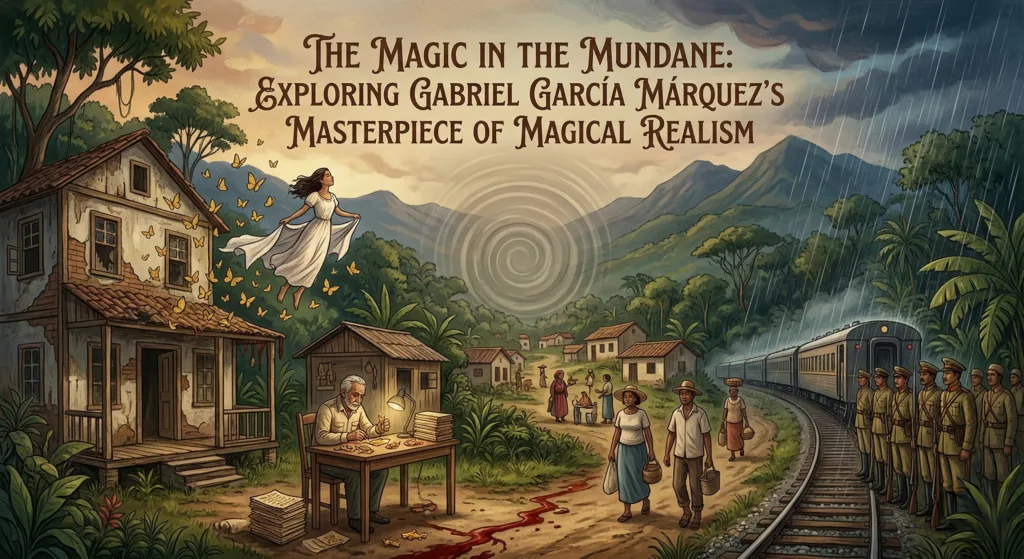
The Genesis of a Literary Phenomenon
There are few opening lines in the history of literature as evocative and instantly recognizable as that of Gabriel García Márquez’s seminal work. When the reader is first introduced to Colonel Aureliano Buendía standing before a firing squad, remembering the distant afternoon his father took him to discover ice, a profound narrative promise is made. Published in 1967, One Hundred Years of Solitude did not merely tell a story; it birthed an entire literary movement and brought Latin American literature to the forefront of global consciousness. Márquez, a Colombian journalist with a penchant for the extraordinary tales told by his grandmother, crafted a narrative that defied traditional structural boundaries, blending the gritty realities of civil war and imperialism with soaring, unapologetic myth.
The novel chronicles the rise and fall of the Buendía family and their fictional, isolated town of Macondo. But to reduce the book to a mere family saga is to misunderstand its architecture. Macondo serves as a microcosm for Colombia, for Latin America, and ultimately for human civilization itself. Through the lens of this isolated settlement, Márquez explores the intricate mechanisms of memory, the heavy burden of history, and the inescapable cycles of human behavior. The publication of the novel coincided with the Latin American Boom, a period of immense literary flourishing, but Márquez’s voice stood apart, characterized by a deadpan delivery of the miraculous and a profound empathy for his deeply flawed characters.
Understanding Magical Realism
The Seamless Blend of Myth and Reality
To appreciate Márquez’s contribution to literature, one must understand the mechanics of magical realism. Unlike high fantasy, which transports the reader to entirely fabricated worlds with their own distinct physical laws, magical realism roots itself firmly in the recognizable world. The magic is not a disruption of reality; rather, it is an organic component of it. In Macondo, a carpet flying through the sky or a plague of insomnia that sweeps through the town is treated with the same mundane practicality as the purchase of a new cooking pot. Conversely, the arrival of modern technology—like magnets, magnifying glasses, and eventually the train—is met with profound awe and terror, treated as dark, incomprehensible magic.
This inversion of the ordinary and the extraordinary forces the reader to question their own perceptions of reality. Márquez utilizes this technique not for mere whimsical effect, but to convey the psychological and emotional truths of his characters. When Mauricio Babilonia is perpetually followed by a cloud of yellow butterflies, it is a physical manifestation of an all-consuming, tragic love. When a trickle of blood travels across town, navigating corners and climbing stairs to inform a mother of her son’s death, it speaks to the unbreakable, visceral bond of family that transcends physical distance.
The Role of Latin American History
Magical realism is inextricably linked to the post-colonial history of Latin America. The genre reflects a reality where the imposition of foreign powers, the brutality of civil wars, and the rapid, often chaotic influx of modernity created a surreal lived experience for the continent’s inhabitants. Márquez uses magical realism to process historical trauma. The most chilling example of this is the banana plantation massacre within the novel. Based on the real-life 1928 Santa Marta massacre in Colombia, Márquez depicts the slaughter of striking workers by the military. However, the true horror lies in the aftermath: the bodies are loaded onto a train and dumped into the sea, and the government engineers a torrential rain that lasts for nearly five years, effectively washing away both the physical evidence and the collective memory of the town. The magical element—the endless rain—serves as a devastating critique of historical erasure and state-sponsored amnesia.
Welcome to Macondo: A Microcosm of Humanity
The Evolution of an Isolated Utopia
Macondo begins as an Edenic settlement, a place so new that many things lacked names, and in order to indicate them it was necessary to point. It is founded by José Arcadio Buendía and his wife, Úrsula Iguarán, after fleeing the ghost of a man José Arcadio killed in a matter of honor. In its early days, Macondo is defined by its isolation, bordered by an impassable swamp and a vast mountain range. The only connection to the outside world is the periodic arrival of gypsies, led by the enigmatic Melquíades, who bring scientific wonders and tales of the world beyond.
As the narrative progresses, Macondo loses its innocence. The arrival of the government magistrate brings political division, sparking decades of bloody civil war between the Liberals and the Conservatives. Later, the arrival of the foreign banana company brings aggressive, exploitative capitalism, transforming Macondo into a bustling, unrecognizable shantytown of zinc roofs and moral decay. Márquez meticulously charts the trajectory of civilization—from primal innocence to complex social structures, leading ultimately to exploitation, decay, and ruin.
The Buendía Dynasty
At the heart of the novel is the sprawling, complex Buendía family tree. Márquez famously reuses names across seven generations—every male is an Arcadio or an Aureliano, and the women are often named Úrsula, Amaranta, or Remedios. This deliberate naming convention creates a dizzying reading experience, but it serves a vital thematic purpose. As the matriarch Úrsula observes, the Arcadios are impulsive, physically massive, and driven by enterprise or lust, while the Aurelianos are withdrawn, intellectual, and prone to profound melancholy. The repetition of names underscores the idea that the family is trapped in a genetic and historical loop, doomed to repeat the mistakes, passions, and tragedies of their ancestors.
Themes That Transcend Time
The Inescapable Nature of Solitude
Despite being surrounded by a bustling town and a crowded house, every member of the Buendía family suffers from a profound, incurable solitude. This solitude is not merely physical isolation; it is an emotional and spiritual inability to connect with others. Colonel Aureliano Buendía, after surviving thirty-two armed uprisings and countless assassination attempts, retreats to his workshop to endlessly craft and melt down little gold fishes, finding peace only in absolute emotional detachment. Amaranta, consumed by bitterness and a tragic rivalry, weaves and unweaves her own burial shroud, choosing the safety of isolation over the vulnerability of love.
Márquez suggests that this solitude is the ultimate human condition, born from an inability to love selflessly. The characters are trapped in their own egos, their own obsessions, and their own traumas. It is only in the final generation, with Aureliano Babilonia and Amaranta Úrsula, that true, uninhibited love is achieved—though it is a love born of incest, fulfilling a generational curse that ultimately brings about the destruction of the family line.
Time as a Circular Concept
Western literature traditionally treats time as linear—a straight path from past to present to future. Márquez, drawing on indigenous philosophies and the repetitive nature of history, constructs time in Macondo as circular. Events, personalities, and conflicts recur with terrifying precision. Úrsula Iguarán, who lives to be well over a hundred years old, becomes the chronicler of this cyclical time, frequently lamenting that time is not passing, but turning in a circle. This circularity is formalized in the parchments left behind by the gypsy Melquíades. These manuscripts, written in Sanskrit and deciphered only by the final Aureliano as the town is being destroyed by an apocalyptic hurricane, reveal that the entire history of the family was preordained, written simultaneously rather than sequentially.
The Enduring Legacy of Márquez
Gabriel García Márquez was awarded the Nobel Prize in Literature in 1982, cementing his status as one of the most important writers of the 20th century. However, his true legacy lies in the countless authors he influenced. The fingerprints of Macondo can be found in Salman Rushdie’s midnight children of India, in Toni Morrison’s haunted landscapes of the American South, and in Haruki Murakami’s surreal, bending realities of modern Japan. Márquez demonstrated that the most profound truths about human nature, politics, and history do not always have to be delivered through strict realism. Sometimes, to capture the full spectrum of the human experience, a writer must invoke the magical.
Why We Still Read Macondo Today
Decades after its initial publication, One Hundred Years of Solitude remains fiercely relevant. We live in an era where history often feels cyclical, where the ghosts of past political conflicts continue to haunt the present, and where modern technology frequently outpaces our emotional capacity to process it. Márquez’s masterpiece offers a mirror to our own world. It reminds us of the dangers of historical amnesia, the destructive nature of unchecked ambition, and the tragic consequences of failing to connect with one another. Yet, amidst the tragedy and the solitude, Márquez’s vibrant, pulsating prose leaves the reader with a sense of awe at the sheer beauty and absurdity of being alive. To read this novel is to step into a world where the mundane is magical, and the magical is the only way to truly understand the mundane.

Do you enjoy the content on Agenda Creativa?
Your contributions help me create new articles, share creative ideas, and keep this platform alive! If you like what I do and want to support my work, you can buy us a coffee.
Every cup of coffee means more than just a gesture – it's direct support for my passion to create inspiring and useful content. Thank you for being part of this journey!
☕ Buy me a coffee