The Two-Dimensional Bin-Packing Dilemma in Garment Construction
Every bespoke tailor and dressmaker encounters the bolt-width conundrum: you source an exquisite deadstock wool crepe or silk duchess satin woven at 60 inches (150 cm), yet your production pattern envelope calculates consumption strictly for a traditional 45-inch (115 cm) width. Conversely, you fall in love with an artisanal block-printed textile or heritage liberty lawn measuring a mere 44 inches wide, while your drafting block mandates a modern 58-inch apparel bolt.
The common instinct among hobbyists and apprentice cutters is simple proportional cross-multiplication: multiply the pattern width by the required length, then divide by the target width. In the pristine world of pure arithmetic, area is invariant. In the tactile reality of the cutting table, fabric conversion is not an abstract area calculation—it is a two-dimensional geometric bin-packing puzzle governed rigidly by warp and weft alignment, pattern piece cross-sections, and structural drape.
Failing to understand the geometric mechanics of nesting, grainline orientation, and textile nap leads inexorably to two costly outcomes: purchasing excessive luxury yardage that sits abandoned as remnant scraps, or suffering a catastrophic fabric deficit that strands an un-cut two-piece sleeve or flared godet mid-layout.
The Core Atelier Mathematics: Area Versus Nesting Capacity
To compute fabric consumption accurately, we must begin with baseline surface area before applying spatial corrections. When textile width contracts, cutting length must expand proportionally to maintain the minimum square measurement required to house the draft.
The Theoretical Surface Area Formula
The standard baseline surface equation operates on the assumption of fluid, zero-waste tessellation:
- L₂ = (W₁ × L₁) / W₂
Where W₁ represents the original pattern envelope width, L₁ represents the envelope length requirement, W₂ represents your actual target bolt width, and L₂ represents the unadjusted mathematical yardage. All width dimensions must share identical units (inches or centimeters), yielding a baseline length in your chosen linear measurement.
Consider an tailored evening jacket requiring 3.5 yards on a 45-inch bolt. Converted purely by area to a 60-inch textile, the formula yields:
- L₂ = (45 × 3.5) / 60 = 2.625 yards (2 ⅝ yards)
While 2.625 yards seems mathematically immaculate, cutting this jacket from precisely 2 ⅝ yards of 60-inch suiting will frequently end in disaster. Why? Because garment pieces are not fluid rectangles that can be broken into microscopic pixels; they are rigid geometric polygons with fixed maximum widths, curving seamlines, and unyielding grainline mandates.
🛠️ Interactive Atelier Tool: Fabric Width Yardage Converter
Skip manual math and cutting guesswork. Use our free interactive tool to instantly calculate your exact measurements, fabric yield, and project specifications:
Why Direct Area Conversion Fails on the Cutting Table
To successfully recompute fabric length across varying widths, the master cutter must account for four non-negotiable physical constraints that dictate marker efficiency.
1. The Minimum Cross-Section Barrier
A circle skirt quadrant, a tailored kimono sleeve, or a sweeping palazzo pant leg possess fixed maximum horizontal footprints. If your back trouser panel measures 24 inches at its widest point from outseam to crotch point, two panels cannot sit side-by-side along the crossgrain on a 45-inch folded bolt (which provides only 21.5 inches of usable cutting width once folded selvage-to-selvage). The pieces must be staggered longitudinally, immediately doubling the required yardage.
However, place that identical pattern on a 60-inch bolt (yielding a 29-inch fold width), and both panels nest side-by-side with ease. When moving from wide to narrow bolts, you encounter a threshold where nesting collapses entirely, requiring massive linear jumps rather than smooth mathematical curves.
2. Usable Width vs. Bolt Width: The Selvage Tax
Never confuse nominal bolt width with usable cuttable width. Textile mills finish fabric borders with woven selvages featuring heavy tension, pinholes from the stenter frame, or contrasting thread headers. A 60-inch wool often provides only 58 inches of usable cloth; a 45-inch silk habotai may yield only 43.5 inches. Always subtract 1 to 1.5 inches (2.5 to 4 cm) from the nominal bolt width prior to executing your conversion math.
3. The Tyranny of the Warp: Grainline Integrity
In high-end dressmaking, grainlines cannot be compromised to squeeze pieces into awkward corners. Garment bodies hung off-grain will twist around the wearer’s torso, trouser legs will corkscrew around the calf, and hems will billow unevenly. Pattern pieces drafted parallel to the warp must stay strictly parallel to the warp. True bias cuts—pioneered by Madeleine Vionnet—demand a meticulous 45-degree angle to both warp and weft, creating enormous triangular offcuts that defy standard rectangular conversion equations.
4. Directional Nap and One-Way Surface Finishes
If you are cutting velvet, corduroy, brushed cashmere, satin, or any textile featuring a directional print, you forfeit the ability to interlock or ‘jigsaw’ patterns head-to-toe. All master panels must point toward the hemline to ensure light reflects uniformly across the garment. This eliminates head-to-foot nesting efficiency, automatically mandating a specialized studio buffer.
Applying Calibrated Atelier Nesting Buffers
In professional couture ateliers, master drafters apply systematic percentage buffers to the theoretical surface equation depending on the garment’s cut and the textile’s physical profile.
- 0% Buffer (Zero Allowance): Strictly viable for utilitarian, non-apparel items composed of simple rectilinear panels—such as window drapery, bed linens, or patchwork quilting blocks.
- 5% Buffer (Minimalist Apparel): Applied when transitioning between adjacent widths (such as 54″ to 60″) on stable plain-weave textiles (poplin, linen, broadcloth) using slim-fit, highly segmented multi-panel garments like corset bodices or pencil skirts.
- 10% Buffer (The Universal Tailoring Standard): The critical safety margin for general apparel cutting. This compensates for standard selvage waste, natural garment curves, facings, interfacings, and minor crossgrain straightening.
- 15% to 20% Buffer (High-Risk Textiles): Mandatory for directional nap textiles (velvet, velour, camel hair), directional prints, large-scale tartan pattern matching, or dramatic sweeping pattern shapes like full circle skirts and bias-cut gowns.
The Master Tailor Conversion Formula
Incorporating the buffer into your baseline math gives you the realistic atelier equation:
Final Cutting Length = [ (W₁ × L₁) / W₂ ] × (1 + Buffer Percentage)
Applying our earlier tailored jacket example (45″ requirement of 3.5 yards converting to 60″ wide suiting) with the industry standard 10% buffer:
- Theoretical Length: (45 × 3.5) / 60 = 2.625 yards
- 10% Atelier Buffer: 2.625 × 1.10 = 2.887 yards
- Rounded to practical cutting increment: 2 ⅞ to 3.0 yards
A Protocol for Validating Your Layout Prior to Cutting
Before shears meet cloth on expensive yardage, follow this three-step validation procedure:
- Determine Usable Fold Geometry: Fold your target width in half lengthwise (wrong sides together or right sides together depending on marking preference). Measure from fold to inside the selvage boundary to verify that your widest flat pattern piece fits entirely within the single-layer or double-layer envelope.
- Pre-Shrinkage Audit: Natural fibers (wool, silk, linen, cotton) can shrink anywhere from 3% to 8% during steaming or laundering. Perform textile pre-treatment before marking yardage; shrinking cloth after purchase reduces both length and cuttable width simultaneously.
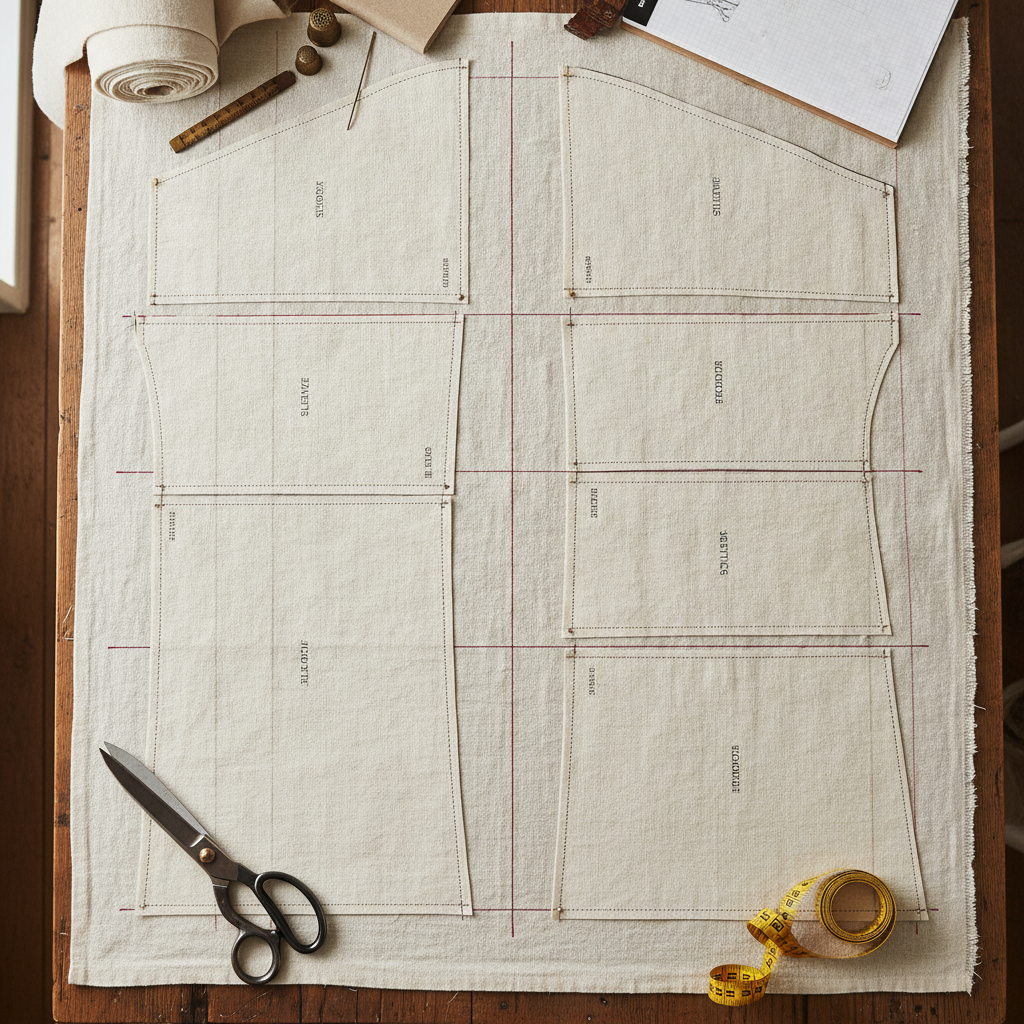
- Simulate the Marker: When working with high-cost luxury textiles, outline your target fabric boundaries on your cutting table using painter’s masking tape. Lay down your major foundational pattern pieces (front coat, back coat, sleeves) to visually verify grainline spacing before cutting the textile off the bolt.
Elevating the Modern Cutting Table
Precision in garment drafting is as much about material stewardship as it is about bespoke fit. Mastering the spatial math behind width conversions transforms you from a pattern follower into an agile maker capable of working across vintage remnants, narrow artisanal loomed silks, and modern wide-width woolens.
As you plan comprehensive atelier collections and manage professional project budgets, explore our companion suites. Calculate intricate surface embellishments, beadwork, and trims with our Embellishment Calculator, and ensure your bespoke commissions remain commercially viable using our Break Even Calculator.
Do you enjoy the content on Agenda Creativa?
Your contributions help me create new articles, share creative ideas, and keep this platform alive! If you like what I do and want to support my work, you can buy us a coffee.
Every cup of coffee means more than just a gesture – it's direct support for my passion to create inspiring and useful content. Thank you for being part of this journey!
☕ Buy me a coffee