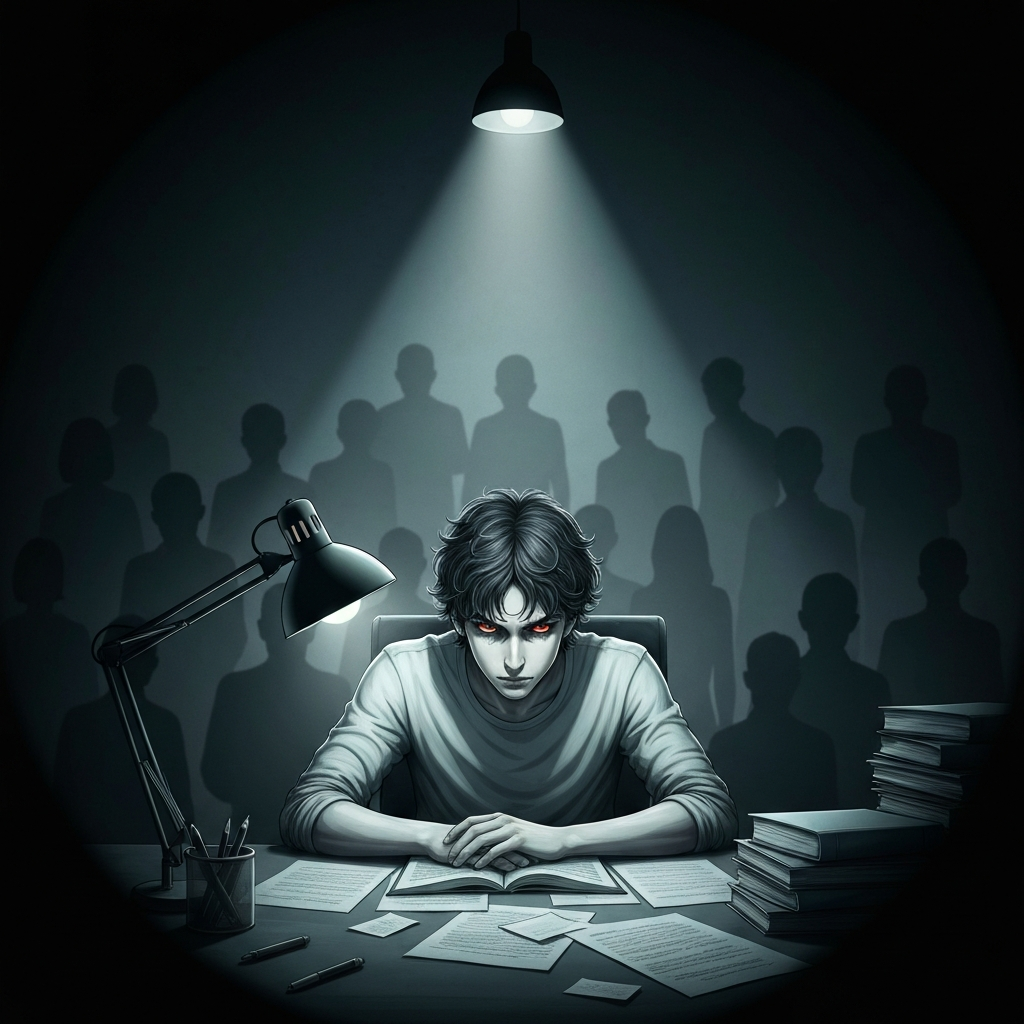
The Phantom Jury in Your Mind
Most of us are never truly alone when we work. Even in an empty room, with the door locked and the internet disabled, we are accompanied by a phantom jury. We write, build, strategize, and execute under the watchful eyes of an invisible audience. We imagine our peers scrutinizing our early drafts, our mentors evaluating our strategic pivots, and our rivals judging our inevitable missteps.
This internalized gaze is not a symptom of vanity; it is an evolutionary glitch. We are wired to care deeply about our standing within the tribe. But in an era where our work is constantly subject to public consumption, this survival mechanism has mutated into a chronic motivational disease. We call this the Spectator Paradox.
The Spectator Paradox dictates that the more you anticipate the judgment of others during the execution phase, the faster your intrinsic drive evaporates. We falsely believe that the pressure of an imaginary audience will keep our standards high and our execution sharp. Instead, it fractures our attention, dilutes our authenticity, and ultimately bankrupts our drive. We stop optimizing for what is effective and start optimizing for what is defensible.

The Anatomy of the Spectator Paradox
The Internalized Board of Directors
To understand why the Spectator Paradox is so destructive, we must first identify the culprits. Every professional carries an internalized board of directors. This board is composed of former bosses, industry peers, vocal critics, and even idealized versions of our own parents. Before we make a decision or finalize a piece of work, we subconsciously submit it to this board for approval.
When you are driven by the board, your primary objective shifts from solving the problem at hand to preempting criticism. You are no longer asking, “What is the best way to accomplish this?” Instead, you are asking, “How will this be perceived?” This subtle shift in framing is catastrophic for deep, sustained motivation. It transforms the act of creation into an act of compliance.
The Shift from Utility to Optics
When the invisible audience takes the wheel, our output inevitably shifts from utility to optics. We choose the complex solution over the simple one because complexity looks more impressive from the outside. We adopt industry jargon rather than plain language because jargon signals belonging. We prioritize tasks that yield visible, immediate results over the quiet, foundational work that actually moves the needle.
This optical optimization creates a profound disconnect between the work we are doing and the value we are creating. Human beings are incredibly sensitive to this dissonance. When we sense that our efforts are performative rather than substantive, our psychological reward systems shut down. The dopamine loop breaks. We experience fatigue, not because we are working too hard, but because we are working out of alignment with reality.
Why the Invisible Gaze Bankrupts Drive
The Exhaustion of Constant Performance
Executing a difficult task requires a massive amount of cognitive bandwidth. Self-monitoring—the act of observing and evaluating your own behavior from a third-party perspective—also requires massive cognitive bandwidth. Attempting to do both simultaneously is a recipe for rapid burnout.
Psychologists refer to this as the cognitive load of self-presentation. When you are constantly performing for the invisible audience, you are running a heavy background application that drains your mental battery. You are splitting your processing power between doing the work and watching yourself do the work. Over time, this chronic division of attention leads to a deep, pervasive exhaustion that no amount of sleep can cure. You are tired because you are never off stage.
The Erosion of Intrinsic Joy
Intrinsic drive—the kind of motivation that sustains elite performers over decades—is deeply tied to the state of flow. Flow requires complete absorption in the present moment. It requires the dissolution of the ego. You cannot enter a state of flow if you are constantly stepping outside of yourself to check how you look.
The Spectator Paradox actively prevents flow by forcing you to maintain a dual consciousness. When the process becomes a prop for external validation, the inherent joy of the work is hollowed out. You are no longer building a company, writing a book, or designing a product because the act itself is intensely rewarding. You are doing it to feed the phantom jury. Once the joy is gone, all that remains is the grind, and willpower alone is a finite resource.
The Architecture of Psychological Privacy
Dismantling the Panopticon
To reclaim your drive, you must cultivate psychological privacy. This does not mean isolating yourself physically or refusing to share your final work. Rather, it means fiercely protecting the execution phase from the anticipation of judgment. You must dismantle the mental panopticon.
The first step is auditing your internalized board of directors. Sit down and explicitly identify whose voices are dictating your choices. Is it a hyper-critical former manager? A competitor you secretly envy? Once you drag these phantom judges into the light, their power diminishes. You can begin to consciously recognize when their voices are interfering with your process. When you feel the urge to over-engineer a solution, pause and ask: “Who am I trying to impress right now?”
The ‘Draft Zero’ Protocol
One of the most effective tools for establishing psychological privacy is the Draft Zero Protocol. Draft Zero is not a first draft. A first draft is something you eventually plan to edit and show to others. Draft Zero is a sandbox where observation is strictly prohibited, even by your future self.
When you begin a new project, make a binding agreement with yourself that the initial output will be destroyed or permanently hidden. It will never be seen by a client, a partner, or the public. By mathematically eliminating the possibility of an audience, you short-circuit the Spectator Paradox. The pressure to perform evaporates. You are free to make ugly, incoherent, and highly effective messes. This unobserved space is where genuine innovation and raw drive are reignited.
How to Cultivate Unwatched Execution
Decoupling Action from Perception
Rebuilding your motivation requires shifting your internal metrics. You must train yourself to value the resonance of the action over the perception of the result. When you complete a task, evaluate it based on personal criteria: Did this solve the core problem? Did I learn something valuable? Did I execute with integrity?
This requires a high degree of intellectual honesty. It is easy to lie to yourself and claim you are ignoring the audience while secretly hoping for their applause. To truly decouple action from perception, you must occasionally engage in high-effort, low-visibility work. Do something incredibly difficult that no one will ever know about. Fix a structural flaw in your business that only you can see. Write a brilliant essay and delete it. These exercises build the muscle of unwatched execution, proving to your nervous system that you do not need an audience to act with excellence.
Building an Opaque Operating System
Finally, protect your process by building an opaque operating system. In a culture that glorifies ‘building in public,’ we are encouraged to share our messy middles, our daily struggles, and our half-baked ideas. While this can build an audience, it is highly toxic to early-stage drive.
Your process should be a black box. The inputs go in, the deep work happens in absolute privacy, and only the highly refined output is released. Stop talking about what you are going to do. Stop sharing your incremental progress with people who have no operational stake in the outcome. By hoarding your process, you build internal pressure. The energy that would have been leaked through performative updates is instead channeled directly into the execution.
The Freedom of the Dark
The most profound realization you will have on the other side of the Spectator Paradox is that the invisible audience never actually cared about you. They were always a projection of your own insecurities. The phantom jury was an illusion.
True, unshakeable drive thrives in the dark. It is forged in the quiet, unwatched moments where you are solely accountable to the work itself. By silencing the imaginary board of directors and cultivating deep psychological privacy, you stop performing for the world and start executing for yourself. You reclaim your attention, your authenticity, and the limitless momentum that comes from simply doing the work.
Do you enjoy the content on Agenda Creativa?
Your contributions help me create new articles, share creative ideas, and keep this platform alive! If you like what I do and want to support my work, you can buy us a coffee.
Every cup of coffee means more than just a gesture – it's direct support for my passion to create inspiring and useful content. Thank you for being part of this journey!
☕ Buy me a coffee
