The Optimism Epidemic in Our Calendars
You sit down on Monday morning, coffee in hand, and map out a perfectly structured week. Every block on your digital calendar fits together like a masterfully played game of Tetris. You estimate that the quarterly report will take two hours, the client presentation another three, and processing your inbox will be an easy forty-five minutes. You feel entirely in control.
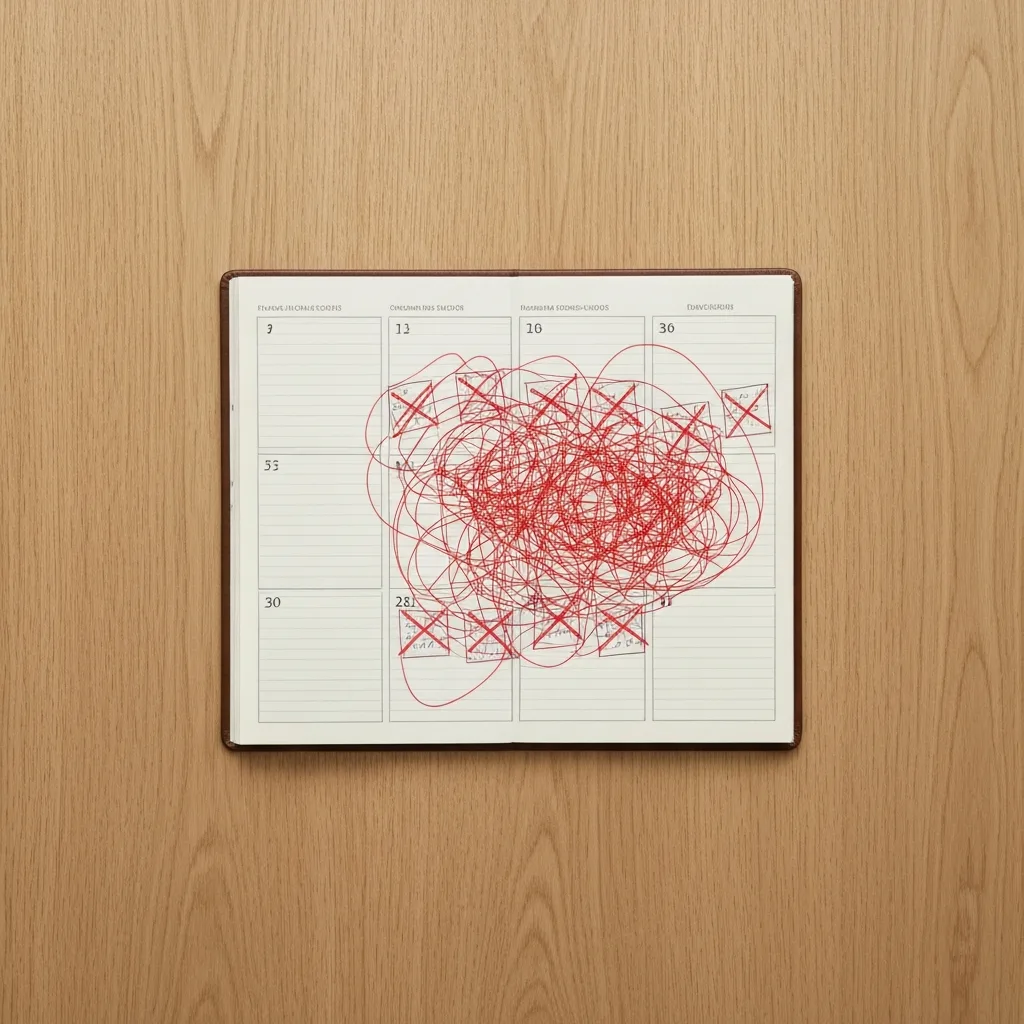
By Wednesday afternoon, the entire schedule has collapsed. The report took five hours because you had to hunt down missing data. The presentation required an extra round of revisions. Your inbox is overflowing, and the perfectly color-coded time blocks from Monday now look like a mockery of your actual workflow. Sound familiar?
We are chronic optimists when it comes to predicting our own future capacity. We assume that because we want a project to take two hours, it will take two hours. This persistent, frustrating phenomenon is not a failure of discipline or a lack of willpower. It is a well-documented cognitive bias known as the planning fallacy, and it is quietly destroying your productivity, your reputation, and your peace of mind.

The Anatomy of the Estimation Blindspot
First introduced by psychologists Daniel Kahneman and Amos Tversky in 1979, the planning fallacy describes our tendency to underestimate the time, costs, and risks of future actions, while simultaneously overestimating the benefits. We do this even when we have direct past experience showing that similar tasks took much longer than expected.
Why does our brain actively sabotage our schedules? The estimation blindspot is driven by three powerful psychological forces:
1. The Happy Path Bias
When we estimate a task, we naturally visualize the 'happy path.' This is an idealized, frictionless vacuum where our energy is consistently at peak levels, software never crashes, colleagues reply to emails instantly, and no urgent crises interrupt our deep work. We plan for the best-case scenario, completely ignoring the statistical probability of everyday friction.
2. Memory Degradation
The human brain is remarkably good at forgetting the specific pain of past struggles. When you think back to the last time you launched a website or audited a financial quarter, you remember crossing the finish line. You conveniently forget the three days you spent troubleshooting a broken plugin or the sleepless night spent hunting down a calculation error. Because we forget the friction of the past, we fail to budget for the friction of the future.
3. The Competence Trap
There is immense social and internal pressure to appear efficient. Telling a client or a manager, 'This will take me three weeks,' feels like an admission of incompetence, whereas promising it by Friday feels proactive and impressive. We allow our desire to please others to override our rational understanding of how long work actually takes.
Hofstadter's Law and the Cost of Unseen Friction
The danger of the estimation blindspot is not just that you miss a deadline. The true danger is the cascading effect it has on your entire workflow. Cognitive scientist Douglas Hofstadter famously coined Hofstadter's Law, which states: "It always takes longer than you expect, even when you take into account Hofstadter's Law."
When a two-hour task bleeds into five hours, it displaces the tasks scheduled for the afternoon. Those displaced tasks get pushed to tomorrow, creating a backlog. By the end of the week, you are operating in a state of reactive panic, frantically trying to clear a deficit that was mathematically impossible to clear from the start.
This chronic underestimation leads to a specific type of burnout. Your calendar transforms from a tool of empowerment into a daily record of your failures. You begin to distrust your own plans, which destroys your motivation to stick to any system at all.
Frameworks for Bulletproof Timelines
Overcoming the planning fallacy requires more than just trying to be 'more realistic.' You cannot out-think a cognitive bias with sheer willpower; you must bypass it with structural rules. Here is how to engineer timelines that actually survive contact with reality.
1. Reference Class Forecasting
The single most effective way to defeat the planning fallacy is to stop looking at the current project in isolation. Instead of asking, 'How long will this take?' you must ask, 'How long did the last three projects of this exact size and scope take?'
This is called reference class forecasting. If you are writing a 2,000-word article, your brain might tell you it will take four hours because you can type 500 words an hour. But if your historical data shows that researching, drafting, editing, and formatting typically takes nine hours, you must schedule nine hours. Your historical data is an objective truth; your current optimism is a biological lie.
2. The Friction Multiplier
For tasks where you lack historical data, you must apply a mathematical buffer to your baseline estimates. Once you determine how long a task should take on the 'happy path,' apply a friction multiplier.
For routine tasks that you perform weekly, multiply your estimate by 1.2. For complex projects with multiple moving parts, multiply by 1.5. For entirely new endeavors where you have zero prior experience, multiply your estimate by 2.0 or even 3.0. This is not padding your schedule out of laziness; it is aggressively protecting your schedule against the unknown unknowns.
3. The Pre-Mortem Protocol
Before committing to a timeline for a major project, run a pre-mortem. Originated by psychologist Gary Klein, this exercise requires you to imagine that it is one week past the deadline, and the project has been a catastrophic failure. You then work backward to determine what killed it.
Did a key vendor fail to deliver? Did the scope creep out of control? Did you get pulled into a different company emergency? By assuming failure has already occurred, you bypass the brain's optimistic filters and surface hidden risks. You can then build specific time buffers into your schedule to account for those exact vulnerabilities.
4. Isolating External Dependencies
The most dangerous elements of any timeline are the parts you do not control. Waiting for a client's approval, a colleague's data pull, or a contractor's revision are the black holes of time estimation.
When building your schedule, decouple your active execution time from your waiting time. Never schedule a task that requires external input on the same day that input is promised. If a client says they will have feedback to you by Tuesday, schedule your revision work for Thursday. Create an airlock between their deadline and your execution block.
Shifting from Time-Based to Output-Based Horizons
Finally, recognize the limits of your own foresight. You can accurately estimate what you will accomplish in the next three hours. You cannot accurately estimate what you will be doing at 2:15 PM three weeks from now.
Divide your planning into two horizons. Manage your immediate horizon (the next 48 hours) with rigid, time-blocked precision. Manage your distant horizon (next week and beyond) with flexible, output-based milestones. Do not assign specific hours to distant tasks; assign them to days or weeks, and only lock them into your daily calendar as they cross into the immediate horizon.
Reclaiming Your Calendar
Accepting the reality of the estimation blindspot is a humbling experience. It requires you to admit that you are not as fast, efficient, or immune to distraction as you would like to believe. But there is profound freedom in this admission.
When you stop planning for the idealized version of yourself and start scheduling for the realistic, friction-prone reality of actual work, something remarkable happens. You stop missing deadlines. You stop working frantic evenings to catch up. The chronic, low-grade anxiety of a collapsing schedule disappears.
By respecting the true cost of your work, you do more than just improve your productivity metrics. You rebuild trust with your team, your clients, and most importantly, yourself.




Do you enjoy the content on Agenda Creativa?
Your contributions help me create new articles, share creative ideas, and keep this platform alive! If you like what I do and want to support my work, you can buy us a coffee.
Every cup of coffee means more than just a gesture – it's direct support for my passion to create inspiring and useful content. Thank you for being part of this journey!
☕ Buy me a coffee