
The Trap of the Endless Polish
You have been working on a presentation for three days. The core argument is sound, the data is accurate, and the slides are legible. Yet, you find yourself spending an extra forty-five minutes adjusting the hex codes of your bar charts and rewriting the same transition sentence five times. The project is functionally complete, but you cannot seem to let it go.
This is not a discipline problem; it is a boundary problem. When we sit down to work, we usually focus entirely on how to start. We create outlines, block out time on our calendars, and gather our materials. But we rarely define exactly what it looks like to finish. In the absence of a clear stopping point, work stretches to fill the time available—a phenomenon famously known as Parkinson’s Law. But more insidiously, a lack of boundaries invites perfectionism. Nature abhors a vacuum, and perfectionism is more than happy to fill the void left by vague objectives.
When you do not know what ‘done’ looks like, your brain defaults to ‘perfect.’ And because perfect is an impossible standard, you end up trapped in a cycle of endless polishing, tweaking, and over-engineering. The solution is not to work harder or faster. The solution is to establish a Completion Threshold.
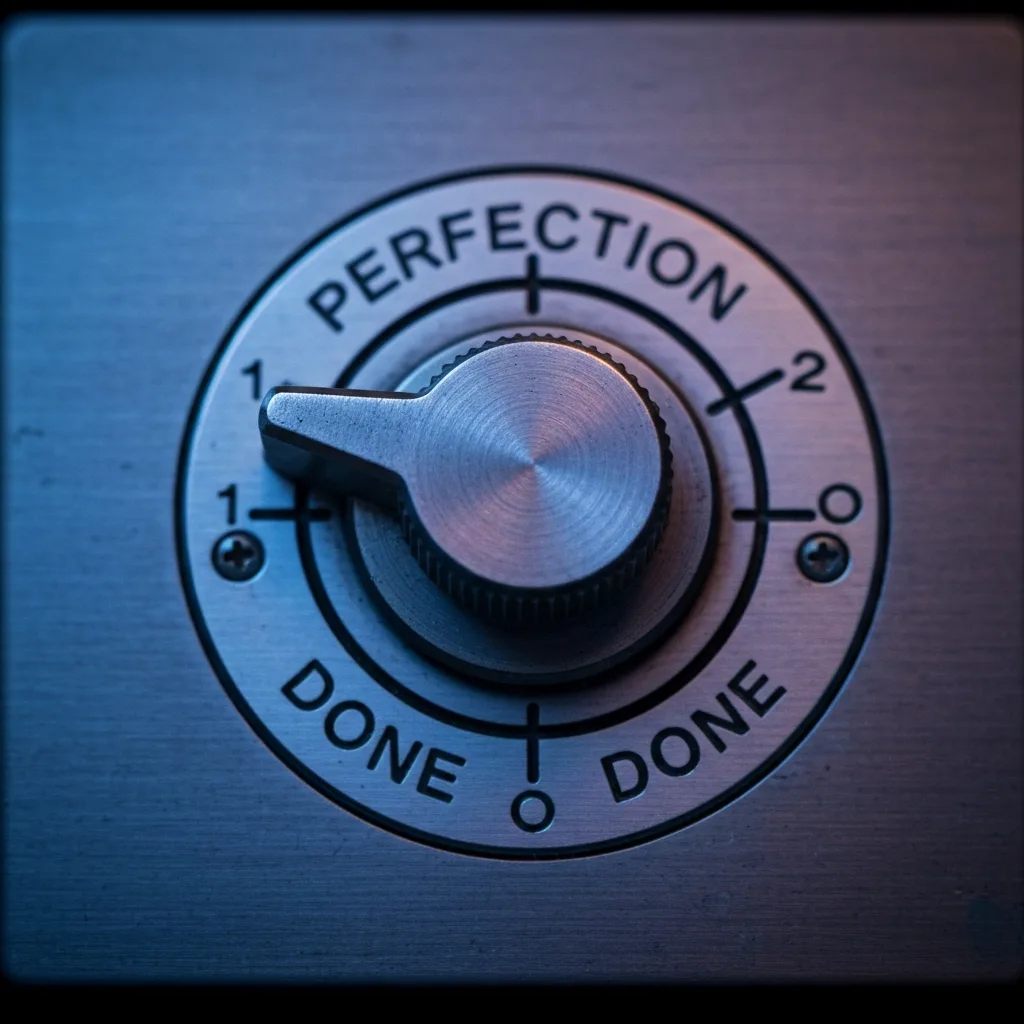
Borrowing from Agile: The Definition of Done
In software development, particularly within Agile and Scrum frameworks, teams rely on a concept called the Definition of Done (DoD). A piece of software is not considered complete just because a programmer feels good about it. It is complete when it meets a strict, pre-agreed checklist: the code is written, it has passed automated testing, it has been reviewed by a peer, and it is successfully integrated into the main system.
This framework is highly effective because it removes emotion and subjective judgment from the equation. It forces a binary outcome: the task either meets the criteria, or it does not.
Applying a personal Definition of Done—or a Completion Threshold—to your daily productivity operates on the exact same logic. A Completion Threshold is an objective, measurable metric that signals a task is ready to be shipped, closed, or handed off. It shifts the finish line from a feeling of satisfaction to a verifiable reality. By deciding in advance what constitutes a finished product, you strip away the anxiety of knowing when to stop and protect yourself from the trap of diminishing marginal returns, where you spend 80% of your time achieving the final 20% of the polish.
How to Build Your Completion Thresholds
Creating effective Completion Thresholds requires a slight shift in how you write your to-do lists and conceptualize your projects. Here is how to architect these boundaries for your own workflow.
1. Shift from Verbs to Deliverables
The most common mistake in task management is writing down activities instead of outcomes. A task labeled ‘Research competitor pricing’ is an activity. It has no built-in stopping point. You could research for twenty minutes or twenty hours.
To create a Completion Threshold, convert the verb into a specific deliverable. Change it to: ‘Draft a one-page document listing the pricing tiers of our top three competitors.’ Suddenly, the boundary is crystal clear. Once that document exists and contains those specific details, you are done. The research phase is forcibly closed, and you are free to move on to the next priority without residual guilt that you should have looked at a fourth competitor.
2. Calibrate to the Stakes
Not all tasks deserve the same level of rigor. A Completion Threshold allows you to intentionally calibrate your effort based on the stakes of the project. If you are writing a quarterly report for the board of directors, your threshold might include multiple rounds of proofreading, data verification, and a peer review.
However, if you are writing a weekly update email for your internal team, your Completion Threshold should be deliberately lower. It might be: ‘Three bullet points detailing progress, one bullet point highlighting blockers, no formatting, spell-checked once.’ By defining a low threshold for low-stakes work, you give yourself permission to produce ‘good enough’ work. You stop wasting executive function on internal communications and save your deep cognitive resources for high-impact projects.
3. The Handoff Rule
For collaborative projects, the most effective Completion Threshold is the Handoff Rule. A task is considered done when the next person in the chain can begin their work without needing to ask you any clarifying questions.
If you are drafting a wireframe for a designer, your threshold is reached when the layout is clear, the copy is attached, and the dimensions are specified. You do not need to make it look pretty; you just need to ensure it is actionable for the next person. If you are working solo, apply this to your ‘future self.’ Your Friday afternoon planning session is done when your Monday morning self can sit down, look at the schedule, and immediately start the first task without wondering what it means.
Applying Thresholds to Physical and Digital Organization
Completion Thresholds are not just for project management; they are incredibly powerful tools for getting organized. Vague organizational goals are the primary reason we procrastinate on cleaning our spaces.
Consider the goal to ‘organize the office.’ This is overwhelming because it is entirely subjective. Does organizing mean color-coding the bookshelf, or just taking out the trash? Without a threshold, you either avoid the task entirely or spend hours alphabetizing files while ignoring the actual clutter.
Instead, establish an objective Completion Threshold for your physical space. A highly functional threshold for an office might be: ‘The desktop is completely visible, all loose papers are inside the filing cabinet, and coffee mugs are in the dishwasher.’ Once those three conditions are met, the office is officially organized. You do not need to dust the baseboards or reorganize your drawer dividers unless those are specifically added to the threshold.
The same logic applies to digital organization. ‘Clean out my inbox’ is a recipe for getting stuck reading old newsletters. A digital Completion Threshold looks like this: ‘Zero unread emails in the primary tab, all actionable emails converted into tasks in the project manager, and all reference emails archived.’ You are not aiming for a perfectly curated folder structure; you are aiming for a functional baseline that allows you to work without friction.
The Psychology of Shipping
Implementing Completion Thresholds requires confronting a specific psychological discomfort: the fear of finality. As long as a project is still being tweaked, it remains full of potential. It hasn’t been judged, criticized, or rejected yet. Hitting your Completion Threshold and definitively calling a project ‘done’ forces you to face reality. It requires vulnerability.
However, shipping is a muscle. The more frequently you meet your thresholds and push work out the door, the stronger that muscle becomes. You begin to realize that frequent, ‘good enough’ iterations are vastly superior to delayed, theoretically perfect masterpieces. Momentum is built by finishing things, not by starting them.
Redefining Your Finish Lines
Productivity is not merely about optimizing your inputs; it is about ruthlessly managing your outputs. Every hour spent over-engineering a completed project is an hour stolen from a new opportunity, from rest, or from your personal life.
Take a look at your current task list. Find the project that has been lingering the longest—the one you keep opening, tweaking, and closing. Write down a single, objective Completion Threshold for it right now. Define the exact, minimum criteria required to get it off your plate. Meet those criteria, close the file, and experience the profound relief of finally being done.




Do you enjoy the content on Agenda Creativa?
Your contributions help me create new articles, share creative ideas, and keep this platform alive! If you like what I do and want to support my work, you can buy us a coffee.
Every cup of coffee means more than just a gesture – it's direct support for my passion to create inspiring and useful content. Thank you for being part of this journey!
☕ Buy me a coffee