
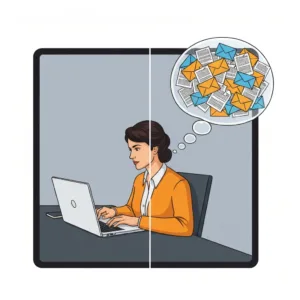
We rarely move cleanly from one part of our day to the next. Instead, we crash into our evenings carrying the residual friction of our workdays. We log off a tense virtual meeting and immediately walk into the kitchen to make dinner, snapping at a partner or child because our nervous system is still locked in a state of defensive arousal. This phenomenon is known as emotional bleed-over, and it is quietly draining our capacity for emotional balance.
For decades, the conversation around work-life balance focused on macro-boundaries: taking a two-week vacation, refusing to work on weekends, or leaving the office at a designated hour. But modern life, characterized by constant connectivity and context collapse, requires a more granular approach. To protect your emotional health, you need to master the architecture of mindful transitions by building micro-boundaries into your daily routine.
The Psychology of Emotional Bleed-Over
To understand why transitions matter, we have to look at how the brain processes sequential events. In the 1970s, psychologist Dolf Zillmann developed the Excitation Transfer Theory. Zillmann found that physiological arousal—whether from stress, anger, or excitement—does not dissipate immediately once the triggering event ends. Instead, that residual arousal transfers to the next situation you encounter.
If you experience a frustrating email exchange at 4:55 PM and sit down to dinner at 5:05 PM, your heart rate, cortisol levels, and cognitive vigilance are still elevated. When a minor annoyance occurs at the dinner table—a spilled glass of water, a loud noise—your reaction is fueled not just by the spill, but by the accumulated physiological stress of the email. You overreact, creating unnecessary interpersonal conflict, which in turn generates more stress.
Without intentional pauses between distinct phases of our day, we operate in a state of continuous psychological drag. The brain never receives the signal that a threat has passed or a task is complete, leading to systemic emotional exhaustion.

What Are Micro-Boundaries?
Micro-boundaries are small, deliberate actions that signal to your brain that one context has ended and another is beginning. They act as psychological palate cleansers.
While a macro-boundary might be taking a sabbatical to recover from burnout, a micro-boundary is taking three minutes to actively decompress between a deep-work session and a collaborative meeting. Micro-boundaries rely on behavioral and sensory cues to shift your cognitive state. They pull you out of autopilot and ground you in the present moment, intercepting the momentum of stress before it can infect the next hour of your life.
4 Pillars of a Mindful Transition
Building effective micro-boundaries requires more than just taking a break; it requires a specific psychological protocol. Here are four evidence-based techniques to construct mindful transitions throughout your day.
1. The “Third Space” Protocol
Dr. Adam Fraser, a researcher specializing in human performance, coined the term “The Third Space” to describe the transitional gap between the First Space (where you were) and the Second Space (where you are going). Fraser identified three distinct phases necessary to successfully navigate this gap: Reflect, Rest, and Reset.
Reflect: Instead of focusing on what went wrong in the previous environment, identify one thing you achieved or handled well. This closes the previous chapter on a note of competence rather than deficit.
Rest: Allow your brain a moment of stillness. This could be two minutes of staring out a window, focusing on your breath, or simply sitting quietly without a screen.
Reset: Clarify your intention for the next space. Ask yourself, “How do I want to show up in this next environment?” This shifts your brain from reactive survival mode into proactive, intentional behavior.
2. Cognitive Closure and the Zeigarnik Effect
In the 1920s, psychologist Bluma Zeigarnik observed that people remember uncompleted or interrupted tasks better than completed ones. This is known as the Zeigarnik Effect. When you leave work with a dozen open loops—unanswered emails, unfinished projects, unresolved decisions—your subconscious continues to process them, consuming vital cognitive bandwidth.
To create a micro-boundary, you must engineer cognitive closure. At the end of a work block or the end of the day, spend five minutes writing down exactly where you left off and what the next immediate step is. By externalizing these open loops onto paper, you signal to your brain that the information is safely stored and no longer requires active monitoring. This simple act dramatically reduces evening anxiety and mental rumination.
3. Sensory State Shifting
The human brain is highly responsive to environmental cues. You can leverage this by using sensory changes to enforce your micro-boundaries. When the sensory environment shifts, it prompts a corresponding shift in your internal emotional state.
If you work from home, the physical boundary between work and life is often nonexistent. You must create it artificially. When you finish working, physically close your laptop and put it out of sight. Change your lighting from bright overhead lights to softer, warmer lamps. Light a specific candle or play a particular genre of music that you only listen to when relaxing. Even changing your clothes—taking off your “work” outfit and putting on comfortable evening wear—sends a powerful somatic signal to your nervous system that the demands of the day have concluded.
4. Physiological Reset
Because emotional bleed-over is fundamentally a physiological issue—rooted in lingering adrenaline and cortisol—your transitions must address your biology. You cannot out-think a dysregulated nervous system; you have to physically process the stress.
During your transition windows, utilize breath pacing to manually lower your heart rate. The physiological sigh—two sharp inhales through the nose followed by a long, slow exhale through the mouth—is highly effective at rapidly reducing autonomic arousal. Just three to five cycles of this breathing pattern during a micro-boundary can clear the physiological remnants of your previous task, leaving you grounded and emotionally neutral for whatever comes next.
Structuring Your Daily Transitions
To implement this architecture, identify the primary friction points in your routine where emotional bleed-over is most likely to occur. There are typically three critical transition windows that require management.
The Morning Pivot
The transition from waking life into work mode sets the tone for your baseline stress levels. Avoid checking emails or messages while still in bed, as this instantly collapses the boundary between rest and labor. Create a morning micro-boundary by establishing a ritual—such as making pour-over coffee, walking the dog, or reading ten pages of a book—that belongs entirely to you before you grant the world access to your attention.
The Task-to-Task Pivot
Moving from a high-concentration task (like writing or data analysis) to a high-empathy task (like a one-on-one meeting) requires a massive cognitive shift. Do not stack these events back-to-back. Schedule intentional five-minute buffers between them. Use this time to stand up, stretch, look at something 20 feet away to relax your optic nerve, and set your intention for the upcoming interaction.
The Work-to-Life Pivot
This is the most critical boundary for preserving your personal relationships. The commute used to serve as a natural “Third Space,” providing time to decompress. If you lack a physical commute, create a psychological one. Walk around your block for ten minutes at the end of the workday. When you return through your front door, you are consciously stepping into your role as a partner, parent, or individual at rest, leaving the professional persona outside.
Preserving Your Emotional Bandwidth
We often treat emotional balance as something we achieve through weekend retreats or an hour of meditation. In reality, emotional equilibrium is won or lost in the margins of our days. It is determined by how we handle the connective tissue between our obligations.
By treating transitions not as wasted time, but as vital psychological infrastructure, you protect yourself from the slow accumulation of daily stress. Implementing micro-boundaries requires discipline, but the return on investment is profound. Taking two minutes to consciously transition between tasks can save you hours of emotional repair later. You stop dragging the debris of yesterday into the reality of today, allowing you to inhabit your life with clarity, presence, and genuine emotional freedom.



Do you enjoy the content on Agenda Creativa?
Your contributions help me create new articles, share creative ideas, and keep this platform alive! If you like what I do and want to support my work, you can buy us a coffee.
Every cup of coffee means more than just a gesture – it's direct support for my passion to create inspiring and useful content. Thank you for being part of this journey!
☕ Buy me a coffee