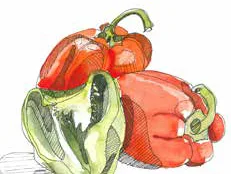
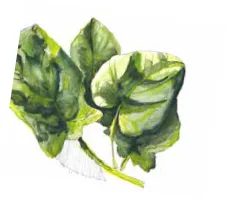
Spinach, Pumpkin and Parmesan Risotto – A Comforting Winter Dish
Risotto is the epitome of Italian comfort food, and this version combines the creaminess of Arborio rice with the sweetness of roasted pumpkin and the earthiness of spinach. Enriched with Parmesan cheese and a touch of garlic and rosemary, this is a dish that wraps you in warmth with every spoonful. Perfect for chilly days!
Ingredients (Serves 4)
320 g pumpkin (seedless, cubed, with skin on)
160 g fresh spinach (stems removed)
55 g fresh cream
15 g grated Parmesan
30 ml olive oil
1 whole garlic bulb
3 sprigs rosemary
540 ml vegetable broth
320 g risotto rice (such as Arborio)
Instructions
1. Prepare the vegetables:
Wash the spinach thoroughly and remove the stems. Clean the pumpkin well (no need to peel – the skin is rich in nutrients!) and cut it into 2 cm cubes. Remove the seeds.
2. Roast the pumpkin:
Preheat your oven to 180°C (350°F). Drizzle half of the olive oil over the pumpkin cubes and roast them for 40 minutes until golden and tender. Set aside.
3. Start the risotto base:
Heat the remaining olive oil in a large pot or deep skillet. Add the rice and stir to coat the grains evenly. Then add the crushed garlic cloves and the rosemary sprigs. Let the rice toast gently for 2 minutes over medium heat, allowing the flavors to infuse.
4. Add the broth:
Begin adding the hot vegetable broth one ladle at a time, stirring constantly and allowing each addition to be absorbed before adding the next. This process takes about 20 minutes. When the rice is nearly done, stir in the spinach leaves.
5. Finish the risotto:
Once the spinach has wilted and the rice is al dente and creamy, remove the rosemary. Stir in the cream, grated Parmesan, and roasted pumpkin cubes. Season with salt and pepper to taste.
Nutrition Tip:
This risotto is not just hearty – it’s a nutrient powerhouse! Spinach is rich in antioxidants and iron, pumpkin is packed with vitamin A, while Parmesan adds a boost of calcium. Garlic and rosemary not only provide deep flavor but also come with immune-boosting and anti-inflammatory properties.
Did You Know?
The pumpkin used in this dish originates from Hokkaido Island in Japan. Harvested between September and November, it stores well through March. Its vibrant orange color is a sign of high beta-carotene content, essential for skin health, strong bones, and good night vision.
Serving Suggestion:
Serve hot with extra grated Parmesan and a drizzle of olive oil. Pair with a glass of dry white wine or sparkling water infused with lemon and rosemary.
Enjoy this vibrant seasonal risotto – a perfect balance of flavor, warmth, and nutrition!
Nutrition Today and Its Impact on Health: What You Need to Know
In a world where our fast-paced lifestyle and modern eating habits increasingly affect our well-being, understanding what constitutes a balanced diet is essential. The concept of “healthy foods” has evolved into the more accurate term “healthy eating”, because no single food can provide all the essential nutrients the body requires.
What Does Healthy Eating Really Mean?
According to the European Food Information Council, healthy eating means variety, balance, and moderation. While there is no “miracle food,” a well-structured diet can prevent or reduce the risk of chronic conditions such as:
Cardiovascular disease
Cancer (including colon and liver)
Gastrointestinal disorders
Obesity and diabetes
Osteoporosis, anemia, and gout
Tooth decay
As Hippocrates famously said: “Let food be thy medicine and medicine be thy food.”
Essential Nutrients That Support Health
1. Dietary Fiber
Soluble and insoluble fiber is key to digestive health, helps prevent constipation, diverticulitis, and even colon cancer. It also plays a role in regulating cholesterol levels and controlling blood sugar.
These essential fats are crucial for proper body function. Omega-3, in particular, provides strong cardiovascular protection and reduces the risk of heart attacks.
Probiotics maintain a healthy gut microbiome and strengthen the immune system, potentially reducing the risk of infections, allergies, and even cancer.
📌 Probiotics: yogurt with Lactobacillus or Bifidobacterium 📌 Prebiotics: garlic, onions, bananas, honey, whole grains, artichokes
5. Polyphenols
These micronutrients, rich in antioxidants, help prevent degenerative diseases, especially heart disease and cancer.
📌 Common sources:
Brightly colored fruits (apples, citrus)
Green tea, calendula tea, red wine
Legumes, soy (isoflavones), and apples (phloridzin)
What Foods Should Be Avoided or Eaten in Moderation?
Smoked and marinated foods – Contain nitrites/nitrates that may form nitrosamines, linked to colon and rectal cancer.
Mycotoxins – Aflatoxins from moldy foods can damage the liver.
Genetically modified foods – Still under debate for safety.
Produce sprayed with pesticides – May pose hormonal and immune risks.
Poor-quality meat and fish – The quality depends on the animals’ feed and water environment.
Harmful Dietary Habits to Avoid
The most common nutrition mistakes that negatively affect health include:
Insufficient consumption of fruits and vegetables
Lack of whole grains
Excessive intake of sugar, salt, and saturated fats
Regular alcohol consumption
Low fiber intake
Unbalanced intake of carbohydrates, proteins, and fats
What You Can Do to Improve Your Diet
🔸 Eat colorful fruits and vegetables daily 🔸 Choose local, seasonal foods from safe sources 🔸 Avoid processed foods, additives, and excess sugar 🔸 Cook more meals at home, avoid fast food 🔸 Always check food labels and ingredients
Final Thoughts
Healthy eating is not about restriction—it’s about balance. The quality, variety, and source of your food can deeply influence your physical and mental well-being. Choose wisely, eat consciously, and turn your meals into a long-term investment in your health.
Bucovinian Tochitură – Rustic Romanian Flavor at Its Finest
Bucovinian Tochitură is one of the most flavorful and rich traditional Romanian dishes, born from the culinary spirit of Bucovina and the generosity of festive winter meals. Though it began as a simple rustic meal – rendered pork fat and cracklings served with polenta – over time, this dish evolved into a celebration of everything delicious about pork, garlic, and farmstead cheese.
The name comes from the Moldavian regional word“tochit”, meaning “melted,” referring to the process of rendering pork fat during the traditional pig slaughter. Over the years, as more of the pork was cooked and used, tochitură became a medley of meat cuts, organ meats, garlic, sausage, and a signature side of potato polenta and fresh cheese.
Ingredients for the Tochitură (Serves 4 generously):
500 g pork leg meat (shoulder or thigh)
250 g pork liver
250 g smoked sausages (preferably homemade)
1–2 pork kidneys
1 liter cold milk (for soaking)
10 garlic cloves
3–4 tablespoons pork lard
5 eggs (for frying)
300 g fresh sheep’s cheese (caș)
Salt and freshly ground black pepper
Preparing the Ingredients:
Cleaning the kidneys: Cut the kidneys in half lengthwise. Carefully remove any internal membranes and fat using a sharp knife. Rub them well with baking soda, rinse thoroughly, and soak in cold milk for at least 2 hours to eliminate any unpleasant odors.
Prepping the liver: Trim any veins, rinse well, and cut into medium-sized pieces. Soak in cold milk for at least 4 hours to tenderize and prevent it from becoming tough during frying.
Slicing meat and sausages: Cut both the pork and the smoked sausages into medium-sized cubes.
Cooking the Tochitură:
Heat the pork lard in a heavy-bottomed pan or cast iron pot.
Add the pork meat and sear gently on low heat until it starts to brown lightly.
Add the kidneys and liver. Cook slowly, stirring occasionally.
Toward the end, add the smoked sausages and crushed garlic. Let everything sizzle for a few more minutes so the flavors blend.
Season with salt and pepper to taste.
Preparing the Fried Eggs:
In a separate pan, melt a little pork lard.
When hot, crack in the eggs, being careful not to overlap them.
Let them set over low heat, then tilt the pan and spoon hot fat over the tops of the eggs to finish cooking without flipping.
Season with salt and, if desired, freshly ground black pepper. Carefully lift each egg out with a spatula.
Bucovinian Potato Polenta (Mămăligă din Cartofi):
This special potato-based polenta is a regional specialty in Bucovina and pairs perfectly with the richness of the meat.
Ingredients:
1 kg potatoes
500 g cornmeal (mălai)
Salt to taste
Method:
Peel and dice the potatoes. Boil in salted water until just covered.
Once cooked, mash them directly in the pot (preferably a cauldron).
Gradually sprinkle in the cornmeal, stirring continuously to avoid lumps.
Return the pot to low heat and cook for around 10 minutes, stirring constantly.
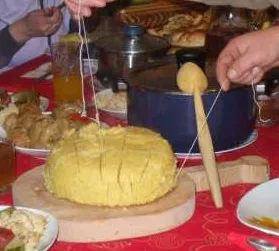
Level the polenta, let it simmer gently for 2–3 more minutes, then turn it out onto a wooden board in the center of the table.
Serving and Assembly:
On each plate, spoon a hearty portion of potato polenta.
Top with the hearty meat mixture and one fried egg.
Grate fresh sheep’s cheese (caș) over the top while everything is still hot.
Serve with homemade pickles: cucumbers, peppers, or sauerkraut for a refreshing contrast.
A True Taste of Bucovina
Tochitură Bucovineană is more than a meal—it’s a warm, satisfying experience steeped in history and flavor. From the rich organ meats to the rustic fried eggs and unique potato polenta, each bite tells the story of rural life, tradition, and celebration. It’s a dish best enjoyed with family, especially during the winter holidays, but it’s welcome at any table year-round.
Perfectly hearty, utterly satisfying, and deeply traditional—this is Bucovina on a plate.
Enjoy!
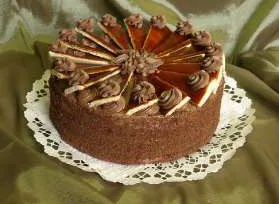
Dobos Cake: The Royal Dessert of Hungary
Dobos Cake is a symbol of sophistication in Hungarian pastry, a creation that has transcended both time and geography. Invented in 1884 by the famous pastry chef József C. Dobos, this spectacular cake quickly won the hearts of dessert lovers across Europe. At the 1885 General Exhibition in Budapest, the cake was even tasted by Empress Elisabeth of Austria-Hungary (Sissi) and Emperor Franz Josef, a moment that solidified its reputation.
Unlike the overly ornate desserts of its time, Dobos cake introduced a revolutionary concept: thin sponge cake layers, alternating with a rich chocolate buttercream, and topped with a crunchy caramelized sugar glaze. This contrast of textures and flavors turned it into a beloved classic that remains a staple at birthdays, weddings, and other special occasions.
Ingredients for the Sponge (for a 22 cm cake)
6 eggs
100 g sugar
100 g flour
35 g melted butter
Preparing the Sponge Layers:
Separate the eggs. Beat the yolks with half of the sugar until light and fluffy.
In a separate bowl, beat the egg whites with the remaining sugar until stiff peaks form.
Gently fold the two mixtures together, then gradually incorporate the sifted flour and melted butter, mixing gently.
Divide the batter into 6 equal parts and bake each layer in a round, lined pan at 190–210°C (375–410°F) for 10–12 minutes, until golden.
Once baked, gently remove the layers with a knife.
Ingredients for the Chocolate Cream:
4 eggs
200 g powdered sugar
235 g room-temperature butter
17 g vanilla sugar
35 g cocoa mass
35 g cocoa butter
200 g dark chocolate (at least 50% cocoa)
Preparing the Cream:
In a double boiler, melt the cocoa mass, cocoa butter, and dark chocolate, stirring constantly.
In another bowl, beat the butter with the vanilla sugar until fluffy.
Separately, heat the eggs with the powdered sugar to no more than 85°C (185°F), then continue beating until completely cooled.
Combine the egg foam with the butter mixture, then gently fold in the melted chocolate mixture until fully combined.
Assembly:
Reserve one of the sponge layers to become the caramelized top.
Spread an even layer of chocolate cream between the remaining sponge layers, smoothing them out nicely.
For the reserved top layer, melt sugar until it turns golden caramel and pour it evenly over the layer. Let it set, then cut it into 20 equal wedges.
Arrange the caramel wedges on top of the cake in a fan shape or circular design.
TIP!
For a flawless finish, refrigerate your Dobos cake for at least 2 hours before serving. This allows the cream to set beautifully and the flavors to meld perfectly.
Dobos Cake is more than just a dessert: it’s a journey through time, a tribute to classic elegance, and a perfect example of confectionery perfection.
Ideal for special occasions, yet refined enough to impress any chocolate lover, this cake invites you to rediscover the authentic flavors of Central Europe.
Enjoy!
Traditional Hungarian Goulash Soup
Goulash soup (Gulyásleves) is one of the most iconic dishes in Hungarian cuisine, with a history that spans several centuries. Originating from the pastoral life of the Hungarian plains (Puszta), goulash was traditionally cooked by shepherds in a single pot — the cauldron — using simple yet flavorful ingredients.
This recipe has stood the test of time, evolving from a rustic shepherd’s meal to a celebrated dish served in restaurants across Budapest and Vienna as early as the 19th century. Today, goulash soup is a staple on Hungarian tables during festive occasions like Christmas, Easter, and Saint Stephen’s Day.
Read on to discover how you can prepare an authentic Hungarian cauldron goulash at home by following this classic recipe that brings the heart of Hungary right into your kitchen.
Ingredients (Serves 4–6)
400g beef or pork leg, cut into 2 cm cubes
1–2 onions, finely chopped
1 tablespoon oil
1 tablespoon sweet paprika (or hot, to taste)
1 garlic clove, crushed
1 teaspoon cumin seeds
Salt and black pepper, to taste
1–3 bay leaves
1–2 carrots, diced
1 green bell pepper, diced
2 tomatoes, diced
Fresh celery leaves
Fresh parsley, finely chopped
1 parsnip, diced
2 potatoes, diced
Preparation Method
1. Sauté the Onion and Brown the Meat
In a large pot or traditional cauldron, sauté the chopped onions in oil until translucent. Add the meat and brown it until it forms a light crust.
2. Add Spices and Simmer
Stir in the paprika and mix well. Pour in a little water to deglaze the pot, then add salt, garlic, cumin seeds, black pepper, bay leaves, and the diced tomatoes. Let everything simmer gently for about 30 minutes.
3. Incorporate the Vegetables
Add enough water to fully cover the meat. Then add the carrots, parsnip, bell pepper, celery leaves, and parsley. Bring to a boil and continue to simmer for another 10 minutes.
4. Finish with Potatoes
Add the diced potatoes and top up with water if needed. Simmer gently until the potatoes are fully cooked and tender.
Serving Suggestion
Serve the goulash soup hot, accompanied by fresh or dried chili peppers and rustic homemade bread or flatbread.
For an authentic experience, try cooking this recipe outdoors over a wood fire, using a classic cast iron Hungarian cauldron to enjoy the full charm of traditional pastoral cooking.
Fun Facts About Goulash Soup:
The word “gulyás” comes from the Hungarian term for “herdsman.”
Originally, goulash was made exclusively with meat from the native Hungarian grey cattle.
Until the 19th century, it was considered an urban delicacy, especially in cities like Budapest.
Today, goulash is regarded as a national culinary symbol of Hungary.
Enjoy this truly authentic soup, rich in history, flavor, and Hungarian tradition!
Caramel Pleasure
„A drop of dream, a dance of longing, Smooth Caramel, an enchanting taste. In every drop is a pleasure That envelops the heart with a sweet caress”
Preparing the layers (3 sheets) Recommended:Preheat the oven to 180°C (top and bottom heat, no fan)
Separate the eggs, placing the whites in a clean, dry bowl.
Whisk the whites with a pinch of salt until they form stiff peaks.
Gradually add 250 g sugar, continuing to whisk until you obtain a dense, glossy meringue.
Gently fold in the flour and finely ground walnuts with a spatula, using upward motions.
Divide the mixture into three equal parts.
Bake each sheet on the reverse side of a baking tray lined with parchment paper for 10 minutes, or until it takes on a light golden hue.
Allow the sheets to cool completely on a wire rack, without stacking.
Preparing the caramelized walnuts
Toast 350 g walnuts in a dry pan over medium heat until they are lightly browned and fragrant. Remove to a bowl.
In a heavy-bottomed saucepan, caramelize 150 g sugar over low heat, stirring gently only when it begins to melt evenly.
When the caramel acquires a copper color, add the toasted walnuts and quickly stir to coat them.
Pour the mixture onto a plate greased with a little oil, and spread rapidly with a spatula.
Allow to cool completely, then crush with a rolling pin, leaving some larger pieces for texture.
Preparing the cooked cream Recommended: Use a bain-marie (place a stainless steel bowl over a pot of hot water, without the bowl touching the water).
In a heatproof bowl, combine: yolks, 250 g sugar, cubed butter, broken chocolate pieces, and rum extract.
Position the bowl over the pot with gently simmering water.
Cook over steam, stirring constantly, until the mixture becomes thick and homogeneous. Estimated time: 10–15 minutes
The cream should visibly thicken (similar to heavy cream).
Allow the cream to cool completely at room temperature.
After cooling, beat the cream for a few minutes to achieve a more airy and smooth consistency.
Incorporate the crushed caramelized walnuts, mixing gently with a spatula.
Assembly
Place the first layer on a serving platter.
Spread one third of the cream evenly.
Continue with the second layer and another third of the cream.
Add the third layer and spread the remaining cream on top.
Level the edges neatly with a knife or spatula.
Decoration (optional, but recommended)
Melt 100 g chocolate in a bain-marie or microwave.
Spread a thin chocolate layer over the cake or create an artistic pattern.
Sprinkle chopped walnuts or place halves for an elegant appearance.
🧊 FINAL RECOMMENDATION Refrigerate the cake for at least 2–3 hours (ideally overnight) so that the layers soften and the flavors meld.
CARAMEL CAKE
📝 Description
A cake with a classic appearance but a spectacular taste, composed of a fine caramel-flavored sponge, topped with a generous layer of tart jam and a silky meringue with a subtle hint of lemon. The soft texture and contrast of flavors make it an ideal dessert for festive meals as well as for days when you want something truly special.
✅ Ingredients
For the caramel syrup and sponge:
200 g granulated sugar (for caramel)
100 ml water (preferably hot)
250 g butter (82 % fat), cut into cubes
4 egg yolks
1 pinch of salt
1 packet baking powder (10–12 g)
300 g plain flour (type 000 or for cakes)
400 g jam (apricot, plum or sour cherry, ideally slightly tart)
For the meringue:
4 egg whites
100 g granulated sugar
2 tablespoons water
100 g granulated sugar (for the meringue syrup)
juice of 1 medium lemon
For greasing the tin:
20–30 g softened butter
1 tablespoon flour
🍳 METHOD OF PREPARATION
Preparation of the caramel syrup
In a heavy-bottomed saucepan, caramelize 200 g of sugar over low heat, without stirring too much, until it takes on a copper-brown color (not burnt).
Carefully pour 100 ml of hot water over the caramelized sugar—beware, it will bubble vigorously.
Immediately add 250 g of butter, stirring continuously until it melts completely and the caramel syrup becomes smooth.
Let the syrup cool for 15 minutes.
Preparing the batter (sponge)
Separate the eggs. Keep the whites refrigerated until needed.
Into the cooled syrup, whisk in the 4 yolks, the pinch of salt, and the baking powder, then gradually sift in the flour, mixing with a whisk or mixer.
The final mixture should have the consistency of a thick batter.
Baking the sponge
Grease a baking tin (approx. 25×35 cm) with butter and dust with a little flour.
Pour the batter into the tin and level with a spoon.
Bake in a preheated oven at 180 °C (moderate heat) for 45 minutes, or until the warm sponge is golden and firm to the touch.
After baking, remove the tin and let the sponge rest for 5–10 minutes.
Preparing the meringue
Beat the 4 egg whites to stiff peaks, gradually adding 100 g sugar.
Separately, in a small saucepan, boil 100 g sugar with 2 tablespoons of water until you obtain a clear syrup.
Pour the hot syrup in a thin stream over the beaten whites, mixing continuously.
Add the juice of 1 medium lemon and beat for another 2–3 minutes, until the meringue is glossy and stable.
Final assembly and baking the meringue
Spread the tart jam evenly over the warm sponge.
Top with the meringue and smooth beautifully.
Return the cake to the oven at low heat (150 °C) for 5 minutes, just until the meringue takes on a light sheen and slight contour.
Turn off the oven, leaving the cake inside for an additional 10 minutes with the door ajar.
🧊 Cooling and Serving
Allow the cake to cool completely at room temperature.
Slice with a knife dipped in hot water and wiped clean each time for even cuts.
🎂 Serving Suggestion Se potrivește perfect cu un ceai negru, cafea amară sau un pahar de lapte rece. Este o prăjitură elegantă, cu gust echilibr
WALNUT, CARAMEL AND WHITE CHOCOLATE CAKE
📝 Description
A refined cake, with a light walnut sponge, caramelized cream with rich texture and sweet white chocolate accents, complemented by a delicate dark chocolate glaze. It is a festive dessert, perfectly balanced between crunchy, creamy, and melt-in-the-mouth, ideal for festive meals or occasions when you want to impress.
✅ Ingredients
For the sponge:
6 egg whites
200 g granulated sugar
200 g finely ground walnuts
1 packet baking powder (10–12 g)
1 packet vanilla sugar (8 g)
50 g plain flour
For the caramel walnut cream:
100 g granulated sugar (for caramel)
250 g chopped walnuts (not ground)
6 egg yolks
50 g granulated sugar
250 g unsalted butter (82 % fat), softened
For assembly and decoration:
100 g grated white chocolate (for the base layer)
200 g dark chocolate (for the glaze)
50 g grated white chocolate (for final decoration)
🍳 METHOD OF PREPARATION
Preparing the sponge
Preheat the oven to 180 °C, static.
Whisk the egg whites with a pinch of salt until they form stiff peaks.
Gradually add 200 g granulated sugar, continuing to whisk until you obtain a firm, glossy meringue.
Gently fold in 200 g ground walnuts, 50 g plain flour, 1 packet baking powder, and vanilla sugar using a spatula with upward motions.
Pour the batter into a 25×35 cm tin lined with parchment paper and bake at 180 °C for 20–25 minutes, or until the toothpick test comes out clean.
Remove the sponge from the oven and, while still warm, grate 100 g white chocolate over the top. Let it melt and absorb into the sponge.
Preparing the caramelized cream
In a saucepan over low heat, caramelize 100 g granulated sugar until it reaches a rich amber color.
Immediately add 250 g chopped walnuts and stir quickly to coat them in caramel.
Separately, beat 6 egg yolks with 50 g sugar until creamy.
Pour the yolk mixture over the caramelized walnuts, then add 250 g cubed butter.
Cook over low heat, stirring continuously, until the caramelized cream thickens visibly and attains a dense consistency.
Remove from heat and allow to cool slightly—remaining warm for easy spreading.
Assembly
Spread the warm caramelized cream evenly over the sponge still covered with melted white chocolate.
Allow the cake to cool completely at room temperature so that the layers settle.
Glaze and decoration
Melt 200 g dark chocolate at a bain-marie or in the microwave in short bursts, then pour over the cake and level quickly.
While the dark chocolate glaze is still soft, grate an additional 50 g white chocolate on top for visual contrast and flavor.
🧊 Serving and Storage
Chill the cake for at least 2 hours before slicing.
For clean cuts, dip your knife in hot water and wipe it between slices.
Store in the refrigerator for up to 4–5 days.
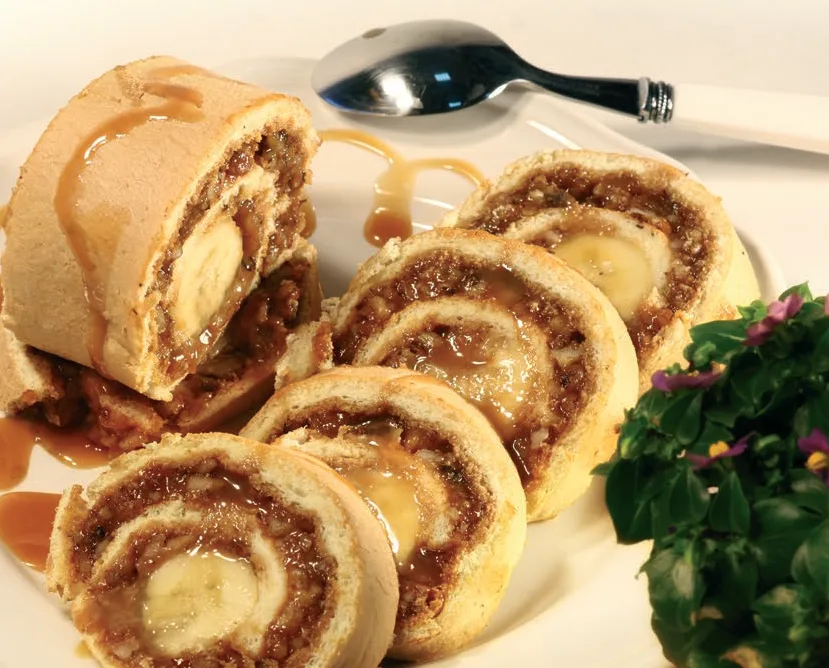
CARAMEL CREAM ROLL
📝 Description
This roll combines a fluffy sponge, an intensely flavored caramel cream with walnuts, and a surprising whole banana filling. It is a dessert balanced between sweet, fruity, and crunchy, ideal for special events or a family meal. The rum flavor and crispy chocolate coating on the outside make it truly exceptional.
✅ Ingredients
For the sponge sheet:
4 eggs
A pinch of salt
60 g granulated sugar
50–60 g plain flour (type 000), sifted
For the caramel walnut cream:
2 whole eggs
125 g granulated sugar (for the eggs)
125 g granulated sugar (for caramelizing)
250 g finely ground walnuts
60 g unsalted butter (82 % fat), cubed
10 g vanilla sugar
15 ml rum extract
For filling and decoration:
2 ripe but firm bananas
🍳 Method of Preparation
Sponge sheet
Preheat the oven to 180 °C (top and bottom heat, no fan).
Separate the whites from the yolks.
Whisk the egg whites with a pinch of salt until they form stiff peaks.
Gradually add 60 g sugar, mixing until you obtain a glossy, firm meringue.
Gently fold in the yolks, one at a time.
Finally, sprinkle in the sifted flour in a thin stream and fold with a spatula in slow upward motions to preserve the air in the batter.
Pour the mixture into a 25×35 cm pan lined with parchment paper.
Bake at 180 °C for 10–12 minutes, until lightly golden and a toothpick comes out clean.
Remove the hot sheet and place it onto a lightly dampened clean towel, then roll it up tightly in the towel. Let it cool.
Caramel walnut cream
In a bowl, beat 2 whole eggs with 125 g sugar until the mixture lightens in color and doubles in volume (approx. 5–7 minutes).
Separately, in a saucepan over low heat, caramelize 125 g sugar until it reaches an amber hue.
Immediately add the ground walnuts, stirring well to coat them with the caramel.
Quickly pour the beaten egg mixture over the walnut caramel, stirring continuously with a whisk over low heat.
When the mixture begins to thicken (without vigorous boiling), add the cubed butter. Continue stirring until it melts completely and the cream becomes glossy and thick.
Remove from heat and stir in the vanilla sugar and rum, then let the cream cool slightly.
Assembling the roll
Unroll the cooled sponge carefully and remove the parchment paper.
Spread ¾ of the warm caramel cream evenly over the entire surface.
At one end, place the whole bananas and begin to roll tightly, taking care to form a neat roll.
Position the roll seam-side down on a platter.
Decoration and serving
Spread the remaining cream over the top of the roll, covering it completely.
Optionally, decorate with chopped nuts, chocolate flakes, or a splash of rum.
Chill for at least 1 hour before serving to allow the cream to set and the shape to stabilize.
🧊 Final Recommendations Slice the roll with a sharp knife dipped in hot water and wiped clean for clean cuts. Store in the refrigerator; it tastes best the next day once the flavors have harmonized.
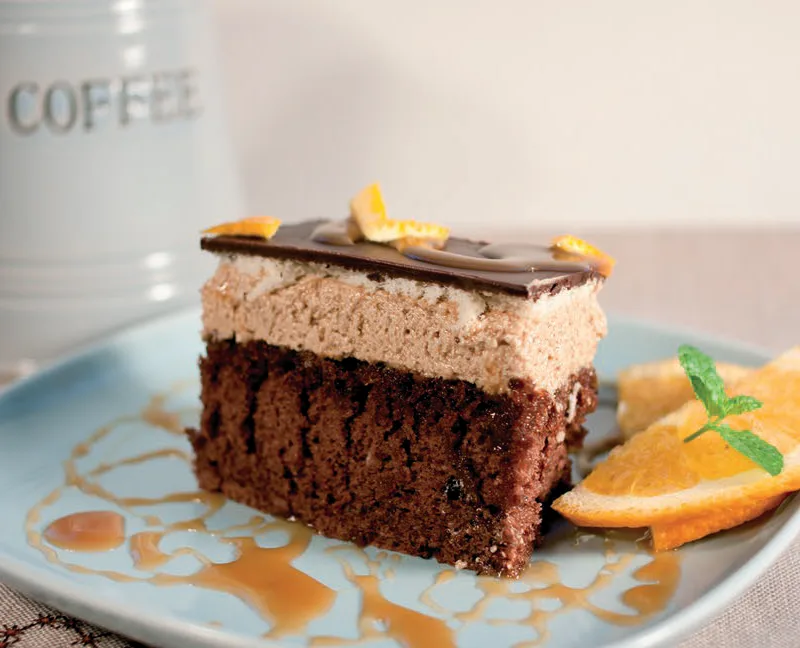
CARAMELIZED CAKE
📝 Description
This refined cake is composed of a fluffy walnut and cocoa sponge, topped with a crunchy caramel layer, a coffee-flavored cream, and a light Doboș sheet. It is an excellent choice for festive occasions, anniversaries, or whenever you wish to surprise guests with an intense and balanced taste. It pairs perfectly with black coffee, an espresso, or a cappuccino, as well as with a glass of liqueur wine such as Port.
✅ Ingredients
For the sponge:
6 eggs
5 tablespoons cold water
11 tablespoons granulated sugar
5 tablespoons plain flour (type 000)
5 tablespoons finely ground walnuts
1 tablespoon cocoa
For the Doboș sheet:
2 eggs
2 tablespoons granulated sugar
2 tablespoons flour
For the coffee-flavored cream:
5 whole eggs
20 tablespoons granulated sugar
4 sachets instant coffee (approx. 8–10 g each)
400 g unsalted butter (82 % fat), soft, cubed
For the caramel:
7 tablespoons granulated sugar
🍳 Method of Preparation
Walnut and cocoa sponge Preheat the oven to 180 °C. Separate the eggs. Beat the egg whites with a pinch of salt until very stiff. Gradually add 11 tablespoons sugar, whisking until the meringue is firm and glossy. Incorporate the yolks one at a time, mixing gently. Add 5 tablespoons cold water, then fold in the flour, ground walnuts, and cocoa with a spatula using upward motions. Pour the batter into a large (30×40 cm) tin greased with butter and dusted with flour or lined with parchment paper. Bake for 20–25 minutes, until a toothpick comes out clean. Let cool in the tin.
Doboș sheet Separate the 2 eggs. Beat the whites until stiff, then add the sugar and yolks. Finally, fold in 2 tablespoons of flour gently. Bake in a small lined tin at 180 °C for 10–12 minutes, until golden. Remove to a rack to cool.
Coffee-flavored cream In a heatproof bowl, beat 5 whole eggs with 20 tablespoons sugar and the instant coffee. Place the bowl over a bain-marie and stir continuously until the mixture thickens slightly (approx. 12–15 minutes). Remove from heat and let cool completely. After cooling, gradually beat in the softened butter cubes until you obtain a smooth and airy cream.
Caramel In a heavy-bottomed pan, melt 7 tablespoons sugar over low heat until deep golden. As soon as it is ready, pour the hot caramel over the cooled sponge, spreading quickly with the back of a metal spoon. Note: The caramel hardens very fast. You may oil the spoon lightly to prevent sticking.
Assembly Over the cooled caramel layer, spread a generous layer (about two-thirds) of the coffee cream. Place the Doboș sheet on top. Level the remaining cream over the Doboș sheet. Optional: Instead of cream on top, you can use melted chocolate for a glossy finish and added flavor.
🧊 Cooling and Serving The cake must be refrigerated for at least 2 hours before serving, ideally overnight. For clean slices, dip your knife in hot water and wipe between cuts.
🎂 Serving Suggestions This cake is especially suitable for:
Special events: Christmas, Easter, anniversaries
Festive meals or family gatherings Served with bitter coffee or a cup of black tea.
Easter Meal Menu – Tradition and Distinct Flavors
Easter is a special celebration, and the Easter meal represents a moment of family gathering and celebration. Culinary traditions are essential for this holiday, and the dishes are rich in aromas and ingredients that pay homage to ancient traditions. Here is a proposal for a complete Easter menu, which includes both traditional dishes and a few modern delights, to satisfy all tastes.
Appetizers
Platter of traditional cold cuts
Homemade cracklings
Boeuf salad with homemade mayonnaise
Homemade pâté with butter and spices
Chicken roulade with vegetables and cheese
Goat cheese with honey and nuts
Tuna-stuffed eggs
Boiled eggs filled with tuna paste and mayonnaise, sprinkled with fresh parsley.
Lamb meatballs with aromatic herbs
Lamb meat patties, fried and served with a mint yogurt sauce.
Mini grape leaf rolls
Traditional rolls with pork and rice, slow-cooked in a tomato and smoked-meat sauce.
Burduf cheese and smoked kashkaval
Platter of fine cheeses served with fresh homemade bread.
Main Course
Roast leg of lamb in the oven Tender lamb seasoned with garlic, rosemary, and olive oil, baked until succulent, served with a side of oven-roasted new potatoes.
Lamb soup with vegetables A light soup of lamb meat, fresh vegetables, and greens, served with sour cream and a slice of lemon.
Whole chicken stuffed with mushrooms and vegetables A whole chicken filled with a mix of mushrooms and vegetables, slow-roasted to retain its juiciness.
Lamb Drob Drob is a traditional Easter dish, essential for the festive table. It is made from lamb offal (liver, kidneys, heart), mixed with fresh herbs, onion, garlic, eggs and spices. These are wrapped in lamb bladder or plastic foil, then baked in the oven to obtain a tasty and tender dish. Drob is served cold, alongside mustard or a spring salad.
Spring crudités salad with boiled eggs Fresh salad with radishes, cucumbers, spring onions and boiled eggs, drizzled with a dressing of olive oil, lemon and mustard.
Tender lamb seasoned with garlic, rosemary and olive oil, baked in the oven until it becomes succulent, served with a side of oven-roasted new potatoes.
Garnishes
Polenta with cheese and sour cream
Fine polenta served with burduf cheese and sour cream, a perfect accompaniment to roast lamb.
New potatoes with aromatic herbs
New potatoes boiled and served with butter and fresh aromatic herbs such as rosemary and thyme.
Peas with carrots and butter
Peas and carrots steamed, finished with a drizzle of butter and fresh parsley for a refined taste.
Sautéed cabbage with bacon
Fresh cabbage sautéed with bacon and spices, a classic side for traditional Easter dishes.
Desserts
Chocolate and berry cake A delicate chocolate sponge, layered with chocolate cream and fresh berries, decorated with whipped cream and grated chocolate.
Fruitcake with candied fruit and nuts A fluffy fruitcake studded with candied fruit and nuts, scented with vanilla and orange zest.
Walnut and raisin sweet bread A fluffy sweet bread filled with walnuts and raisins, baked traditionally, perfect to end the Easter meal.
Pasca with cheese and raisins Pasca made with sweet cheese and raisins, flavored with vanilla and lemon zest, baked until golden and beautifully browned.
Drinks
Plum brandy or rachiu A traditional spirit, used to open the appetite and lend an authentic note to the Easter table.
White and red wine To accompany the festive meals, we serve selected white and red wines, which pair perfectly with lamb and chicken dishes.
Mint lemonade A refreshing drink, ideal for spring meals, made from freshly squeezed lemons and fresh mint leaves.
Additional Suggestions: To add a personal touch and delight your guests, consider placing on the table traditional dishes from your region or special family recipes. Also, remember to pay attention to the presentation of the dishes, decorating the table with spring flowers and candles for a festive ambiance.
The Easter meal is the perfect moment to enjoy time with loved ones, and this menu is designed to bring both tradition and flavor to every dish. Enjoy your meal and happy holidays!
Splendor with Kiwi, Oranges and Other Surprises
Ingredients
For the sponge
150 g plain flour
5 eggs
120 g granulated sugar
10 tablespoons water
1 packet baking powder
50 g chopped walnuts
For the cream
200 g Unirea margarine for creams
4 eggs
120 g sugar
10 g cocoa powder
100 g ground walnuts
For the syrup
100 g sugar
10 tablespoons water
For decoration
500 ml whipped cream
Candies for garnish
3 kiwis
2 oranges
50 g grated chocolate
Preparation time: 90 minutes Difficulty: Medium
🍳 Method of Preparation
Preparing the sponge
Separate the eggs: Begin by separating the whites from the yolks. Use two separate bowls for this step.
Beating the egg whites: Whisk the whites in a large bowl with an electric mixer until you obtain stiff peaks. It is essential to beat them long enough so they are fluffy and do not collapse.
Preparing the yolks: In another bowl, beat the yolks with 120 g of sugar using the mixer. Gradually add the 10 tablespoons of water, continuing to mix until the mixture is smooth and airy.
Incorporating the dry ingredients: To the yolk mixture, add the baking powder, chopped walnuts (50 g), and flour. Mix well to obtain a uniform batter.
Folding in the egg whites: Alternately fold in the beaten whites and the dry mixture—one spoonful of flour mixture, then two spoonfuls of egg whites—using a gentle motion to preserve the air.
Baking: Pour the batter into a buttered and floured baking pan. Bake at medium heat (around 180 °C) for 20 minutes, or until the sponge is golden and passes the toothpick test (insert a toothpick into the center—if it comes out clean, it’s done). After baking, let it cool completely on a wire rack.
Once cooled, slice the sponge horizontally into two equal halves.
Preparing the cream
Cooking the cream: In a bowl, beat the 4 whole eggs with 120 g sugar. Add the cocoa powder and place the mixture over a bain-marie. Cook over low heat, stirring constantly to prevent lumps, until the cream thickens to a dense consistency.
Cooling the cream: Once thickened, remove from heat and allow the cream to cool completely at room temperature.
Whipping with margarine: After cooling, beat the cream with 200 g Unirea margarine for creams until you obtain a smooth, creamy filling. Then fold in the 100 g ground walnuts until well incorporated.
Preparing the syrup
Cooking the syrup: In a small saucepan, combine 100 g sugar and 10 tablespoons of water. Simmer over low heat, stirring occasionally, until the sugar fully dissolves and the syrup becomes slightly viscous. Allow the syrup to cool completely.
Assembling the cake
Soaking the sponge: Using a pastry brush, gently soak each sponge layer with the cooled syrup. Be generous but careful not to oversaturate, so the sponge remains light.
Applying the cream: Once the layers are well soaked, spread a generous, even layer of the walnut–cocoa cream on each half.
Decorating the cake
Whipping the cream: Beat 500 ml of whipped cream with a mixer until firm. Optionally sweeten with a little powdered sugar.
Fruit and chocolate garnish: Arrange the whipped cream evenly over the surface. Top with thin slices of kiwi and orange, then sprinkle with grated chocolate for an elegant finish.
Final touches: Add decorative candies and sprinkle with orange zest for an extra burst of flavor and a festive look.
Finishing After decorating, chill the cake in the refrigerator for several hours so all the flavors and textures set perfectly. It is best served after at least 2–3 hours of cooling, or even overnight for an optimal result.
Suggestion: The “Splendor with Kiwi, Oranges and Other Surprises” cake is perfect for a special occasion or celebration, offering a harmonious blend of a fluffy sponge, a smooth cream, and a refreshing fruit note.
The Book “The Glass Bead Game” – A Detailed Exploration of Hermann Hesse’s Work
Introduction to the Universe of “The Glass Bead Game”
The book “The Glass Bead Game”, published in 1943 by Hermann Hesse, stands as one of the most important works of twentieth-century German literature. The context in which this work was written is deeply influenced by the political and social turmoil of the time, as well as by the author’s personal experiences. Hesse, a renowned writer, was profoundly marked by both World War I and World War II, and these experiences—along with his reflections on human nature and spirituality—are woven throughout this complex work.
The Glass Bead Game, an innovative allegory, unfolds in a utopian future called Castalia, where culture and education are held in the highest regard. This society aims to cultivate deep thinking and artistic capacity, placing emphasis on the balance between intuition and reason. Hesse explores a range of themes, such as the duality of existence, the conflict between the intellectual and sensual life, and the search for meaning in the modern era.
The protagonists of the book, especially Joseph Knecht, become symbols of the modern individual navigating between lofty ideals and the challenges of daily life.
Moreover, the importance of the work “The Glass Bead Game” transcends the borders of German literature, having a significant impact on twentieth-century philosophical and artistic thought. Hesse succeeds in creating a bridge between ethics and aesthetics, between knowledge and the direct experience of existence. This complex work remains relevant today, inviting readers to reflect on their own experiences and aspirations in a complex, ever-changing world.
Hermann Hesse’s Biography Hermann Hesse was born on July 2, 1877, in Calw, Germany, into a family with deep cultural roots blending religious and intellectual influences. Raised in a strict Protestant environment, the young Hesse was exposed early on to values and concepts that shaped his worldview. His studies at an elite academic institution proved unfavorable, and he left formal education early to dedicate himself to literature. This decision was a crucial step in his formation as a writer, freeing him from the constraints of the educational system and directing him toward exploring his own thoughts and feelings.
Personal experiences, including inner crises and spiritual quests, had a significant impact on his literary work. Throughout his life, Hesse underwent a series of tumultuous events, including receiving the Nobel Prize in Literature in 1946. The cultural and political context of Germany, especially during the interwar period, deeply influenced his writings, reflecting social tensions and the upheavals of war. Consequently, his books reflect not only a search for personal identity but also an exploration of the human condition’s complexity.
This search is particularly evident in “The Glass Bead Game”, which synthesizes Hesse’s central themes: the duality of the human spirit, the interaction between reason and intuition, and the search for meaning amid chaos. Hesse uses his characters as vehicles to comment on the social and spiritual state of his era, intertwining his personal biography with a profound reflection on the world around him.
The Theme of the Game and the Symbolism of the Beads In “The Glass Bead Game”, Hermann Hesse addresses a central theme that proves deep and multifaceted: the Game as a mechanism for exploring the interconnectedness of art, science, and spirituality. The beads, symbols of this interconnectivity, become tools through which characters can express their inner dilemmas and conflicts, as well as access a deeper understanding of human existence. The Game itself is a complex metaphor for the process of knowledge and personal exploration, reflecting the individual’s search for meaning in a world full of uncertainties.
Through the Game, Hesse conveys philosophical messages that resonate with the crises of the modern era. The main character, Joseph Knecht, is in a continuous search for the balance between fundamental human instincts and the demands of the intellect. This duality is symbolized by his choices within the Game, where each bead chosen represents not just an aesthetic decision but a step toward a profound understanding of reality. Discernment between the different domains of knowledge—artistic, scientific, and spiritual—becomes essential for his personal evolution.
Furthermore, the symbolism of the beads suggests the complexity of human interactions, underlining how each individual can make a unique contribution to a larger system. This holistic vision of interconnectedness is itself a pertinent observation on how various disciplines converge to create an integrated understanding of the world. Thus, Hesse’s message remains relevant today, suggesting that harmony between art, science, and spirituality can offer solutions to contemporary challenges.
Key Characters in “The Glass Bead Game” Hermann Hesse’s “The Glass Bead Game” centers on the life and evolution of its protagonist, Joseph Knecht. Knecht, a talented young man, is introduced to the complex universe of the Bead Game, which symbolizes a form of art and knowledge. Throughout the narrative, readers observe Knecht’s learning and transformation, leading to inner revolutions and, ultimately, an existential crisis. His journey illustrates the conflict between intellectual ideals and everyday reality.
Besides Josef Knecht, other key figures shape the novel’s themes. The Game’s community is populated by important characters such as Magister Ludi, the spiritual leader who guides Knecht and imparts essential knowledge about the art of the Game. His role is fundamental in shaping the protagonist’s perspective on life and the values of the Game.
Knecht’s mentors, like Plinio Designori, profoundly influence his thinking and choices. Designori represents the novel’s vision of personal responsibility and the pursuit of truth, significantly impacting Knecht’s path. In contrast, characters such as Maria, who symbolizes more sensual and emotional aspects of existence, highlight the conflict between reason and feeling in the protagonist’s life.
Through these characters’ development, Hesse weaves a complex story that invites readers to reflect on fundamental human values and dilemmas. Thus, “The Glass Bead Game” becomes an exploration not only of the individual but also of social interactions and the search for authentic knowledge.
Structure and Narrative Style Hermann Hesse’s “The Glass Bead Game” is renowned for its narrative complexity and refinement. The work’s structure is elaborate, integrating various narrative perspectives that contribute to thematic depth. Hesse employs a style alternating between first-person and third-person narration, allowing readers to experience both the protagonist’s intimate thoughts and a broader view of events in his fictional universe. This alternation enables a nuanced exploration of human complexity, bringing both aspirations and moral dilemmas to the forefront.
An essential aspect of Hesse’s style is his abundant use of symbols and metaphors, which permeate the entire work. The Game itself symbolizes the interconnection between individuality and collectivity, between reason and intuition. The beads, as central objects of the Game, can be interpreted as representations of fragmented knowledge and human experiences. This symbolic choice reflects Hesse’s attempt to explore the relationship between the various facets of spiritual and rational life. As the narrative progresses, readers are invited to engage in deep reflection on the meaning of existence and spiritual seeking.
Overall, the structure and narrative style of “The Glass Bead Game” are fundamental to understanding its complex message. Hesse evokes not merely an intellectual Game but also a process of self-discovery, highlighting the full diversity of human experience. This blend of narrative techniques ensures total immersion in his literary universe, captivating readers throughout the entire work.
The Entire Philosophy of the Game Hermann Hesse’s “The Glass Bead Game” transcends a simple story, presenting itself as a profound reflection on life, education, and the arts. Hesse explores themes such as the balance between reason and intuition, as well as the pursuit of happiness and personal fulfillment. This rich work thus becomes a pretext for discussing the complexity of human existence and its interactions with art and culture.
A crucial aspect of the Game’s philosophy is the dichotomy between reason and intuition. Hesse suggests that in life—and especially in art—rational and intuitive abilities must coexist and collaborate. This idea is symbolized by the Game itself, offering a framework where participants must navigate the strict rules of reason while allowing themselves to be guided by inner inspiration and creativity. Thus, the individual is encouraged to develop a profound understanding of their own emotions and intuitions, harmonizing them with logical thought.
Moreover, the search for happiness and personal fulfillment is central to “The Glass Bead Game”. Hesse emphasizes that true happiness cannot be found in external achievements but rather in self-understanding and the balance created between different aspects of life. Through his characters, the author encourages readers to discover their passions and authentic values, engage in self-exploration, and find their place in the world, even in the face of existential uncertainty. This introspective journey thus becomes the key to a meaningful and fulfilled life.
Impact on Contemporary Literature Hermann Hesse’s “The Glass Bead Game” has had a significant impact on contemporary literature, influencing both writers and artists across various fields. First published in 1943, this philosophical novel stands out for its exploration of human complexity and the relationship between intellect and feeling. Many modern authors acknowledge the importance of Hesse’s themes, which continue to resonate with today’s readers. For example, the search for balance between reason and emotion, central to Hesse’s work, frequently appears in contemporary literature.
Another relevant aspect is the portrayal of spiritual and self-discovery themes, found in the works of authors like Haruki Murakami or Elena Ferrante, demonstrating Hesse’s influence on diverse literary voices. Additionally, Hesse’s blending of musical and artistic concepts within his narrative inspires many contemporary artists seeking to combine written art with music, visuals, and other forms of creative expression.
Beyond literature and art, Hesse’s ideas and concepts in “The Glass Bead Game” resonate in fields such as philosophy, psychology, and education. These disciplines have enriched current cultural dialogue by reinterpreting Hesse’s thought, proving that his vision of personal and cultural development remains relevant and valuable today.
Critical Reception Since its publication in 1943, Hermann Hesse’s “The Glass Bead Game” has sparked significant interest among literary critics and readers. The novel, considered a complex philosophical work, addresses themes such as culture, spirituality, and the search for the self. Critical reception was varied, reflecting the text’s abstract style and cultural references. Some critics praised its innovation and depth of thought, highlighting how Hesse integrates music, art, and philosophy into the plot.
Others felt “The Glass Bead Game” was elitist and inaccessible, arguing that its abundance of cultural allusions and philosophical style hindered appreciation by general readers. This division fueled lively debates in literary circles and many reviews. Over the decades, the book gradually entered the canon of world literature, and its critical appraisal improved. Hesse came to be recognized as a master of narrative, and “The Glass Bead Game” was hailed as a symbol of spiritual mastery.
The novel’s impact on the broader public was significant. Despite initial criticisms, “The Glass Bead Game” reached a wide audience, becoming a source of inspiration for many readers seeking a deeper understanding of existence. The ongoing interest demonstrates its capacity to generate dialogue and reflection, preserving its relevance and influence in the literary landscape of the twentieth and twenty-first centuries.
Conclusions and Personal Reflections In conclusion, “The Glass Bead Game” is an essential work in Hermann Hesse’s literature, addressing complex subjects such as the search for meaning, the interconnection between knowledge and spirituality, and the balance between reason and intuition. This novel is not just a story about a Game but a profound reflection on life and how individuals can evolve in their personal quests. Reading this work may prompt each reader to reexamine their perspectives on society and their place within it.
The fundamental message of the book is that education and self-reflection are vital for personal development. “The Glass Bead Game” urges us to consider how we can use our talents and knowledge in ways that enrich not only ourselves but also those around us. Emphasizing the balance between intellectual and spiritual life underscores the necessity of integrating practical experiences into our journey—not limiting ourselves to theoretical knowledge alone.
This work invites readers to reflect on its relevance today, when modern society’s challenges can be overwhelming. In a world dominated by rapid information and superficiality, a return to the values articulated in “The Glass Bead Game” can offer not only guidance but also inspiration. Thus, Hermann Hesse provides not just a cultural trajectory but a personal one, encouraging us to explore ourselves and take responsibility for our own evolution.
Apple and Cinnamon Pie – A VEGAN DESSERT
Ingredients
For the dough:
90 g Unirea Original margarine
90 g Unirea Margarine for Creams
600 g flour
280 g granulated sugar
8 g vanilla sugar
20 g fresh yeast
250 ml mineral water
A pinch of salt
For the filling:
1 kg grated apples
1 teaspoon cinnamon
Preparation time: 60 minutes Difficulty: Medium
Method of Preparation:
1. Dough Preparation:
Sift the flour into a large bowl to aerate it and remove impurities for a fluffy dough.
Make a well in the center and place the fresh yeast inside. Sprinkle in 1 teaspoon granulated sugar to activate the yeast.
Pour 250 ml of lukewarm mineral water (not hot) over the yeast, stir gently, and let sit 10–15 minutes until bubbles form.
Once activated, add the vanilla sugar, salt, and softened Unirea Original margarine. Mix gently until margarine is fully incorporated.
Gradually add the sifted flour, stirring to avoid lumps. When the dough becomes too stiff for a spoon, turn it out onto a floured surface.
Knead by hand for 10–15 minutes until smooth, elastic, and easy to shape. If too sticky, add a little more flour, but avoid over-drying.
Place the dough in a clean bowl, cover with a damp towel, and let it rise for 30–40 minutes until doubled in volume.
2. Filling Preparation:
Meanwhile, wash, core, and grate the apples.
Transfer to a sieve and gently squeeze out excess juice to prevent a soggy filling.
Place the drained apples in a large bowl, add the cinnamon, and mix thoroughly. For extra sweetness, adjust with a little sugar to taste.
3. Assembling the Pie:
After the dough has risen, divide it into two equal parts.
Roll out the first portion on a lightly floured surface into a thin sheet.
Brush the entire surface evenly with Unirea Margarine for Creams.
Spoon the apple–cinnamon filling onto the dough, leaving a small border to seal.
Roll up tightly into a log, pinching the edges to seal.
Repeat with the second portion of dough and filling.
4. Preparing for Baking:
Arrange the filled logs in a large baking tray greased with Unirea Original margarine—either spiraled or side by side.
Cover with a clean towel and let rise another 15–20 minutes.
Before baking, brush each log with Unirea Margarine for a golden, crispy crust. Optionally, sprinkle granulated sugar on top for extra sweetness and crunch.
5. Baking:
Preheat the oven to 180 °C.
Bake for 35–40 minutes, or until the pie is evenly golden and crisp.
Allow to cool completely in the tray to firm up before slicing.
6. Finishing Touches:
Once cooled, slice into desired portions.
For an extra touch, dust each slice with vanilla sugar.
Baking Tip: Letting the dough rise in the tray before baking yields a fluffier pie. For a glossier finish, brush the top with a syrup of beaten egg and honey before baking—this creates a delicious glaze.
This apple and cinnamon pie is perfect for any occasion, filling your home with an irresistible aroma. With its light dough and sweet apple filling, it’s the ideal dessert for lovers of traditional flavors. Enjoy!
Butter Substitute Option: You can replace Unirea margarine with butter for a richer flavor and more tender texture. Use an equal amount of butter (90 g for the dough and 90 g for brushing) to maintain the proportions. Butter will give the pie a more natural taste.
📬 Stay Creative
Get free tools, fresh articles, and creative inspiration delivered to your inbox.
🍪 We use cookies to improve your experience. By continuing to use this site, you agree to our use of cookies.