The Birth of a Literary Phenomenon
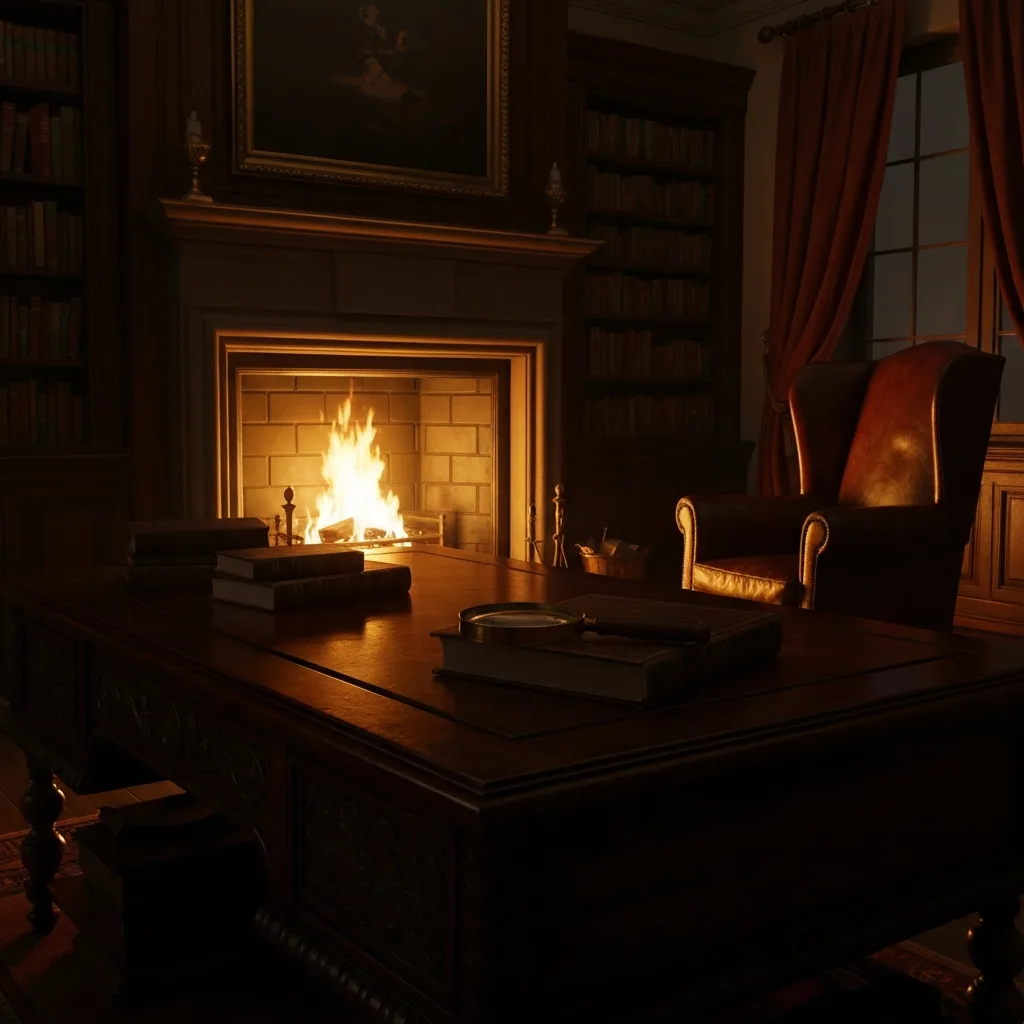
Picture a sprawling English country estate, isolated by a sudden winter storm. The guests are gathered in the drawing room, sipping sherry and exchanging polite but guarded pleasantries. Upstairs, the wealthy patriarch lies dead behind a locked door. The local police are baffled, but thankfully, a sharp-witted amateur sleuth happens to be among the guests. This is the quintessential setup of the classic whodunit, a narrative structure that achieved its absolute zenith during the Golden Age of Detective Fiction.
Spanning roughly from the end of the First World War to the onset of the Second, the 1920s and 1930s represented a unique cultural moment. Society was reeling from the unprecedented devastation of global conflict. In the wake of such chaotic, senseless loss of life, readers craved order, logic, and resolution. The detective novel provided exactly that. A murder in a mystery novel was not a tragic reflection of reality; it was an intellectual puzzle. The detective acted as the agent of moral and logical restoration, arriving in a disrupted world, deciphering the chaos, and returning society to a state of equilibrium.

The Queens of Crime and Their Unrivaled Reign
While many authors contributed to the boom of the mystery genre, the era was undeniably dominated by a group of brilliant women known as the Queens of Crime: Agatha Christie, Dorothy L. Sayers, Margery Allingham, and Ngaio Marsh. These authors did not merely write popular fiction; they fundamentally engineered the mechanics of the modern mystery novel.
Agatha Christie: The Master of Misdirection
No discussion of detective fiction is complete without acknowledging Agatha Christie. As the best-selling novelist of all time, Christie’s genius lay in her unparalleled ability to manipulate the reader’s assumptions. She understood that human beings naturally rely on cognitive shortcuts, and she exploited those blind spots with surgical precision. Novels like The Murder of Roger Ackroyd and And Then There Were None broke the established conventions of their time, proving that the narrator, the police, or even the victims themselves could not be inherently trusted. Christie stripped the mystery down to its psychological core, relying on dialogue and subtle behavioral cues rather than physical action.
Dorothy L. Sayers: Elevating the Genre
If Christie was the architect of the puzzle, Dorothy L. Sayers was the author who gave the genre its literary weight. A formidable scholar and translator, Sayers believed that detective fiction could be as intellectually rigorous and character-driven as any mainstream literary fiction. Through her aristocratic detective, Lord Peter Wimsey, Sayers explored complex themes of post-war trauma, women’s education, and social class. In novels like Gaudy Night, the mystery itself almost takes a backseat to the rich, atmospheric exploration of academic life in Oxford. Sayers proved that a book could be both a gripping whodunit and a profound novel of manners.
The Rules of the Game: Fair Play and the Detection Club
What separated the Golden Age mysteries from earlier sensation novels or the later hardboiled fiction of the American pulp magazines was a strict adherence to the concept of ‘fair play.’ The mystery was a contract between the author and the reader. The author was obligated to provide all the necessary clues to solve the crime, hidden in plain sight, before the detective revealed the solution.
This commitment to fair play was formalized by the creation of the Detection Club in London, a society of British mystery writers who swore an oath to write stories free of divine revelation, feminine intuition, mumbo-jumbo, jiggery-pokery, or acts of God. The most famous distillation of these rules came from Father Ronald Knox, who penned his ‘Ten Commandments’ of detective fiction in 1929. Knox decreed that the criminal must be mentioned early on, that supernatural agencies are ruled out as a matter of course, and that secret rooms or passages must be kept to a strict minimum.
While these rules might seem restrictive today, they functioned as the boundaries of a playing field. By establishing a rigid framework, authors were forced to be infinitely more creative within those limitations. The pleasure for the reader was not in the shock of a random twist, but in the realization that the answer was right in front of them the entire time, expertly camouflaged by the author’s sleight of hand.
The Archetypal Sleuth: Brilliance and Eccentricity
The Golden Age solidified the archetype of the great detective. These characters were rarely professional police officers; in fact, the official constabulary was usually depicted as well-meaning but hopelessly unimaginative. The true detective was an outsider, an amateur whose brilliant mind operated on a higher frequency than the rest of humanity.
To make these towering intellects palatable to the reader, authors endowed them with distinct, often comical eccentricities. Hercule Poirot had his obsession with symmetry, his meticulously groomed mustache, and his reliance on the ‘little grey cells.’ Miss Marple used her deep understanding of human nature, honed in the tiny village of St. Mary Mead, to draw devastatingly accurate parallels to brutal murders. Lord Peter Wimsey hid his razor-sharp intellect behind the facade of a foolish, babbling aristocrat.
These quirks served a dual purpose. First, they made the characters highly memorable and endearing, ensuring long-running series viability. Second, they caused the murderers within the stories to underestimate the detectives, allowing the sleuths to quietly gather information while the culprits let their guard down.
The Closed Circle: Anatomy of the Perfect Setting
The setting of a Golden Age mystery is as crucial as the detective. The era popularized the ‘closed-circle’ mystery, a scenario where a crime is committed in an isolated environment with a strictly limited number of suspects. The country house, the snowbound train, the remote island, or the academic college were favored locations.
This isolation serves a practical narrative function: it eliminates the infinite variables of the outside world. The reader does not have to worry about a random burglar or an anonymous assassin. The killer is in the room. This tightens the psychological tension, forcing a group of polite, civilized people to confront the terrifying reality that one among them is a ruthless killer.
Furthermore, the English country house setting allowed authors to explore the rigid class structures of the era. The divide between the wealthy family upstairs and the army of servants downstairs provided a fertile ground for hidden motives, secret affairs, and long-simmering resentments. The murder acts as a catalyst, shattering the veneer of polite society and exposing the ugly truths hidden beneath the surface.
The Enduring Legacy in Modern Literature and Film
Eventually, the Golden Age gave way to the gritty, hardboiled noir fiction of writers like Raymond Chandler and Dashiell Hammett, who brought murder out of the drawing room and into the dark, rain-slicked streets. However, the influence of the classic whodunit never truly faded. Its DNA is woven deeply into the fabric of modern storytelling.
Today, we are witnessing a massive resurgence of the Golden Age style. In cinema, Rian Johnson’s Knives Out franchise is a loving, meticulous homage to the Christie-style country house mystery, updated with razor-sharp modern social commentary. In literature, authors like Anthony Horowitz construct brilliant, meta-textual puzzles that rely heavily on the fair-play rules established a century ago. The explosion of the ‘cozy mystery’ subgenre, featuring amateur sleuths solving crimes in quaint towns, is a direct descendant of Miss Marple’s adventures in St. Mary Mead.
Even massive mainstream hits like Richard Osman’s The Thursday Murder Club owe their success to the blueprint drawn up in the 1920s: eccentric amateur detectives, a limited pool of suspects, and a puzzle that respects the reader’s intelligence.
The Final Deduction
We continue to read and revere the Golden Age of Detective Fiction because the fundamental appeal of the puzzle remains unchanged. In a world that is often unpredictable, unfair, and confusing, there is immense comfort to be found in a story that promises a definitive answer. The classic whodunit assures us that the clues are there if we look closely enough, that human nature is legible, and that, by the final page, the truth will be brought into the light.




Do you enjoy the content on Agenda Creativa?
Your contributions help me create new articles, share creative ideas, and keep this platform alive! If you like what I do and want to support my work, you can buy us a coffee.
Every cup of coffee means more than just a gesture – it's direct support for my passion to create inspiring and useful content. Thank you for being part of this journey!
☕ Buy me a coffee