The Paralysis of Premature Perfection
You sit down to tackle a critical project. It could be a strategic proposal, a complex piece of code, or a slide deck for a high-stakes presentation. You open a blank document, type a single sentence, and immediately delete it. You rewrite it. You pause to adjust the font size. You spend ten minutes searching for the perfect adjective. Two hours later, you have one flawless paragraph, a looming sense of dread, and a schedule that is entirely derailed.
This is the Fidelity Trap. It is the insidious belief that the first iteration of your work should closely resemble the final product. We consume high-fidelity outputs every day—polished books, seamless applications, beautifully designed interfaces—and we subconsciously expect our creation process to mirror that final, pristine state. But consumption and creation operate on entirely different mechanical principles. When you attempt high-resolution drafting, you are forcing your brain to act as both the gas pedal and the brake simultaneously. The result is not excellence; it is cognitive gridlock.

The Cognitive Cost of High-Resolution Drafting
To understand why the Fidelity Trap is so destructive to your output, we have to look at how the brain processes different types of work. Creating something from nothing requires divergent thinking. It is an expansive, non-linear, and inherently messy process. You are pulling disparate ideas together, testing boundaries, and generating raw material.
Refining that work, however, requires convergent thinking. Editing, formatting, and polishing are reductive processes. They require precision, logic, and a critical eye. Divergent and convergent thinking utilize different neural pathways, and your brain cannot hold both states optimally at the exact same millisecond.
The dual-processing bottleneck
When you try to write and edit at the same time, you are not actually multitasking. You are micro-switching between two opposing cognitive states. You generate an idea (divergent), instantly criticize its phrasing (convergent), adjust the formatting (convergent), and then try to get back to generating the next idea (divergent). This rapid context-switching rapidly depletes your executive function. The friction you feel when you are “stuck” is rarely a lack of ideas; it is the exhaustion of trying to run two incompatible mental operating systems at once.
The longer you stay in this dual-processing bottleneck, the more your momentum degrades. Procrastination is the natural byproduct of this friction. Your brain recognizes that the task is cognitively expensive and painful, so it seeks immediate relief in the form of distractions, minor administrative tasks, or checking your inbox.
Engineering a Progressive Iteration Protocol
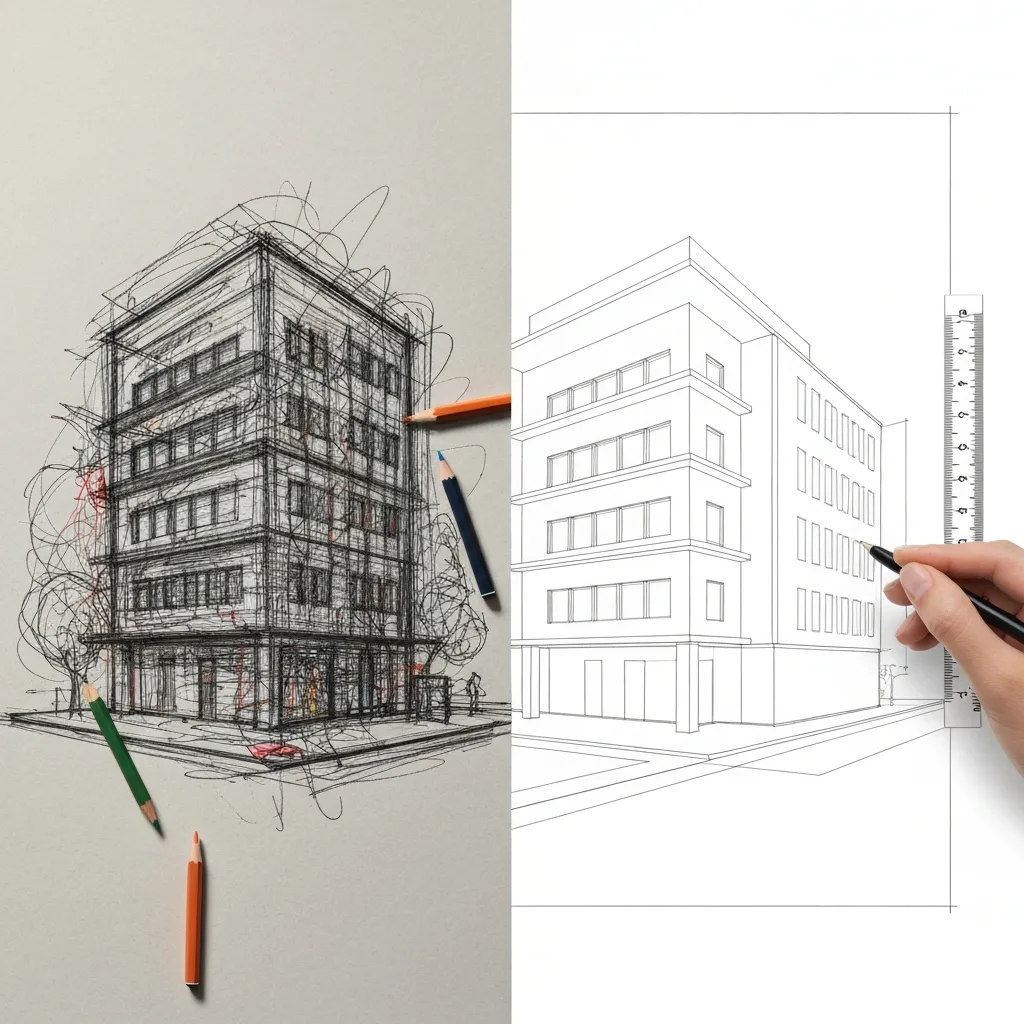
The antidote to the Fidelity Trap is a framework called Progressive Iteration. Instead of trying to force a high-resolution output on the first pass, Progressive Iteration deliberately separates the stages of creation by their required level of fidelity. You build the project in layers, moving from low-resolution chaos to high-resolution polish, ensuring that you only ever ask your brain to perform one type of cognitive labor at a time.
Phase 1: The Zero-Draft (Low-Fidelity)
The goal of the first phase is strict capture. You are not building a product; you are mining raw materials. During this phase, you must aggressively lower your standards. If you are writing a document, use bullet points, sentence fragments, and messy logic. If you are coding, write pseudocode. If you are designing, draw literal boxes on a piece of paper.
The cardinal rule of the Zero-Draft is that you are not allowed to edit. Do not hit the backspace key. Do not fix typos. Do not look up a statistic—just write “[INSERT STAT HERE]” and keep moving. The metric of success in this phase is volume and velocity, not quality. By removing the pressure to make it “good,” you eliminate the friction of starting. You bypass the inner critic entirely.
Phase 2: The Structural Scaffold (Medium-Fidelity)
Once you have a massive pile of raw material, you switch your cognitive state. In Phase 2, you are an architect. You take the chaotic fragments from your Zero-Draft and begin organizing them into a logical skeleton. You move blocks of text around, establish a hierarchy, and test the narrative or logical flow.
Crucially, you are still not allowed to polish. If a sentence is clunky but the idea is in the right place, you leave it alone. If a transition is abrupt, you ignore it. Your only concern is the structural integrity of the project. Does point A lead logically to point B? Is the core argument sound? By focusing solely on structure, you solve the biggest macro-problems of the project without getting bogged down in the micro-details.
Phase 3: The Polish (High-Fidelity)
Now, and only now, do you engage your critical editor. In the final phase, you refine the vocabulary, optimize the code for performance, align the pixels, and fix the grammatical errors. Because the structure is already sound, the editing process is virtually frictionless. You are no longer worried about what you are saying or where it belongs; you are entirely focused on how it is presented.
This is where the high-resolution magic happens. Because you saved your convergent thinking energy for the very end, you have the cognitive stamina required to make the final product truly exceptional.
Implementing Progressive Iteration in Daily Workflows
Progressive Iteration is not just for writing books or launching massive software products. It is a daily operational philosophy that can dramatically accelerate your routine tasks.
For Presentations: Never open your slide design software first. The software is designed for high-fidelity formatting, which triggers the Fidelity Trap. Instead, write the narrative of your presentation in a plain text editor. Build the structure. Only when the story is finalized should you open the presentation software to add visuals and layout.
For Strategic Planning: Do not start by building a complex spreadsheet with perfectly formatted cells and formulas. Dump all your variables, goals, and constraints onto a physical whiteboard. Draw the relationships. Once the logic is sound, transfer it to the digital format.
For Difficult Conversations: If you need to draft a sensitive email or prepare for a tough meeting, word-vomit your raw emotions and thoughts into a private document. Get the messy, unfiltered version out of your head. Then, use Phase 2 to extract the actual business problem, and Phase 3 to draft the professional, diplomatic response.
The Illusion of Efficiency
The most common objection to Progressive Iteration is that doing three separate passes takes longer than simply doing it right the first time. This is the ultimate illusion of efficiency. Trying to do it “right the first time” is exactly what causes you to stare at a blinking cursor for forty-five minutes. It is what causes projects to stall for weeks.
By separating the cognitive loads, you eliminate the friction that causes stalls. The total time spent executing is drastically reduced because you never hit a wall of decision fatigue. You are always moving forward, even if the early steps look messy.
Excellence is not born from a single, flawless execution. It is the result of layered refinement. If you want to increase your output and eliminate the stress of creation, you must give yourself permission to produce garbage on the first pass. Lower your standards for the start, so you can aggressively raise them for the finish. Escape the Fidelity Trap, and let iteration do the heavy lifting.
Do you enjoy the content on Agenda Creativa?
Your contributions help me create new articles, share creative ideas, and keep this platform alive! If you like what I do and want to support my work, you can buy us a coffee.
Every cup of coffee means more than just a gesture – it's direct support for my passion to create inspiring and useful content. Thank you for being part of this journey!
☕ Buy me a coffee