
Most productivity advice operates on a fundamentally flawed premise: the belief that with enough optimization, you can do everything. The underlying promise of every new app, planner, and time-blocking method is that if you just arrange your tasks perfectly, you will finally clear your plate. But the math of modern knowledge work simply does not allow for this. Every day, you are bombarded with more inputs, requests, and obligations than any human could reasonably process in a week, let alone twenty-four hours.
The standard response to this impossible volume is to try and move faster. We attempt to ruthlessly schedule our days down to the minute. We read about the routines of billionaires and try to graft them onto our own chaotic lives. But efficiency is often a trap. When you become highly efficient at processing your inbox, your reward is rarely more free time; your reward is a higher volume of emails. The system simply recalibrates to your new speed, handing you more work to fill the void.
If efficiency cannot save you from burnout, what can? The answer lies in a deeply uncomfortable but entirely necessary practice: strategic neglect. Instead of trying to keep all the plates spinning, strategic neglect is the conscious, calculated decision to let specific plates crash to the floor.
The Trap of Universal Competence
From a young age, we are conditioned to aim for universal competence. The traditional education system rewards the student who gets an ‘A’ in every subject. We carry this conditioning into adulthood, believing that a successful professional, partner, or parent must maintain a flawless record across every domain of life. We want to be the responsive colleague, the visionary leader, the attentive friend, and the perfectly organized householder.
The psychological burden of trying to maintain an ‘A’ grade in every area of your life is immense. It forces you into a reactive state. Because you refuse to let anything slip, your attention is constantly hijacked by whatever is most urgent, regardless of its actual importance. You spend your days putting out tiny fires while your most significant, high-leverage projects gather dust.
There is a massive difference between dropping a ball by accident and dropping it on purpose. When you drop a ball by accident—because you forgot, or because you simply ran out of hours in the day—it generates anxiety, guilt, and panic. You feel like you are failing. But when you look at a task and consciously decide, ‘I am not going to do this, and I accept the consequences,’ you reclaim your agency. The task is still undone, but the psychological weight of it evaporates.
The Efficiency Illusion
To understand why strategic neglect is necessary, we have to dismantle the efficiency illusion. Parkinson’s Law states that work expands to fill the time allotted for its completion. But in the modern digital economy, we experience Parkinson’s Law in reverse: the volume of incoming work expands to consume whatever capacity you have to process it.
If you figure out how to do a two-hour task in thirty minutes, the world will not let you sit quietly for an hour and a half. It will immediately hand you three more thirty-minute tasks. You cannot optimize your way out of an infinite pipeline. The only way to survive an infinite pipeline is to build a filter that actively rejects a significant portion of what tries to pass through it.
Defining Strategic Neglect
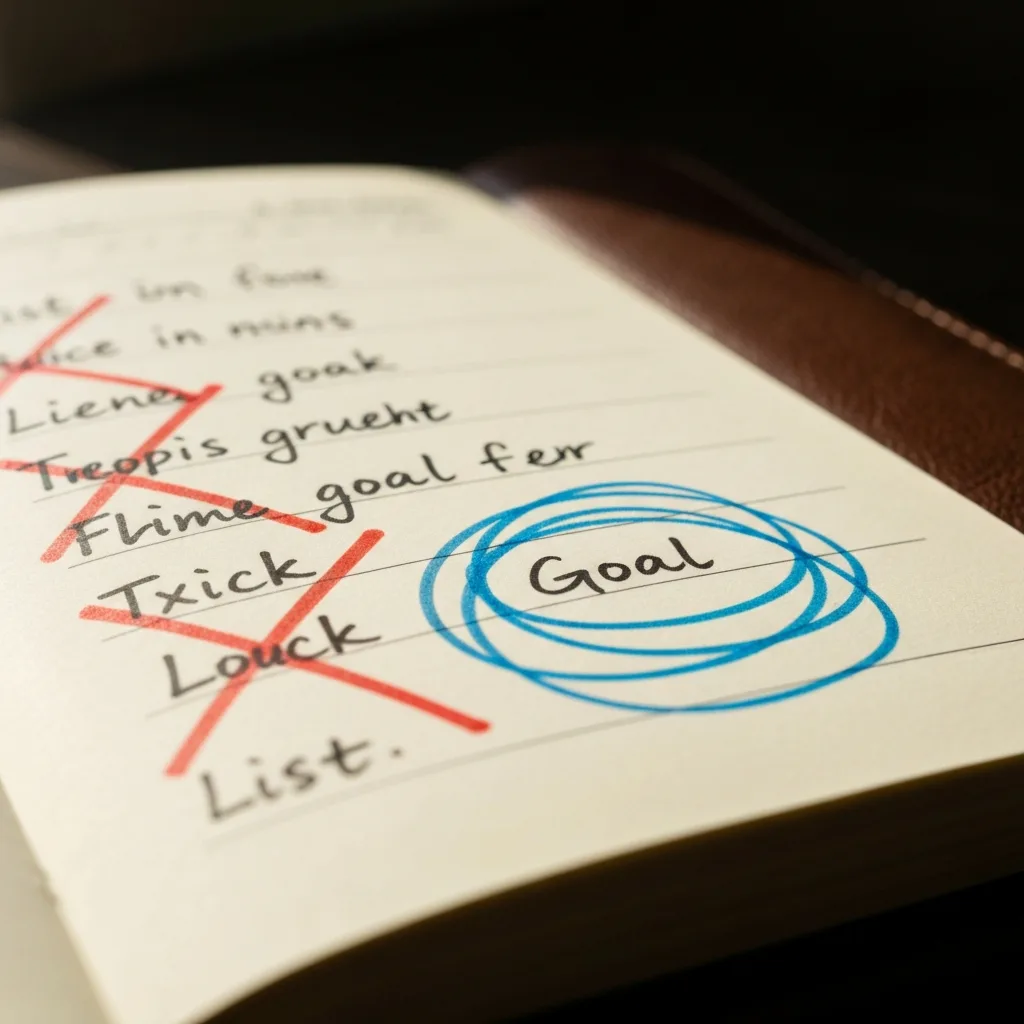
Strategic neglect is not laziness. Laziness is a passive failure to meet obligations due to a lack of effort or discipline. Strategic neglect is an active, highly disciplined choice. It requires you to look at your landscape of responsibilities, identify the areas that yield the lowest return on your time and energy, and intentionally withdraw your effort from them.
It is the practice of purposeful abandonment. By choosing where you will fail, you protect the resources necessary to succeed wildly in the areas that actually matter.
Glass Balls vs. Plastic Balls
A helpful framework for implementing strategic neglect is the juggling metaphor often attributed to author Nora Roberts. In life, you are juggling dozens of balls. The secret is understanding that some of these balls are made of glass, and some are made of plastic.
If you drop a plastic ball, it bounces. No real harm is done. The project gets slightly delayed, a minor email goes unanswered, or the living room stays messy for another day. But if you drop a glass ball, it shatters. This represents your health, your core relationships, and the deep, strategic work that defines your career trajectory.
The tragedy of the modern worker is that we treat every ball as if it were made of glass. We sacrifice sleep (a glass ball) to answer late-night emails (plastic balls). We neglect our most important creative work (glass) to attend status meetings where we have no active role (plastic). Strategic neglect is the process of identifying the plastic balls and deliberately letting them fall so you can use both hands to catch the glass.
Establishing Zones of Acceptable Mediocrity
To practice strategic neglect, you must create ‘zones of acceptable mediocrity.’ These are specific domains in your life or work where you give yourself explicit permission to be a C- student.
For example, you might decide that your email inbox is a zone of acceptable mediocrity. You will respond to critical messages from your boss or key clients, but you will completely ignore the rest. You accept that some people might find you slow to respond, or even rude. You trade that social friction for the hours of deep focus you gain back.
Or perhaps your zone of acceptable mediocrity is household administration. You decide that you will no longer spend your weekends optimizing your filing system or perfectly manicuring your lawn. You accept a baseline level of messiness because the energy saved can be redirected toward your side business or spending time with your children.
The Pareto Principle—the 80/20 rule—is highly relevant here. In many areas of life, 20 percent of the effort yields 80 percent of the results. The problem is that we often spend the remaining 80 percent of our effort chasing that final 20 percent of quality. Strategic neglect asks: What if you just stopped at 80 percent? What if ‘good enough’ truly was good enough?
The Communication Protocol
The most common objection to strategic neglect is fear of the professional or social consequences. ‘If I just stop doing things, I will get fired,’ people argue. This is where communication becomes critical. You do not practice strategic neglect in secret; you manage expectations openly.
If you are stepping back from a recurring commitment, you use the ‘slow fade’ or the ‘hard no.’ You might say to a colleague, ‘I am currently dedicating all my bandwidth to the Q3 product launch, so I won’t be able to contribute to the weekly newsletter moving forward.’ Notice the phrasing. It is not an apology; it is a statement of priorities. You are clearly signaling what you are protecting.
By communicating your neglect, you train the people around you to respect your boundaries. Over time, they will stop handing you plastic balls because they know you will not catch them.
The Psychological Friction of Letting Go
Even with clear communication, implementing strategic neglect feels terrible at first. Our egos are deeply intertwined with our capacity to be helpful, responsive, and capable. When you intentionally let an email go unanswered or allow a minor project to miss a deadline, your brain will flood you with warning signals. You will feel a strong urge to jump in and fix it.
You must sit with this discomfort. Recognize that the anxiety you feel is not a sign that you have made a mistake; it is simply the friction of breaking a deeply ingrained habit of people-pleasing. Your self-worth cannot be tied to your responsiveness. It must be tied to the quality and impact of your deep work.
Reframing Refusal as Protection
The easiest way to overcome the guilt of dropping the ball is to reframe what you are actually doing. You are not saying ‘no’ to a task; you are saying ‘yes’ to your priorities. Every time you let a plastic ball drop, you are building a fortress around a glass ball.
When you ignore a low-priority request, you are protecting your energy for your family. When you refuse to attend an unnecessary meeting, you are protecting the cognitive bandwidth needed to solve a complex problem. Neglect is not an act of hostility toward the world; it is an act of fierce protection for what matters most.
Putting It Into Practice
Theory is useless without execution. To begin practicing strategic neglect, you do not need to overhaul your entire life. You simply need to start small. Look at your to-do list for the upcoming week and identify one task, project, or obligation that you are dreading—something that consumes time but offers very little real value.
Now, make the conscious decision not to do it. Cross it off your list entirely. Do not reschedule it; delete it. If someone is expecting it, send a brief, polite message explaining that you do not have the capacity to deliver it right now. Then, watch what happens.
The sky will not fall. The business will not collapse. You might experience a brief moment of awkwardness, but it will quickly be replaced by a profound sense of relief. You have just bought back a piece of your life.
True productivity is not about doing more things. It is about doing the right things, and having the courage to let the rest go. Embrace the power of purposeful abandonment. Let the plastic balls drop, and watch how much lighter you feel.

Do you enjoy the content on Agenda Creativa?
Your contributions help me create new articles, share creative ideas, and keep this platform alive! If you like what I do and want to support my work, you can buy us a coffee.
Every cup of coffee means more than just a gesture – it's direct support for my passion to create inspiring and useful content. Thank you for being part of this journey!
☕ Buy me a coffee