The Physics of Gathering: Beyond the Guesswork of Fullness
Gathering is deceptively regarded as one of dressmaking’s simplest foundational techniques. However, in haute couture and bespoke tailoring, gathering is understood not merely as bunched fabric along a stitchline, but as an exercise in structural textile physics. When flat, two-dimensional yardage is gathered into a stabilized, shorter band—such as a fitted waiststay, sleeve cuff, or tailored yoke—you alter the fabric’s gravitational fall, surface tension, and internal air volume.
The central dilemma in execution lies between two disastrous extremes: under-gathering and over-gathering. Under-gathering a soft textile yields a limp, uneven garment that lacks architectural integrity, collapsing into lifeless vertical folds. Conversely, over-gathering a mid-to-heavyweight textile creates thick, stubborn lumps along the seam allowance. This bulk distorts the waistline, resists pressing, breaks sewing needles, and forces the seam outward away from the body in an unflattering ridge.
Achieving a balanced, fluid silhouette requires calibrating your fullness multiplier against the physical weight, weave density, and drape coefficient of your specific yardage.
The Atelier Fullness Ratio Matrix: Pairing Fiber to Formula
The mathematical multiplier you assign to a seam determines its finished three-dimensional presence. Fullness ratios express the relationship between the flat, cut width of the textile panel and the finished, stabilized seam length. A ratio of 2.0x means your cut piece is precisely twice the length of the band to which it will be sewn.
To design with intention, consult this benchmark matrix before laying shears to cloth:
- 1.5x Fullness (Subtle Ease & Structured Tailoring): Ideal for heavy linens, wool crepe, raw silk dupioni, brocade, and velvet. These dense weaves possess high structural memory. Applying anything greater than 1.6x creates unmanageable seam thickness that will not sit flush against the body.
- 2.0x Fullness (Classic Garment Fullness): The universal standard for shirting cotton, cotton lawn, poplin, linen-viscose blends, and lightweight wool challis. This ratio yields defined, rhythmic gathers with moderate loft without overloading standard 1.5 cm (5/8 in) seam allowances.
- 2.5x Fullness (Fluid, Dramatic Mobility): Optimized for silk habotai, rayon viscose, silk georgette, and sandwashed cupro. These supple textiles have low bending resistance, requiring tighter bunching to generate shadow, dimension, and fluid wave patterns.
- 3.0x to 4.0x Fullness (Weightless & Gossamer Flounce): Strictly reserved for sheer or ultra-lightweight textiles such as silk chiffon, tulle, netting, and silk organza. Because these fibers feature minimal yarn mass, extreme compression is essential to produce visual opacity and sculptural buoyancy.
The Mathematics of Panel Layout & Bolt Width Division
Once you calculate your total gathered width, translating that figure to commercial bolt widths (typically 115 cm / 45 inches or 150 cm / 60 inches) requires strict pattern geometry. Fabric behaves differently along the straight grain (warp) versus the crosswise grain (weft). Gathering is almost universally drafted along the crosswise grain, allowing the stable vertical warp yarns to cascade gracefully toward the hem.
To calculate the flat cut width for any gathered panel:
Flat Cutting Width = (Target Finished Width × Fullness Ratio) + Total Vertical Seam Allowances
For instance, drafting a 70 cm gathered waistband skirt in silk crepe at a 2.5x ratio requires 175 cm of continuous gathering width. If your fabric bolt is 140 cm wide between selvages, a single panel is insufficient. You must divide the 175 cm requirement across multiple panels, adding seam allowances for every vertical joining seam.
Accounting for three joining seams of 1.5 cm each (adding 3 cm per seam allowance pair, totaling 6 cm for two joining seams), the required flat cutting width becomes 181 cm. This necessitates cutting two balanced panels of 90.5 cm each across the grain, keeping panel dimensions symmetrical to ensure vertical seamlines fall evenly at the side seams or center back.
🛠️ Interactive Atelier Tool: Fabric Gathering Calculator & Ruffle Estimator
Skip manual math and cutting guesswork. Use our free interactive tool to instantly calculate your exact measurements, fabric yield, and project specifications:
Launch Free Fabric Gathering Calculator & Ruffle Estimator →
Graduated Tier Dynamics: Avoiding the Hem Weight Collapse
In tiered skirts, tiered gowns, and layered petticoats, the mathematics becomes compound. A common construction failure is applying a static multiplier (e.g., 2.0x) to every successive tier. If Tier 1 is gathered at 2.0x to the waist, and Tier 2 is gathered at 2.0x to Tier 1, and Tier 3 is gathered at 2.0x to Tier 2, the bottom tier quickly balloons to eight times the original waist circumference.
While this produces dramatic hem sweep, the cumulative weight of the lower hem can drag the upper tiers downward, flattening their loft and straining horizontal tier seams. To achieve balanced, tiered drape:
- Tier 1 (Hip Tier): Maintain a restrained ratio of 1.4x to 1.6x. This limits excess volume directly over the high hip and keeps the silhouette streamlined around the pelvic crest.
- Tier 2 (Mid-Thigh to Knee): Apply a ratio of 1.75x to 2.0x calculated against the bottom edge of Tier 1.
- Tier 3 (Flounce or Hem Sweep): Calibrate between 1.8x and 2.2x calculated against Tier 2. This creates an elegant, bell-shaped cascade rather than an unmanageable triangular pyramid.
Atelier Assembly: The Three-Row Differential Basting Protocol
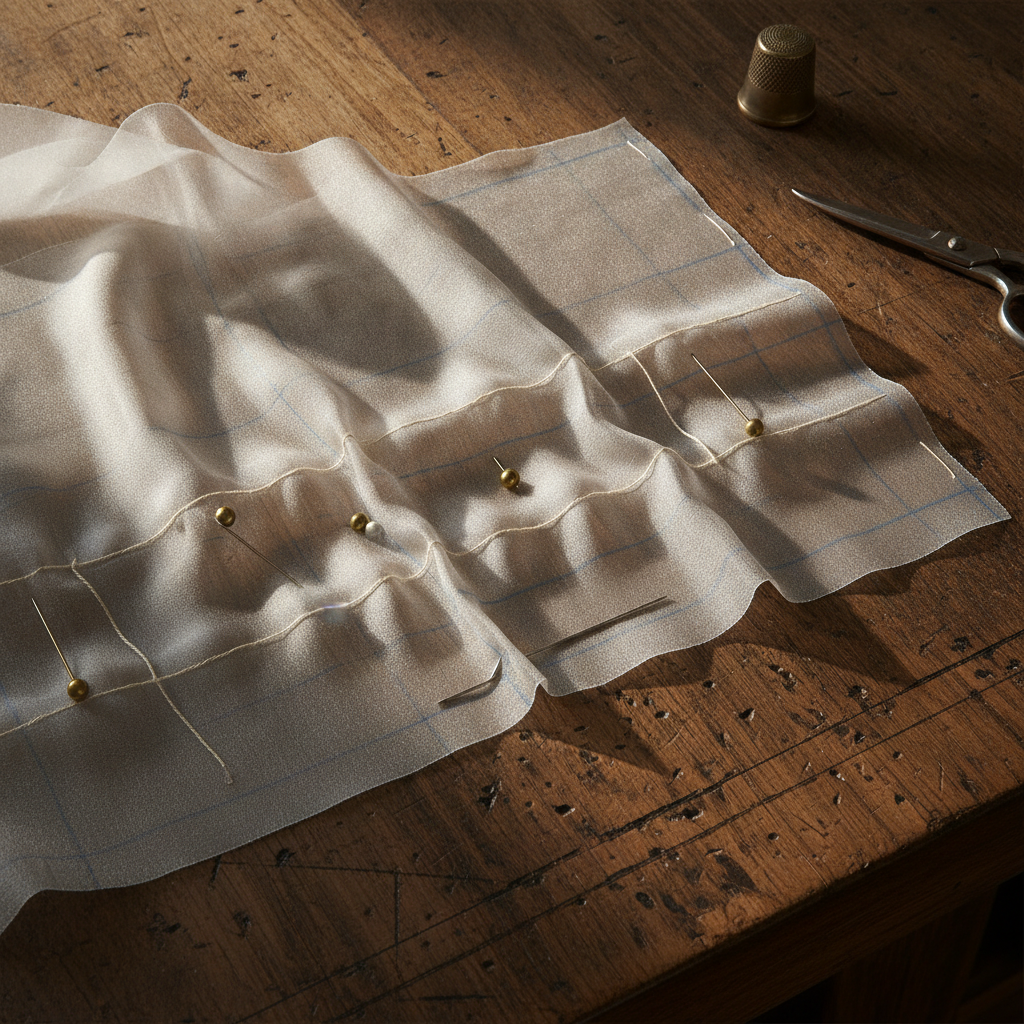
Never rely on a single row of machine basting to gather yardage. Single threads snap under tension, distribute fabric unevenly, and tilt seam allowances at erratic angles. In professional dressmaking, the three-thread basting system is the standard for precision control:
- Row 1 (Stabilizing Thread): Stitch exactly 6 mm (1/4 in) from the raw edge, inside the seam allowance. Set stitch length to 4.0–4.5 mm.
- Row 2 (Seamline Guide Thread): Stitch precisely on the planned seamline (typically 15 mm or 5/8 in from the raw edge).
- Row 3 (Control Thread): Stitch 6 mm past the seamline toward the garment body (21 mm from the raw edge).
Anchor your threads firmly at one end using a figure-eight wrap around an inserted straight pin. Divide both the gathered panel and the target band into eighths using tailor’s chalk or tailor’s tacks. Match these balance points precisely before pulling the bobbin threads from the unanchored end.
Having basting threads positioned on both sides of the actual seamline forces the fabric to fold into clean, parallel vertical flutes (pleatlets) perpendicular to the stitchline, rather than bunching into messy diagonal wrinkles.
Grading and Pressing the Seam Allowance
Once you sew the structural seam directly between your basting rows, remove Row 2 and Row 3 basting stitches. Never press the iron flat onto the gathered body of the garment; doing so will crush the soft vertical pleats into harsh, two-dimensional creases.
Instead, use the narrow tip of a professional gravity-feed steam iron or a tailor’s ham. Press strictly into the seam allowance itself, directing steam up into the gathers without resting the iron’s soleplate on the fabric. To reduce waistline bulk, grade the seam allowances: trim the gathered skirt allowance down to 6 mm while leaving the waistband or yoke allowance at 10 mm. This staggered cut prevents a sharp ridge from printing through to the right side of the garment.
Refining Your Studio Production Workflow
Precision fabric calculations save hours of pattern adjustments and reduce expensive yardage waste. Before drafting intricate gathered garments, evaluate client proportions using our Body Shape Adviser to determine whether high-fullness tiers or subtle 1.5x gathers best flatter the client’s balance points.
Furthermore, when drafting couture commissions that require dozens of meters of gathered ruffles or tiered panels, track your billable labor, fabric shrinkage allowances, and overhead costs using our Project Price Estimator. By uniting strict textile geometry with structured atelier finishing, you elevate simple gathers into balanced, runway-grade works of art.
Do you enjoy the content on Agenda Creativa?
Your contributions help me create new articles, share creative ideas, and keep this platform alive! If you like what I do and want to support my work, you can buy us a coffee.
Every cup of coffee means more than just a gesture – it's direct support for my passion to create inspiring and useful content. Thank you for being part of this journey!
☕ Buy me a coffee